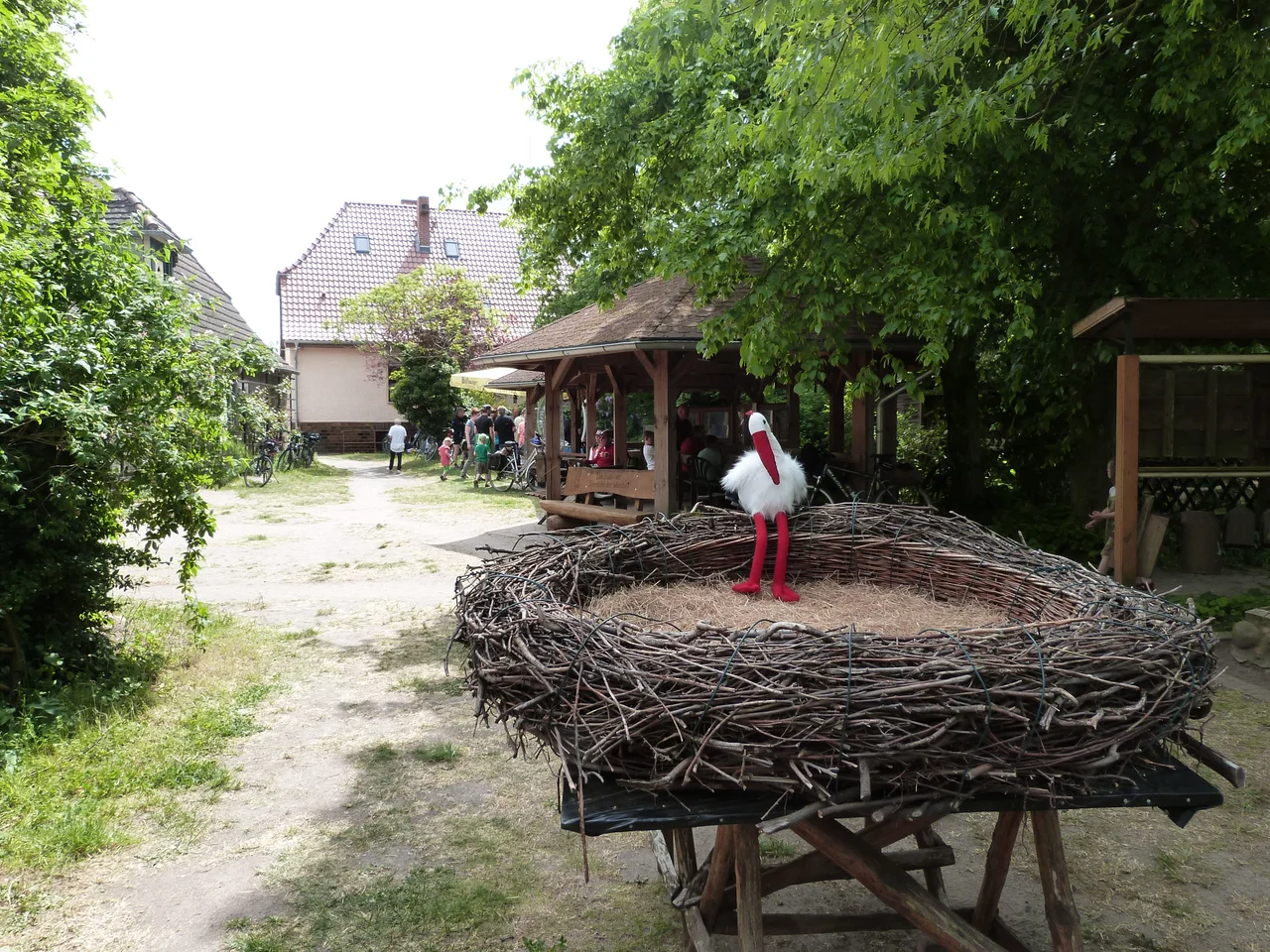

Stork Farm Loburg
Between fifty and seventy of them arrive every year, and most arrive badly. A bird that hit a power line. A chick blown out of a nest in a summer storm. A clutch of eggs left cold because the adults never came back. They all end up on the same three hectares at the edge of Loburg, a town of about two thousand people in Jerichower Land, where one family started taking in broken storks in 1979 and never stopped. Something close to two thousand white storks have passed through since, along with more than seven hundred birds of prey. About two in three go back to the sky. The rest are the reason the place looks the way it does.
The Man Who Counted Nests
Christoph Kaatz was an ornithologist who lived in Loburg and spent his working life on a single bird. He counted the local white stork population and tracked whether it was holding. He built nesting platforms. He banded birds so that somebody, somewhere down the flyway, might read the ring and add a line to the record. He pulled together a team of specialists for white stork protection and made the case for conservation loudly and locally, in a corner of Saxony-Anhalt where nobody was obliged to listen. In 1979 the Kaatz family set up a rescue station for injured and orphaned storks on their own property, which is a decision with no obvious end point — birds keep arriving. Kaatz ran it as a volunteer, was elected chairman when the operation went independent, and in 2010 received the Federal Cross of Merit.
A Garden, a District, a Ministry, a Club
Few small institutions have changed hands so often without changing address. It began as a family's back garden. In 1988 the culture department of Bezirk Magdeburg — an administrative district of East Germany — took the stork farm over and placed it under the control of the town of Loburg, which was still independent then. After the state of Saxony-Anhalt came into being, the farm was folded into the environment and nature protection ministry and became the state ornithological station, which is a considerable promotion for a rescue centre that started with a shed. Then, on 1 January 2006, an association took it back: the Storchenhof Loburg, chaired by Kaatz. In four decades the same patch of ground was private, municipal, socialist, ministerial, and private again. The birds did not notice.
Reading the Map a Bird Draws
Wild storks from Loburg carry satellite transmitters, and the tags do something a leg ring never could: they draw the whole migration, day by day, instead of producing a single dot when a dead bird turns up in a foreign field. The best known of them was a white stork called Prinzesschen. Her routes were followed for years, and after she died the farm built her a memorial with those routes mapped on it — a monument, in a German village, to the flight path of one bird. Storks reintroduced from the farm often refuse to go far. They settle near the buildings they were raised in, which makes the place a strange hybrid: part hospital, part wild colony that never quite left.
The Ones Who Stay
Not every bird recovers enough to be released. A stork with a wing that will not carry it cannot be sent off to cross the Bosphorus, and those birds are housed at Loburg permanently. They are the residents visitors actually meet — close, unbothered, standing about on legs like red wire. The farm also keeps heritage livestock: Heidschnucke, the shaggy heath sheep of northern Germany, and old varieties of chicken that commercial breeding has left behind. It gives the site the atmosphere of a working smallholding rather than a facility, which is more or less what it is. Loburg itself has been here far longer than any of it — first recorded in 965, granted town rights in 1207, and still holding a town hall built in 1609.
Seven Years on a Restaurant
In 2016 the association bought a former restaurant nearby, along with the house attached to it, and set about turning the dining room into an environmental education centre. With subsidies and a great deal of patience, the work took seven years. It opened to the public in May 2023, and the permanent exhibition inside is about exactly one subject: the white stork — what it eats, where it goes, why its numbers rise and fall, and what happens to it when it meets a power line. The building's previous customers came for lunch. Its current ones come to find out why the nest on the church roof is empty this year, and whether it will be occupied next spring.
From the Air
The Stork Farm sits at 52.117°N, 12.088°E, on the edge of Loburg in Jerichower Land, Saxony-Anhalt. Best viewed at 1,500-3,000 ft AGL. The landscape is flat farmland and wet meadow between the Elbe and the Fläming ridge — the sort of ground white storks work, so the birds themselves are a plausible sight in season, soaring on thermals in spring and late summer. Navigational anchors: the Elbe about 20 km west, the town of Burg to the northwest, and Magdeburg roughly 40 km west. Nearest airports: Magdeburg-Cochstedt (EDBC) about 55 km southwest, Leipzig/Halle (EDDP) about 80 km south, Berlin Brandenburg (EDDB) about 90 km east-northeast. No terrain obstacles; ground fog is common over the river meadows on autumn mornings.
Nearby Stories
- Genthin Rail Disaster 2.9 km away
- Bauhaus Dessau 7 km away
- Treuenbrietzen 15 km away
- Paretz 18 km away
- Gardelegen Massacre 21 km away
- Lichtenburg Concentration Camp 29 km away
- Quedlinburg 32 km away
- Helmstedt–Marienborn border crossing 37 km away