
All Saints' Church, Wittenberg
The most famous door in Protestant history is a replacement. The wooden portal that Martin Luther is said to have posted his Ninety-five Theses on burned in 1760, when Imperial gunners shelled the Prussian-held fortress of Wittenberg and set the Castle Church alight. Nearly a century later King Frederick William IV of Prussia had bronze doors cast to hang on the same jambs — a thousand kilograms of metal, ornaments modelled by the sculptor Friedrich Drake, and the ninety-five propositions themselves inscribed across the panels in their original Latin. They were dedicated on 10 November 1858, the 375th anniversary of Luther's birth. Visitors photograph the raised letters every day without always registering that the wood they came for has been gone for more than two and a half centuries, and that what replaced it was a monument to an argument, not the argument itself.
A Prince's Chapel and a Faculty Notice Board
The first building here was modest. A chapel dedicated to All Saints went up around 1340 beside the new residence of the Ascanian duke Rudolf I of Saxe-Wittenberg, was consecrated on 6 May 1346, and was placed by its founder under the direct jurisdiction of the Holy See; Pope Boniface IX declared it Wittenberg's main church in 1400. The church Luther knew came later. When the Wettin prince Frederick III — Frederick the Wise, elector of Saxony from 1486 — had the old Ascanian fortress rebuilt, he commissioned a new All Saints' from the architect Conrad Pflüger, raised between 1490 and 1511 in Late Gothic style, with furnishings by Tilman Riemenschneider, Jacopo de' Barbari and Albrecht Dürer. In 1502 Frederick founded the University of Wittenberg, the Leucorea, and All Saints' became its chapel. Doctorates were conferred here. Philipp Melanchthon delivered his inaugural address here. And the main portal served, unglamorously, as the board where the faculty pinned up notices.
The Thirty-First of October
Luther was a theology professor in his thirties, and the ninety-five propositions he drew up were an invitation to argue rather than a manifesto — a call for academic disputation on the sale of indulgences. Whether he walked to the portal on the eve of All Saints' Day 1517 and posted them there cannot be established; the account comes from Philipp Melanchthon. What is documented is that on the same day Luther sent his objections in a letter to Albert, Archbishop of Mainz, the churchman whose indulgence campaign had provoked them. The disputation he wanted never stayed inside a lecture hall. Within eight years the Lutheran rite had been introduced in this church, in 1525 — the same year Frederick the Wise died and was buried in it.
Fire, Bronze, and an Eighty-Eight-Metre Sermon
The Seven Years' War very nearly ended the building. Prussian troops held the Wittenberg fortress, Imperial forces shelled it, and the fire that followed in 1760 left only half the foundation standing and none of the wooden portals. Restoration waited until 1883, the fourth centenary of Luther's birth, when the Prussian architect Friedrich Adler and his pupil Paul Ferdinand Groth rebuilt the church as a neo-Gothic memorial — new rib vaulting, new apse, new galleries. It was re-inaugurated on 31 October 1892, exactly 375 years after the posting it commemorates. The rebuilt steeple rises 88 metres, and around it, just below the crown, runs a line from the hymn Luther wrote: Ein feste Burg ist unser Gott. A mighty fortress is our God. On a church that had recently been shelled to its footings, the choice of text was not accidental.
Who Lies Under the Nave
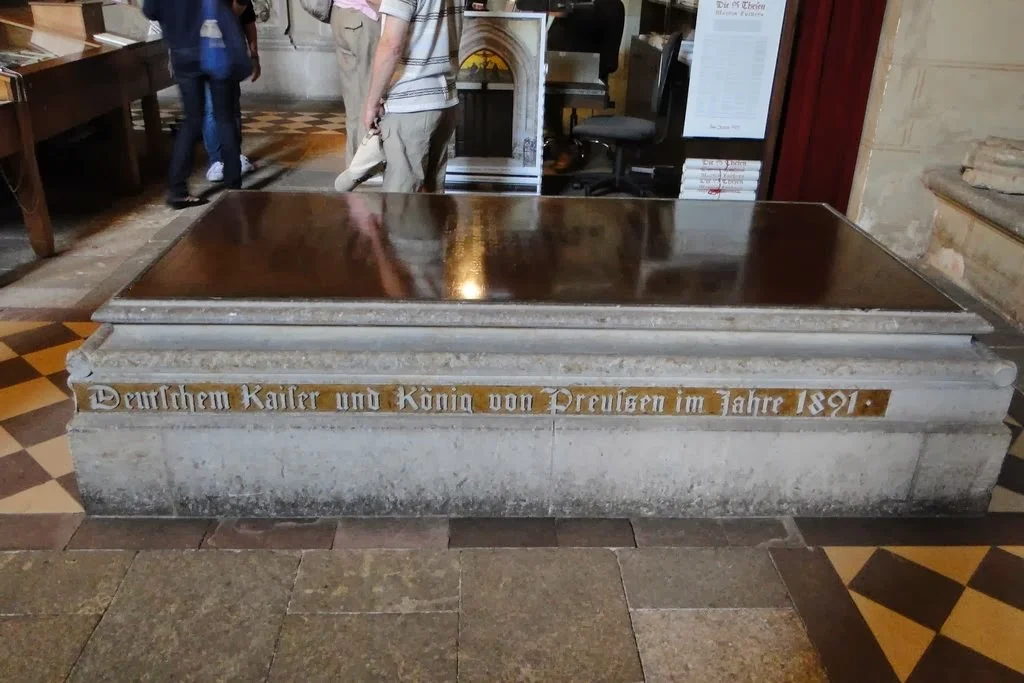
Luther died at Eisleben in February 1546 and was brought back here. Melanchthon preached at the burial. The casket lies roughly 2.4 metres beneath the nave floor, near the pulpit, and the inscription above it is plain to the point of bookkeeping: here is buried the body of the Doctor of Sacred Theology, Martin Luther, who died in the year of Christ 1546, on February 18th, in his hometown Eisleben, after having lived for 63 years, 2 months, and 10 days. Melanchthon himself was buried here in 1560. Around them the church became a gallery of the movement they started. Life-sized alabaster figures of Frederick III and his brother, Elector John, stand in the nave, with bronzes of both by Peter Vischer the Younger and Hans Vischer. Paintings by Lucas Cranach the Elder and the Younger hang throughout. Full-sized statues flanking the nave name the rest of the cast: Nicolaus von Amsdorf, Caspar Cruciger, Johann Brenz, Urbanus Rhegius, Justus Jonas, Georg Spalatin, Johannes Bugenhagen, Melanchthon, Luther.
Swords Into Ploughshares
A Castle Church parish was established in 1949, and under East German rule the building found a second political life. Friedrich Schorlemmer served as preacher here from 1978, and All Saints' became a centre of the GDR peace movement that took its emblem and its slogan from Isaiah — swords into ploughshares. In 1983, five hundred years after Luther's birth, twelve new stained-glass windows were installed, made by Renate Brömme for the Lutheran World Federation and honouring the students who carried the Reformation outward. The church was inscribed on the UNESCO World Heritage List in 1996, with the other Luther and Melanchthon sites in Wittenberg and Eisleben, and given a new glazed brick roof in 1999-2000. It is still a working parish church. It also houses the town's historical archives, the Riemer-Museum and a youth hostel — a building where people sleep, argue and worship above the grave of a man who set out to hold a debate.
From the Air
All Saints' Church stands at 51.866°N, 12.638°E, at the western end of Wittenberg's old town on the north bank of the Elbe in Saxony-Anhalt. The 88-metre steeple, with its distinctive crowned lantern, is the tallest thing for kilometres across flat Saxon plain and is the easiest visual fix on the town from the air; the parallel spire of the Stadtkirche sits a few hundred metres east along Collegienstraße. Leipzig/Halle (EDDP) lies about 55 km southwest, Berlin Brandenburg (EDDB) about 80 km northeast. Best viewing is a slow pass at 1,500-3,000 ft AGL, running the Elbe upstream from the northwest so the river bend and the old town wall line up ahead. Haze over the lignite country to the south can cut slant visibility in summer; winter high pressure gives the crispest light on the sandstone.
Nearby Stories
- Rudolf Virchow 17 km away
- Magdeburg Water Bridge 17 km away
- Stalag III-A 19 km away
- Inner German Border 22 km away
- Jahrtausendturm 29 km away
- Battle of Mühlberg 31 km away
- Lichtenburg Concentration Camp 31 km away
- Eisleben 33 km away