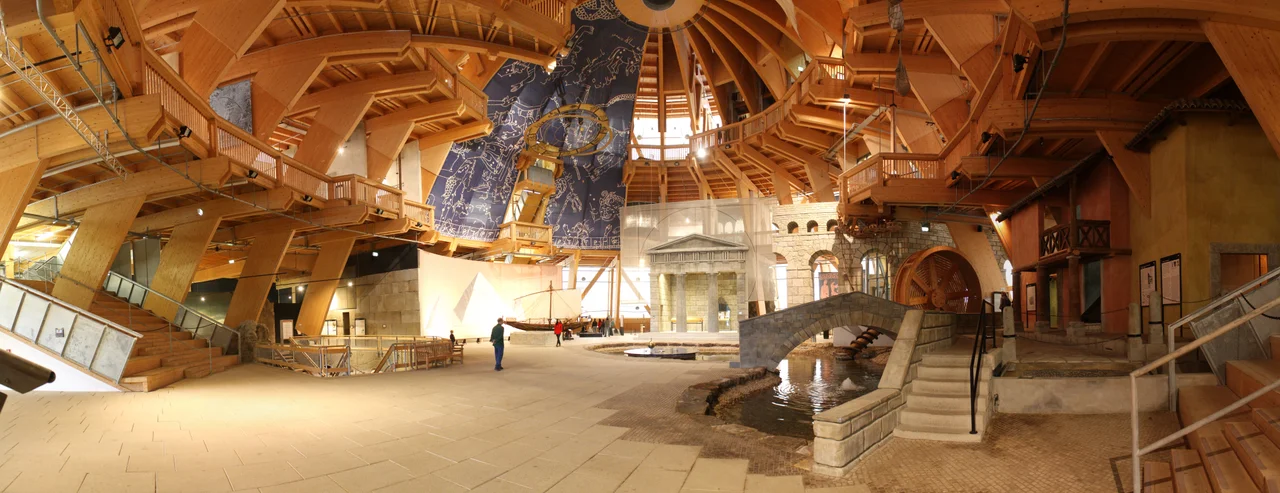

Jahrtausendturm
It leans, and the lean is on purpose. Sixty metres of laminated timber rise out of a park on the east bank of the Elbe, wrapped in a translucent membrane and tapering into an asymmetrical cone that looks a few degrees off true — a shape drawn by the Swiss painter and designer Johannes Peter Staub. Inside, the tilt turns out to be useful. The climb through the Jahrtausendturm is chronological: six thousand years of human enquiry stacked floor by floor, starting with an Egyptian dwelling at the bottom and ending with microcosm and macrocosm near the top. At the summit there is a telescope. Aim it west across the rooftops and you can read the clock face on Magdeburg Cathedral, a building whose masons laid their first stones four centuries before anyone on the third floor worked out what a vacuum was.
What the Garden Show Left Behind
Germany's Bundesgartenschau moves from city to city and mostly leaves parkland behind it. Magdeburg's turn came in 1999, the show was laid out in the Elbauenpark on the river's eastern floodplain, and the tower went up as its centrepiece. It was not meant to survive. Structures built for a garden show are ordinarily temporary by design, and this one was intended to come down with the rest of the exhibition — except that Magdeburg found it had acquired a landmark and a science museum in a single object, and kept it. A quarter of a century later the Jahrtausendturm is still the thing people photograph in the Elbauenpark, and admission to it is simply bundled into the park ticket, as though a six-storey wooden museum were a normal feature of municipal gardens.
Five and a Half Thousand Cubic Metres of Wood
The numbers are the point of the building as much as the exhibits are. Sixty metres tall on an oval footprint of 70 by 50 metres, it swallowed 5,500 cubic metres of laminated timber, encloses about 61,000 cubic metres of air, and carries roughly 5,000 square metres of translucent skin stretched over its ribs. Two routes go up. Inside there is a stairway; outside, a wooden spiral ramp winds round the cone for 450 metres, and if you take the direct way instead it is 243 steps to the viewing platform. All of this makes it one of the tallest wooden towers in the world, which is a slightly obscure superlative until you stand underneath the thing and register that a structure this size is holding itself up on glued-together boards.
Climbing Through Six Thousand Years
Five of the six floors are exhibition, and they are laid out in strict chronological order, so you ascend through time. The lowest deals with the earliest cultures — an Egyptian dwelling you can walk into, a grave chamber, a labyrinth — alongside the mathematics and physical sciences of deep antiquity. The second covers the Middle Ages, 500 to 1500, with the science of early Arabia, the classical world-systems, and simple machines you operate yourself: pulley blocks, a water wheel, a hand-cranked impeller for pumping liquid. The third runs from the Renaissance to about 1750 and takes on mechanics, magnetism, alchemy, medicine, the printing press, the telescope, and the vacuum — which in this city is not an abstract topic, given that a seventeenth-century mayor of Magdeburg built his reputation on proving that nothing could hold two copper bowls together against sixteen horses.
Where the Pendulum Hangs
The fourth floor is subdivided into three levels and covers roughly 1650 to 1859, which is where the exhibition gets crowded: optics, chemistry, biology and sensory perception on one level, then electricity, radio engineering, caloric theory, stellar parallax and the Doppler effect. The fifth turns to modern research in the sciences and medicine under the headings microcosm and macrocosm, and the sixth is simply the observation deck. Roughly eighty hands-on experimental setups are distributed across some 8,000 square metres of floor, with several hundred further displays and diagrams filling the gaps. The single best object is not on any floor. A Foucault pendulum is hung from the top of the tower and swings down through the middle of it, tracing out the rotation of the Earth for anyone patient enough to watch, and an Archimedes screw turns nearby — two demonstrations that need no explanation, only time.
Keeping Wood Standing
A large timber building left outdoors is a permanent argument with the weather, and the Jahrtausendturm eventually lost a round of it. Moisture worked into the structure, the exterior ramp deteriorated, and between 2015 and 2016 the tower was renovated at a cost of around two million euros to put both right. There is a certain symmetry in this. The exhibition inside spends five floors explaining how people learned to measure decay, stress, humidity and load, and the container holding that exhibition is a live demonstration of the same problems. It reopened, and it goes on leaning over the Elbauenpark exactly as intended — a temporary building that has now been permanent for far longer than it was ever meant to exist.
From the Air
The Jahrtausendturm stands at 52.1388°N, 11.6664°E, in the Elbauenpark about 2.5 km east of Magdeburg Cathedral and on the far side of the Elbe from the old city. From 1,000–2,000 ft AGL the park is the obvious feature — a large block of open green and water inside the eastern suburbs — and the tower reads as a pale, off-centre cone sitting at its heart, quite unlike anything else on the skyline. Line the cathedral's two Gothic towers up with it and you have the sightline the summit telescope uses. Magdeburg–Cochstedt (EDBC) lies about 40 km southwest, Leipzig/Halle (EDDP) roughly 90 km south-southeast, and Berlin Brandenburg (EDDB) about 130 km east. The translucent skin picks up low sun well, so the tower is most legible from the air early and late in the day; overhead at noon it flattens into the treeline.
Nearby Stories
- Quedlinburg 10 km away
- Inner German Border 13 km away
- Helmstedt–Marienborn border crossing 16 km away
- Jerichow Monastery 21 km away
- Bauhaus Dessau 31 km away
- Autostadt 32 km away
- All Saints' Church, Wittenberg 36 km away
- Lichtenburg Concentration Camp 48 km away