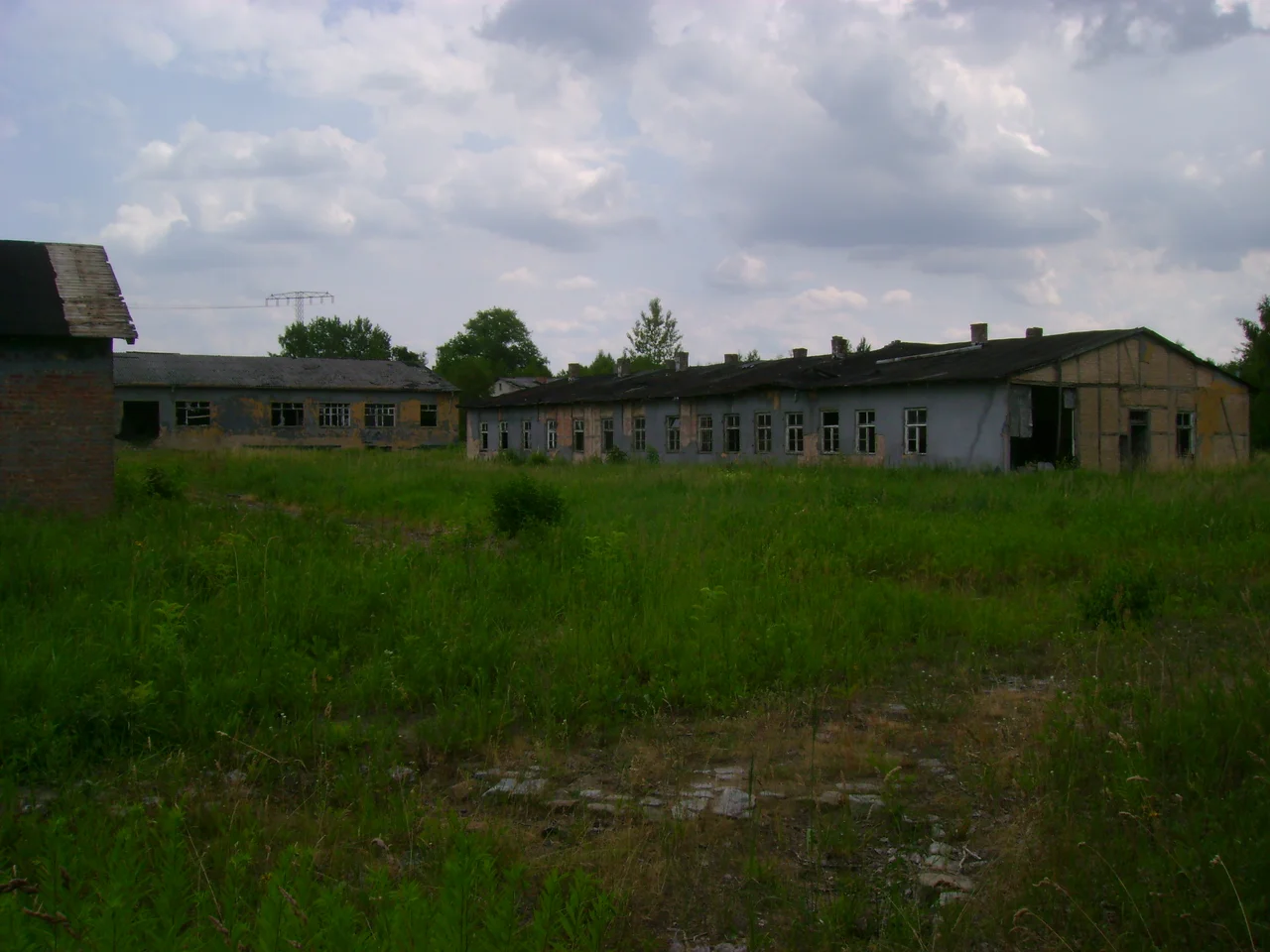

Stalag III-A
There are two kinds of grave at Luckenwalde. Prisoners who died here and were not Soviet citizens were buried individually, with military honours, each under his own marker in the camp cemetery. Soviet prisoners were buried anonymously, in mass graves. Nothing about that difference was accidental, and nothing about it was a wartime improvisation. It was policy, applied from the top, and it is the clearest single fact about Stalag III-A: the same camp, the same guards, the same fences, and two entirely separate ideas about whose life was subject to any rules at all. Between four and five thousand men died here. The great majority of them were Soviet.
Built Before There Was a War
Planning for the camp began before Germany invaded Poland, which is to say before there were any prisoners to hold. It was laid out for 10,000 men, the largest camp in the Third Military District, and it was regarded as a model for others. The first Polish prisoners arrived in mid-September 1939 to find no barracks at all - only tents, twelve metres by thirty-five - and they were put to work building the huts before winter arrived. When the huts were finished the Poles were moved elsewhere. Dutch and Belgian prisoners occupied the camp briefly, and then, from the middle of 1940, 43,000 French prisoners arrived and remained the largest single group until the end of the war. Yugoslav and Soviet prisoners came in 1941. Some 15,000 Italian military internees followed in late 1943, most of them quickly dispersed to other camps.
Ten Nations, Two Standards
On paper the camp ran to the Geneva Convention and the Hague Regulations, and delegates of the International Committee of the Red Cross inspected it regularly. Soviet prisoners were excluded from all of it, on the argument that the USSR had never signed the Geneva Convention. That legal reasoning had a practical meaning: no inspections, no parcels, no standard of food or shelter anyone could be held to. Conditions for Soviet prisoners were significantly worse as a direct result, and the death figures show exactly how much worse. Italians, after their country left the Axis, were also generally mistreated. French, British and American prisoners were treated comparatively well - and the Germans partly maintained that appearance by moving Polish prisoners out to harsher forced-labour subcamps, or by threatening to send them to concentration camps.
The Winter of 1941/42
Typhus went through the camp that winter and killed somewhere between 2,000 and 2,500 Soviet prisoners. Typhus spreads through lice, and lice spread through cold, crowding, thin clothing and no means of washing - which is to say the epidemic was a consequence of the conditions rather than an interruption of them. Soviet mortality at Stalag III-A ran far above that of every other nationality held there. These were men who had been captured in uniform and were entitled, by any reading of the laws of war, to be kept alive. Instead they starved and sickened within a fenced rectangle in Brandenburg, and were buried without names in ground that also holds carefully marked individual graves. The town's own account puts it flatly: more than 5,000 prisoners, especially from the Soviet Union, died of hunger and illness.
The Camp Was Mostly Somewhere Else
No more than 8,000 men were ever held at the main camp at once. Everyone else was out working. Stalag III-A administered more than a thousand Arbeitskommandos - work detachments - scattered across the whole state of Brandenburg, cutting timber and labouring in industry. The camp was less a prison than a clearing house for forced labour, and most of the men on its rolls would have known it chiefly as an address. In the last months the traffic reversed. Around a thousand prisoners arrived in early 1945 from Stalag VIII-C and Stalag Luft III, others from Stalag XXI-C at Wolsztyn and Stalag Luft 7 at Bąków. Among those marched here from Stalag Luft III in late January was Phil Lamason, the New Zealand pilot who had commanded the Allied airmen imprisoned at Buchenwald. In February the entire population of Stalag III-B was evacuated in, on top of a camp already overcrowded and filthy.
22 April 1945, and After
As the Red Army approached, the guards left. The prisoners were still there when Soviet troops reached the camp on 22 April 1945, and the men who walked out included Stefan Grzybowski, later rector of the Jagiellonian University, and the Polish priest and resistance member Józef Warszawski. Lamason was eventually flown out via Hildesheim to Brussels and on to England. Luckenwalde today is a town of about 21,000 people some 50 kilometres south of Berlin, better known for its textile mills, its hat factory designed by Erich Mendelsohn, and the chimneys that once earned it a nickname. The camp stood in the Frankenfelde district. The cemetery is still there, and an exhibition in the local history museum keeps the account - which matters, because the men in the unmarked ground cannot keep it themselves.
From the Air
The camp site lies at 52.091 N, 13.130 E, in the Frankenfelde district on the edge of Luckenwalde, about 50 km south of Berlin on flat glacial ground in the Nuthe valley. From 2,000-4,000 ft the town reads by its Marktturm and its old industrial quarter, with the Berlin-Halle railway and the B101 running north-south through it and the A9 autobahn a few kilometres west. Little of the camp survives above ground; the cemetery is the anchor. Schönhagen (EDAZ) is about 13 km north and is the natural base for a visit; Berlin Brandenburg (EDDB) lies 40 km northeast. This is a burial ground and a memorial site rather than a sight - visitors should treat it accordingly, and the museum exhibition in town is the right first stop. Terrain is flat, with summer haze the usual limiter over the Brandenburg pine belt.
Nearby Stories
- Stahnsdorf South-Western Cemetery 0.7 km away
- Gigafactory Berlin-Brandenburg 5.5 km away
- Brandenburg an der Havel 7.8 km away
- Tropical Islands Resort 9.4 km away
- Wendish-German double church 26 km away
- Lichtenburg Concentration Camp 28 km away
- Wittenberg 28 km away
- Bauhaus Dessau 30 km away