
Tropical Islands Resort
The building was raised for an airship that was never built. On flat sandy ground fifty kilometres south of Berlin, CargoLifter AG spent €78 million on a hall 360 metres long, 210 metres wide and 107 metres high, with not one supporting pillar inside it — 5.5 million cubic metres of enclosed air, the largest free-standing hall in the world and the fourth-largest building anywhere by usable volume. It was commissioned in November 2000 and named the Aerium. The CL160 heavy-lift airship it was designed to house never got off the drawing board. CargoLifter went bankrupt in mid-2002, and the state of Brandenburg was left holding the biggest empty room on Earth.
Luftwaffe, Red Army, Airship Company
The site had already outlived three sets of ambitions. The Luftwaffe began developing Brand-Briesen Airfield in 1938. The Red Army took it in May 1945 and then stayed, adding a second runway and hardened, nuclear-resistant command and control facilities for a fighter regiment — a Soviet forward base an hour's drive from West Berlin.
German reunification in 1989–90 came with an agreement that Soviet forces would be out of the country by 1994. The federal government took full ownership of the airfield in 1992, and CargoLifter bought it to build airships on. When the company collapsed a decade later, the hangar simply stood there. It was open to visitors, who came to look at the inside of an enormous, immaculate nothing.
Twenty-Six Degrees, Every Day of the Year
In June 2003 the Malaysian corporation Tanjong bought the hall for €17.5 million, €10 million of which came as a subsidy from Brandenburg. The building permit arrived on 2 February 2004, and Tropical Islands opened on 19 December 2004 — mid-December, in Brandenburg, which was very much the point.
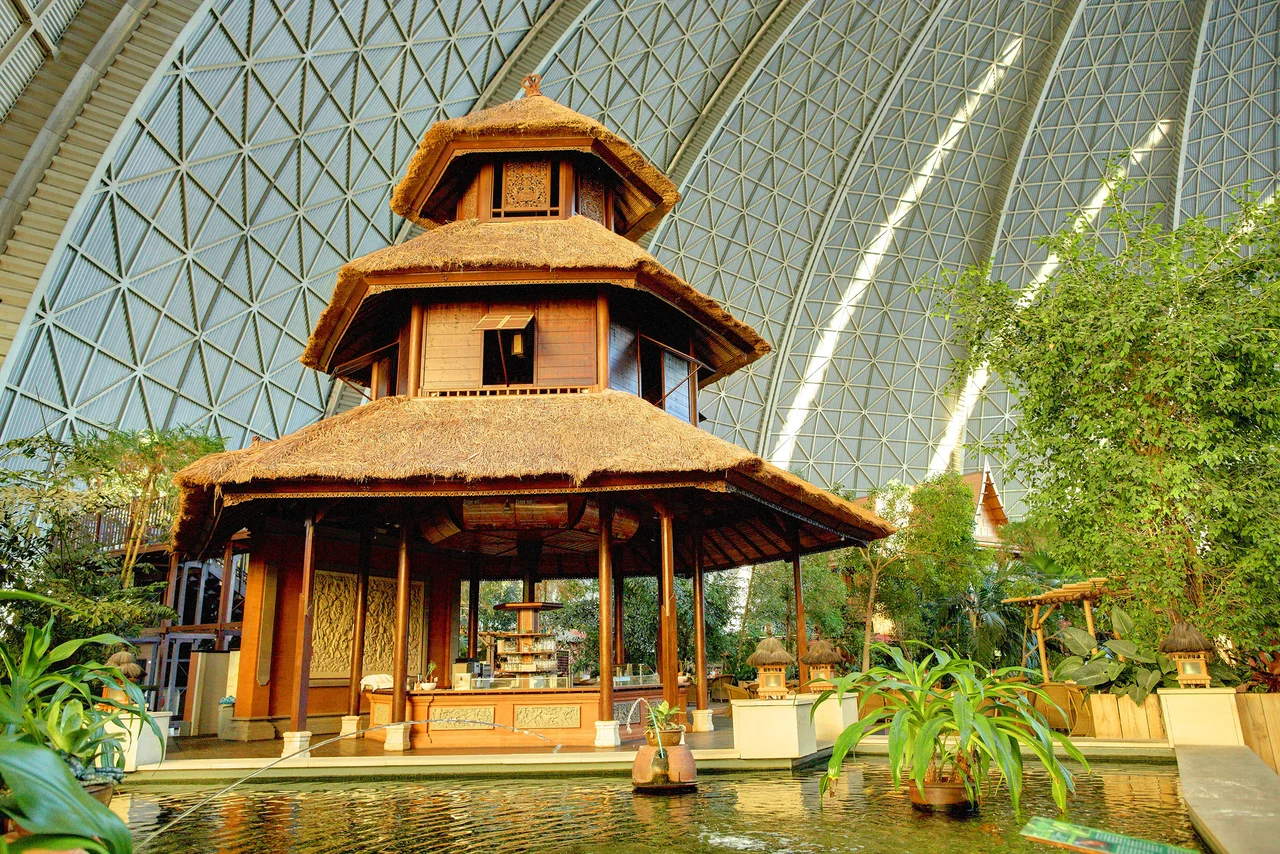
Inside, the air is held at 26 °C and about 64 percent humidity, every single day of the year. There is a Tropical Sea: a 140-metre pool covering 4,400 square metres at a uniform depth of 1.35 metres, edged by 200 metres of sand. There is a Bali Lagoon with fountains, whirlpools and a current canal. A village of replica buildings from Thailand, Borneo, Samoa and Bali sits under the roof, and a 27-metre tower drops four water slides into the middle of it. Outdoors, the Amazonia area adds more than 35,000 square metres of pools, sunbathing lawn and beach volleyball.
The Plants Couldn't See
The rainforest was the part nobody had modelled properly. Around 50,000 plants of some 600 species went in beneath a steel roof that turned out to block most of the light they needed. Photosynthesis stalled and the palms sulked.
The fix, installed in October 2005, was a 20,000-square-metre panel of UV-transparent ETFE film set into the southern face of the dome above the South Sea bathing area — a window of two full hectares, letting unobstructed daylight down onto the beach and the vegetation behind it. The plants have grown well ever since. In a hall 107 metres tall that matters more than it sounds: the greenery has had two decades to climb, and it is no longer decorative shrubbery.
Slow Start in the Pines
Commercially, the early years were bleak. The resort needs roughly 1.25 million visitors a year to operate cost-effectively; in 2005 it lost somewhere between €10 million and €20 million, and by October 2006 had drawn about 600,000 people. The diagnosis was largely geographic. Tropical Islands sits well outside Berlin in a corner of southern Brandenburg where average disposable income runs below the national figure, and there was not enough local money within easy reach. Management widened the catchment, marketing into Poland, restructured the ticket pricing and added places to sleep.
It worked. 2008 brought the resort's first profit, on 300,000 overnight stays, and a campsite went up beside the hall that year. A six-part sauna complex — the largest tropical sauna in Europe, with rooms modelled on the cave temple at Elephanta in India and on Angkor Wat in Cambodia — had opened in 2007 alongside a 4,000-square-metre children's area. The Spanish group Parques Reunidos bought the resort in December 2018. Around 600 people now work inside the hangar, which can take 8,200 visitors in a day.
From the Air
Coordinates 52.0375°N, 13.7486°E, in the Dahme-Spreewald district of Brandenburg, about 50 km south of Berlin's southern boundary and immediately east of the A13 autobahn. The target is impossible to miss: a single silver-grey arched hall 360 m long and 107 m high standing alone in flat pine forest, with the twin runways of the former Brand-Briesen Airfield still legible on the ground beside it. Best viewing altitude is 2,000–4,000 ft AGL, low enough to read the scale of the hangar against the trees. Berlin Brandenburg (EDDB) lies roughly 40 km north; Schönhagen (EDAZ) is the nearest general-aviation field to the northwest. The surrounding Brandenburg lake and forest country is largely uncontrolled airspace below the Berlin TMA, but check the EDDB approach sectors. Low winter sun picks the hangar's curved roof out from a long way off.
Nearby Stories
- Sperenberg Airfield 4.4 km away
- Gigafactory Berlin-Brandenburg 6.7 km away
- Cottbuser Ostsee 7.7 km away
- Natur-Park Südgelände 8.6 km away
- Eisenhüttenstadt 15 km away
- Wendish-German double church 15 km away
- Kostrzyn nad Odrą 29 km away
- Lichtenburg Concentration Camp 36 km away