
Natur-Park Südgelände
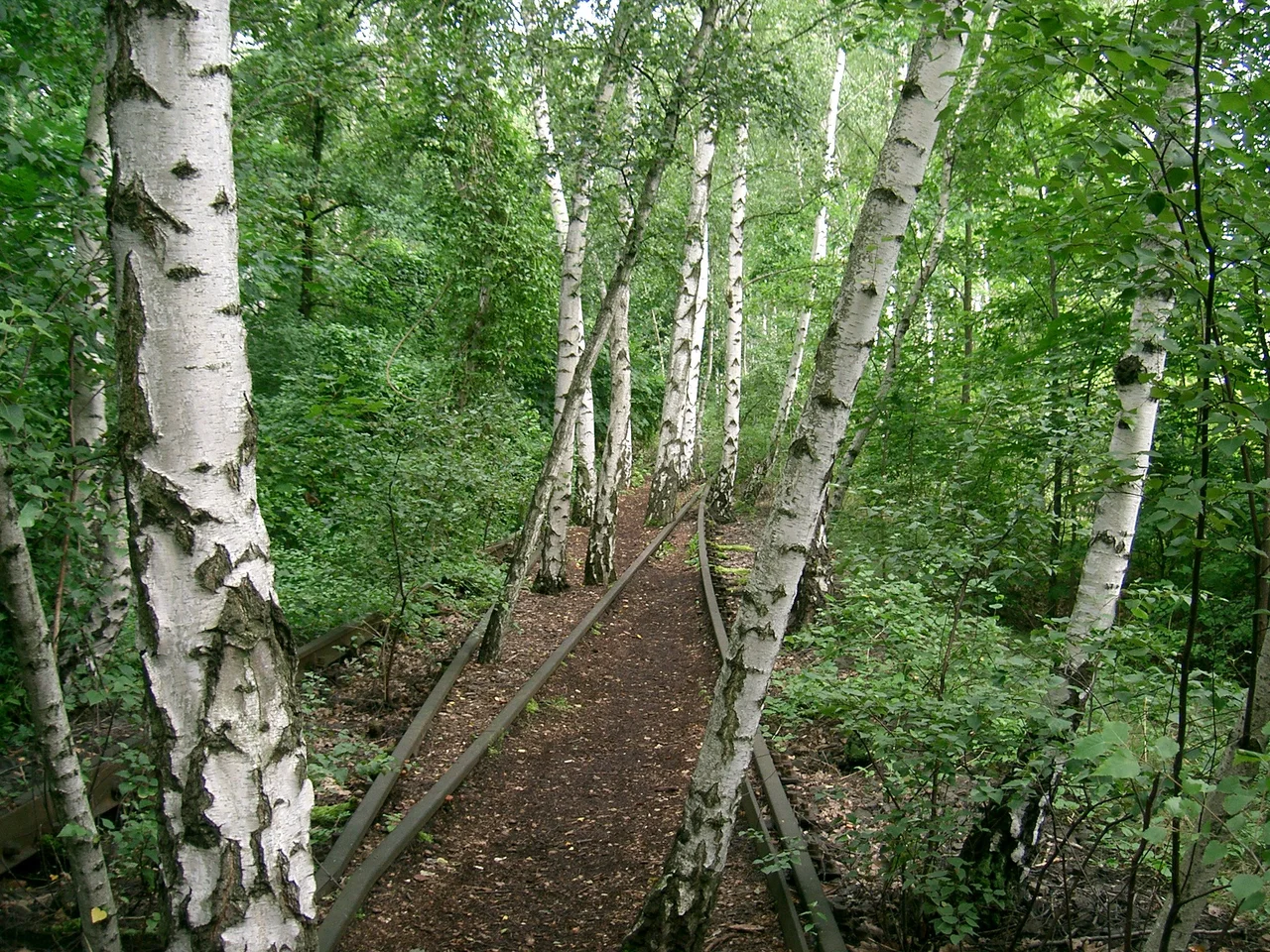
Ninety-five species of bee live here, more than sixty of them endangered. Also 366 kinds of fern and seed plant, 49 fungi, 49 birds, 57 spiders, and fourteen species of grasshopper and cricket. None of this was planted. Natur-Park Südgelände is eighteen hectares of former marshalling yard in Schöneberg where the trains stopped running and nobody came back, and what filled the gap between the rails is now one of the richest patches of habitat inside Berlin. Trees have rooted straight into the ballast. Rust-red rails run under moss and disappear into undergrowth. There is a steam locomotive parked in a clearing with trees growing around it.
What Grows on Ballast
Railway land is a peculiar habitat: crushed stone, no topsoil to speak of, punishing drainage, decades of trampling and heat, and — crucially — no gardeners. The plants that colonise ground like this are the ruderals, the opportunists of disturbed sites, the same tribe that takes bomb rubble and building plots. They should be nothing special. Instead, left alone for forty years in the middle of a city, they produced a mosaic that ordinary parkland cannot match: dry grassland where the ballast is still bare, scrub where the seed rain reached, and closed woodland where the soil has finally deepened enough to hold it. The bee count is the giveaway. Ninety-five species need ninety-five different combinations of flower, bare sand and nesting hole, and a mown lawn provides none of them.
Why the Trains Stopped
The Tempelhof marshalling yard opened in 1889 and was enlarged repeatedly into the 1930s, with a locomotive depot added in 1931. What killed it was politics, not economics. The Anhalter Bahnhof, the great southern terminus this yard fed, was closed in 1952 as the division of the city severed the lines that gave it a purpose, and the western half of the yard shut with it. Nature moved in immediately. The eastern half kept going on a reduced footing, with the Reichsbahn still working the depot, so for decades the site was half live railway and half accidental forest. It is a strangely precise fossil of the Cold War: a piece of infrastructure that simply had nowhere left to send anything.
The Neighbours Said No
In the late 1970s the plan was to build a new freight station on the site, which would have cleared the lot. Local residents organised as the Bürgerinitiative Schöneberger Südgelände and stopped the clearances proposed in 1980; the wider scheme dragged on and was finally abandoned in 1989. Six years later Deutsche Bahn handed the land to the city of Berlin as environmental compensation for damage the company had done elsewhere — a transaction that turned an accident into a policy. Grün Berlin took on the conversion with money from the Allianz environmental foundation, the site gained nature and landscape protection in the spring of 1999, and the park opened that year as a project of Expo 2000. It had taken the neighbours nineteen years.
Walking Above the Ground
The design solved an obvious problem — how do you let thousands of people into a nature reserve without them wrecking it — with a piece of engineering that fits the place exactly. A steel-grating walkway roughly 600 metres long runs through the protected core, carried on steel pipes that rest on the old rails. You walk above the ground rather than across it, on metal, along the alignment the trains used, with the vegetation closing over your head. It is not a boardwalk in a wetland pretending to be invisible. It is unmistakably an industrial object placed inside a wood, and it makes the doubled nature of the site impossible to ignore.
Rust, Water Tower, Sculpture
The hardware stayed. A Class 50 locomotive built in 1940 stands where the depot was, alongside a turntable; two large flying junctions, the flyovers that once let trains cross each other's paths without meeting, survive in the southwest corner. A water tower from 1927 rises about fifty metres above the trees, restored in 2019 and visible for some distance. The old locomotive hall is a working venue — theatre, dance and performance, including Berliner Festspiele events — so the loudest thing on the site is often a rehearsal. Threaded through all of it are sculptures and installations by the artists' group Odious, which a 2014 academic survey of European landscape policy singled out as a distinctive element of the park. The effect of the whole is neither museum nor wilderness. It is a place that was abandoned, and then, deliberately, left that way.
From the Air
52.4597°N, 13.3580°E, in Schöneberg in the borough of Tempelhof-Schöneberg, southern Berlin. From the air the park reads as an unusually dark, unusually long green strip in dense city fabric, orientated roughly north–south and following the alignment of the old railway; the S-Bahn ring and the Priesterweg and Südkreuz stations frame its northern end, and the wide track bed leading north toward the city centre marks where the Anhalter lines ran. The best single anchor is Tempelhofer Feld about 3.5 km east-northeast — the enormous grassed oval of the closed Tempelhof airport, whose runways are still fully visible from altitude. Tempelhof (EDDI) ceased operating in 2008 and is a public park; do not plan an approach there. Berlin Brandenburg (EDDB) is about 8 nm southeast, Schönhagen (EDAZ) about 14 nm south-southwest. All of this lies inside Berlin's controlled airspace. In winter the leafless canopy exposes the rail geometry beneath — the fan of the old yard is legible from above in a way it never is from the walkway.
Nearby Stories
- Silvio Gesell 3.3 km away
- Brandenburg an der Havel 9.4 km away
- Gigafactory Berlin-Brandenburg 10 km away
- Sperenberg Airfield 11 km away
- Eberswalde Hoard 13 km away
- Tropical Islands Resort 19 km away
- Wittenberg 38 km away
- Battle of Wittstock 49 km away