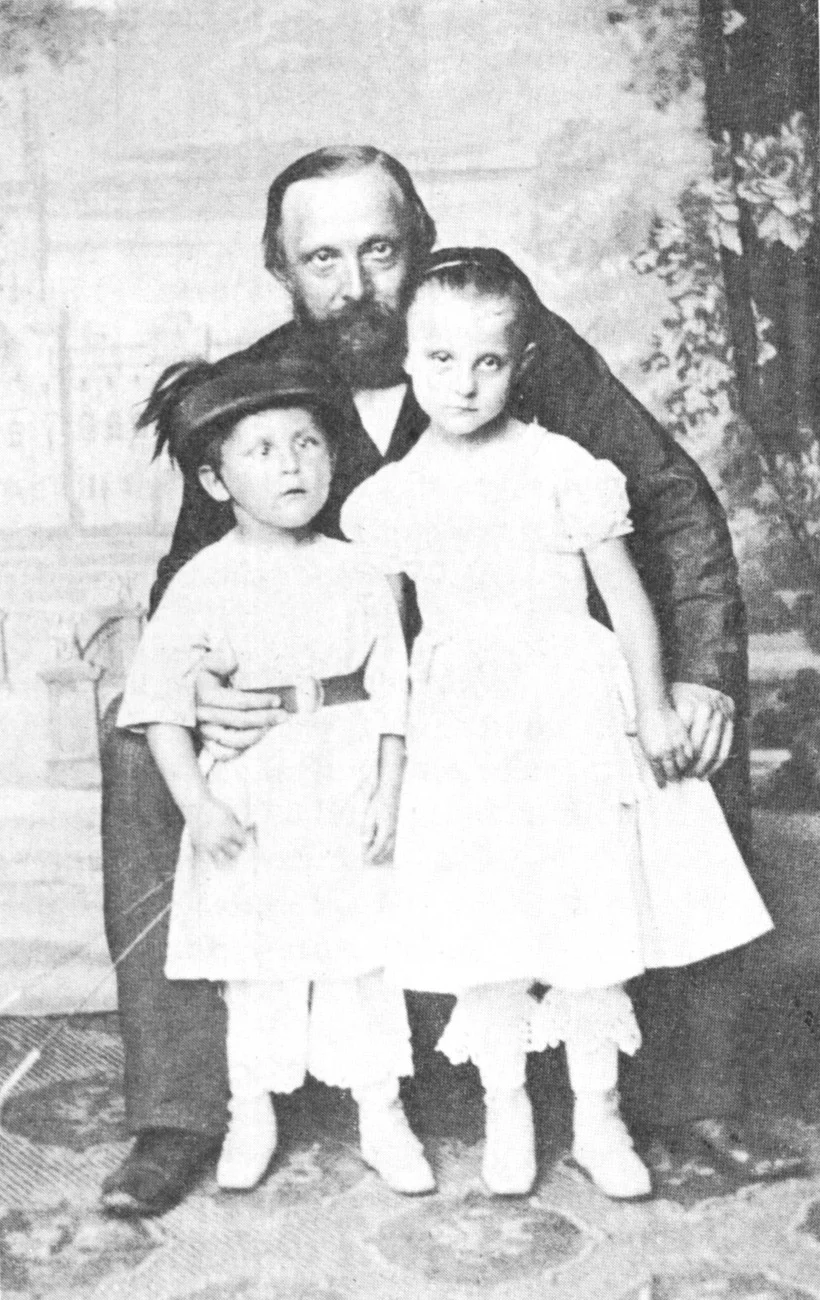

Rudolf Virchow
In the 1880s Rudolf Virchow organised the collection of a strange kind of data. Across every German state but one, teachers recorded the hair, skin and eye colour of the children in front of them - roughly 6,760,000 of them, with separate records kept for about 75,000 Jewish pupils. It was, at the time, one of the largest surveys ever attempted of anything. Virchow published the results in 1886, and they were not what the emerging race theorists wanted. Fewer than a third of German children were blond. Just over half were mixed types. Among Jewish children, eleven per cent were blond. His conclusion was that there were no pure races in Germany - neither a Jewish one nor a German one. He was seventy-five when he said so, and he was still saying it when he died.
Medicine Is a Social Science
In 1847 the Prussian government sent a young doctor to Upper Silesia to explain a typhus epidemic among the region's Polish-speaking poor. Virchow came back with a 190-page report that barely discussed drugs. The epidemic, he argued, was produced by hunger, ignorance and powerlessness, and its causes were the policies of the government that had commissioned him. His prescriptions were full and unlimited democracy, education, freedom and prosperity. Eight days after returning to Berlin, in March 1848, revolution broke out and he joined it. That July he helped found a weekly, Die Medizinische Reform, published under two banners: medicine is a social science, and the physician is the natural attorney of the poor. The paper was closed by June 1849 and he lost his post at the Charité. Würzburg gave him Germany's first chair of pathological anatomy instead. The Charité took him back in 1856.
All Cells Come From Cells
His science was built on a single, disciplined idea: disease happens in cells, and to understand it you look. Cellular Pathology, published in 1858, is where modern pathology begins, and its slogan - omnis cellula e cellula, every cell from a cell - killed off the last respectable version of spontaneous generation. The credit is genuinely complicated. The epigram was coined by François-Vincent Raspail, and the evidence for cell division came from Robert Remak, whose work Virchow initially doubted and then, in 1855, published as his own, ending their friendship. What was unambiguously his fills a medical dictionary: he named leukemia in 1847, described chordoma in 1857, coined embolism and thrombosis, worked out how a clot in a leg vein reaches the lung, developed the first systematic method of autopsy, and traced the life cycle of the roundworm Trichinella spiralis - which is why meat inspection exists, adopted first in Berlin.
The Attorney of the Poor Builds a Sewer
He meant the politics. Virchow sat on Berlin's municipal council from 1859 and was elected to the Prussian House of Representatives in 1862, later winning a Reichstag seat, and he co-founded the liberal German Progress Party. From 1869 he worked with the engineer James Hobrecht to give Berlin what it conspicuously lacked: a sewer system and a central water supply. The scheme drained the city through twelve independent radial systems out to irrigation fields beyond the built-up area - the cleanest available solution to urban sewage at the time, and a larger contribution to Berliners' life expectancy than any operation he ever performed. His opposition to Bismarck's finances provoked a challenge to a duel from the chancellor. He was not consistently on the liberal side of everything: he backed Bismarck's campaign against the Catholic Church, and gave it the name it still carries, Kulturkampf.
The Numbers Refused
Virchow founded the German Anthropological Association in 1869 and the Berlin Society for Anthropology, Ethnology and Prehistory in 1870, at exactly the moment when European anthropology was hardening from measurement into ideology. He used the discipline against itself. The schoolchildren survey was designed to test whether a distinct German type and a distinct Jewish type could be found in the population, and its answer was no - both groups were overwhelmingly mixed, and neither could be sorted by appearance. At the anthropology congress in Karlsruhe in 1885 he denounced what he called the Nordic mysticism surrounding Aryan race theory. He opposed rising antisemitism directly, argued for minority rights, and dismissed Haeckel's social Darwinism as politically dangerous and anti-democratic. He was arguing with the future, and losing, and he knew it.
Wrong in Interesting Ways
He was also capable of being magnificently, stubbornly wrong. He rejected germ theory and Semmelweis's insistence on disinfection. He called Darwin an ignoramus and his own former student Haeckel a fool. Examining the original Neanderthal skeleton in 1872, he ruled it an ordinary human deformed by rickets and arthritis, which set European palaeoanthropology back by years - and then joined Schliemann's expedition to Troy in 1879 and published on the skulls found there. The one case where posterity has moved back toward him is his most notorious. Called in on Kaiser Frederick III's throat, he examined the 1887 biopsy and insisted it was not cancer; he was accused of malpractice for a century. The Kaiser is now thought to have had hybrid verrucous carcinoma, a form nobody could identify until 1948. On 4 January 1902 Virchow fell jumping from a moving streetcar on Leipziger Straße and broke his femur. He never recovered, and died on 5 September. He lies in an honorary grave in the Alter St.-Matthäus-Kirchhof in Schöneberg.
From the Air
The tile coordinate for this story, 52.28 N, 13.22 E, sits in the flat lake-and-forest country of the Teltow south-west of Berlin; the places that actually belong to Virchow lie some 20-30 km northeast, in the city itself. From 2,000-4,000 ft over central Berlin the Charité campus is identifiable on the Spree bend in Mitte, north of the Reichstag and Hauptbahnhof, and the separate Campus Virchow-Klinikum stands in Wedding further northwest. His grave is in the Alter St.-Matthäus-Kirchhof off Großgörschenstraße in Schöneberg, a green rectangle among dense blocks just south of the Landwehr Canal. Berlin Brandenburg (EDDB) lies southeast of the city and its controlled airspace covers the whole approach - central Berlin is not casually overflown, so plan the transit properly or view from the Havel side. Schönhagen (EDAZ) is the nearest general-aviation base to the tile itself, about 15 km southeast.
Nearby Stories
- Karlslust Dance Hall Fire 1.3 km away
- Swiss International Air Lines Flight 850 9.2 km away
- Gigafactory Berlin-Brandenburg 12 km away
- Brandenburg Euthanasia Centre 15 km away
- Wittenberg 18 km away
- Friesack Camp 20 km away
- Spreewald 23 km away
- Lutherhaus 41 km away