.jpg)
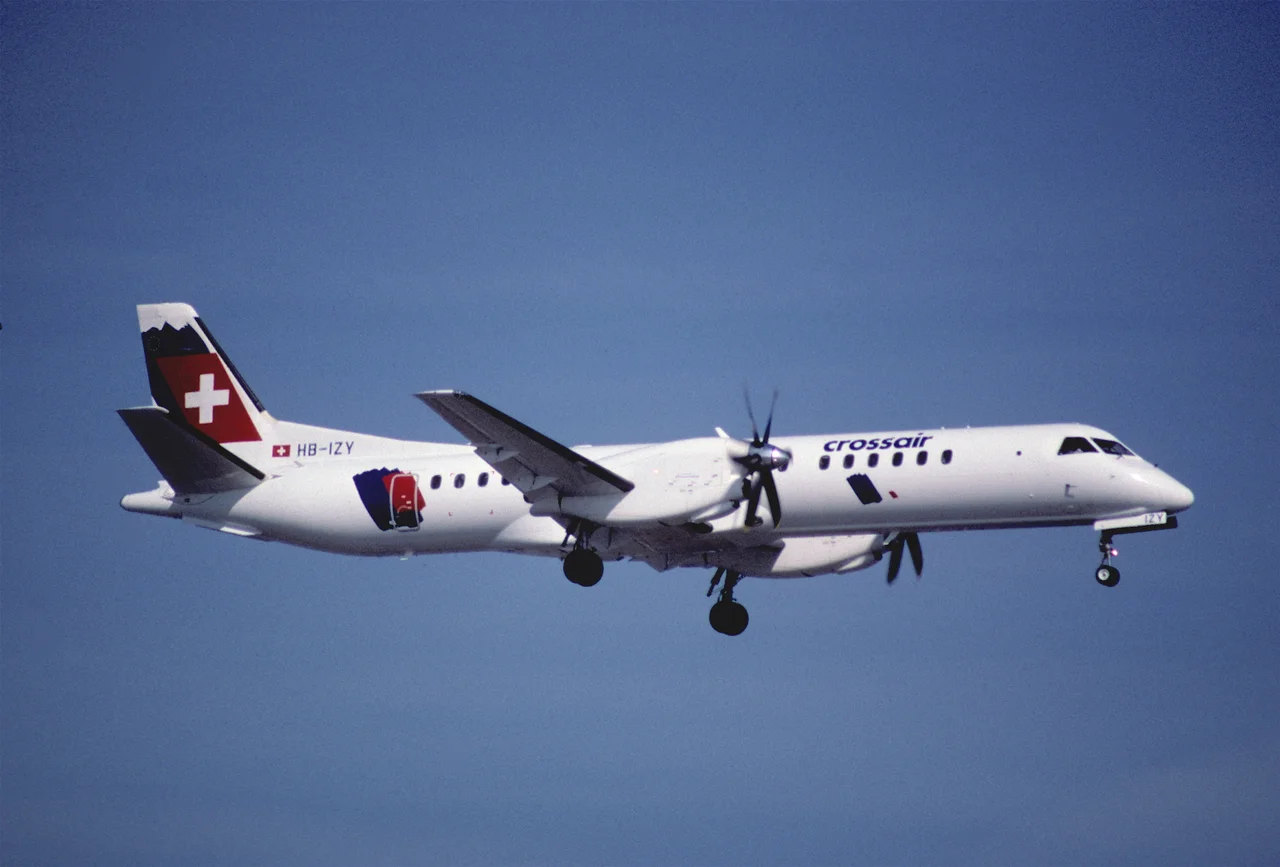
Swiss International Air Lines Flight 850
'We'll take anything at this point.' The moment those words came over the frequency, air traffic control stopped treating Swiss International Air Lines Flight 850 as a diversion and started treating it as an emergency. The Saab 2000 had left Basel that afternoon for Hamburg with four crew and sixteen passengers. It had already been turned away from Hamburg, blocked from Hannover, and thrown off an approach into Berlin. It was 10 July 2002, the storm behind it was the worst summer weather Berlin had seen in fifty years, and the crew were now asking a controller to name any runway in northern Germany they could still reach.
A Different Aeroplane and a Longer Briefing
Flight 850 was supposed to be an Embraer 145. The Embraer was unavailable, so a Saab 2000 was substituted — HB-IZY, named Doldenhorn, five years old, with 12,303 flight hours and 12,069 landings behind it — and the crew briefing was extended by fifteen minutes to cover the change. They pushed back from Basel at 14:55 UTC.
The forecast they carried was not good but it was survivable: a line of thunderstorms, winds up to 45 knots at Hamburg and at both designated alternates, Hannover and Bremen. What they did not carry was the set of SIGMETs issued about an hour before departure, warning that a front was building with thunderstorm tops to 38,000 feet around Bremen. Those never reached the flight deck. Had they, the investigators later concluded, the crew would probably have understood that the storms ahead were not isolated cells but one connected system.
The Derecho
What had formed over northern Germany that day was a derecho — a long-lived, fast-moving line of storms that produces straight-line winds along a front hundreds of kilometres wide. Gusts reached 81 knots. In Berlin, seven people were killed: ordinary Wednesday-afternoon deaths, under falling trees and debris, in a city that had not seen a summer storm like it in half a century.
Flight 850 flew into the edge of that system on approach to Hamburg's runway 23 and hit severe turbulence. The crew abandoned the approach descending through 3,300 feet and went into a hold to think. Bremen, the designated alternate, lay 55 nautical miles southwest — on the far side of the front. Another aircraft landed at Hamburg on runway 33 in strong winds, but the crew of 850 declined to try it and asked instead for Hannover. Controllers offered nothing else, and nobody asked.
Tegel Says CAVOK
The front got to Hannover first. En route, the weather blocked the turn, and the crew swung east for Berlin instead. Tegel's automatic information broadcast said the field was clear with no significant change expected. The 17:50 METAR said CAVOK, NOSIG.
It was wrong, and the investigators said so bluntly: the cold front was 30 km southwest of the airport and had covered 100 km in the previous hour, so NOSIG had no business being in that report and a SPECI should have been issued. A corrected METAR finally went out at 18:20, showing thunderstorms and gusts to 55 knots — two minutes before Flight 850 began its approach to runway 08L. The crew asked for priority, reporting fuel for forty minutes. Then the turbulence found them again, the approach was abandoned, and they asked for somewhere else. Controllers suggested Eberswalde. On the way there, more thunderstorms appeared ahead.
Twenty Miles and a Phone Call
Hamburg control offered Neubrandenburg. The crew turned it down — too far. Then came Werneuchen, a former Soviet air base northeast of Berlin, twenty nautical miles away, with a runway advertised as 1,500 metres.
A controller telephoned the chairman of the flying club at Werneuchen to check. The answer contained the fact that would matter more than any other that evening: the concrete surface was 2,400 metres long, but an earth bank had been thrown across it, leaving 1,500 metres usable. The runway markings had never been changed to say so. Almost an hour after breaking off at Hamburg, in fading light, on a field with no runway lighting, the captain looked at the concrete and remarked that it was longer than Berne, and told the first officer to land wherever he liked. The first officer put the aircraft down at what looked like the threshold.
Three Thousand and Five Days
The markings were for the runway that no longer existed. The aircraft ran into the earth bank, which tore off all three undercarriage legs, and slid to a halt on its belly with the fire alarm sounding for the port engine. The crew ran the fire drills on both engines. Everyone aboard got out; one woman injured her leg. The Saab was written off.
The German Federal Bureau of Aircraft Accident Investigation took 3,005 days to finish its report, publishing in October 2010 — more than eight years. The findings spread the blame widely: crew resource management on the flight deck, SIGMETs that never reached the crew, a METAR that told them Berlin was clear when a front was an hour away, non-standard phraseology from controllers on the approach to Werneuchen, and runway markings that described a runway which no longer existed. Twenty people flew into a derecho with none of that information, and twenty people walked away.
From the Air
The accident site is Werneuchen airfield (EDBW) at 52.6328 N, 13.77 E, in Brandenburg about 30 km northeast of central Berlin, elevation roughly 80 m. It remains active as a Sonderlandeplatz used mainly by ultralights, with runway 08/26 now 800 m of concrete, 28 m wide — but the enormous Soviet-era surface is still legible from the air, a pale 2,400 m strip far wider and longer than anything the current traffic needs, with the dividing works across it clearly visible. That contrast is the story: from 2,000 ft the runway plainly looks long enough. The town of Werneuchen sits immediately southwest, with flat Barnim farmland in every direction and few competing features. Recommended viewing altitude 1,500-2,500 ft AGL. Strausberg (EDAY) is about 11 km southeast with 1,200 m of concrete, Eberswalde-Finow (EDAV) about 22 km north with 1,480 m, and Berlin Brandenburg (EDDB) about 35 km south-southwest. Note the local hazard the accident itself illustrates: summer convection over the north German plain builds fast, and this sector has no high terrain to warn you it is coming.
Nearby Stories
- Das Buddhistische Haus 4 km away
- Battle of Großbeeren 5.4 km away
- St. Mary's Church, Chojna 5.9 km away
- Zehdenick Abbey 7.6 km away
- Frankfurt (Oder) 10 km away
- Kingdom of Prussia 13 km away
- Storkow Castle 15 km away
- Chwarszczany 16 km away