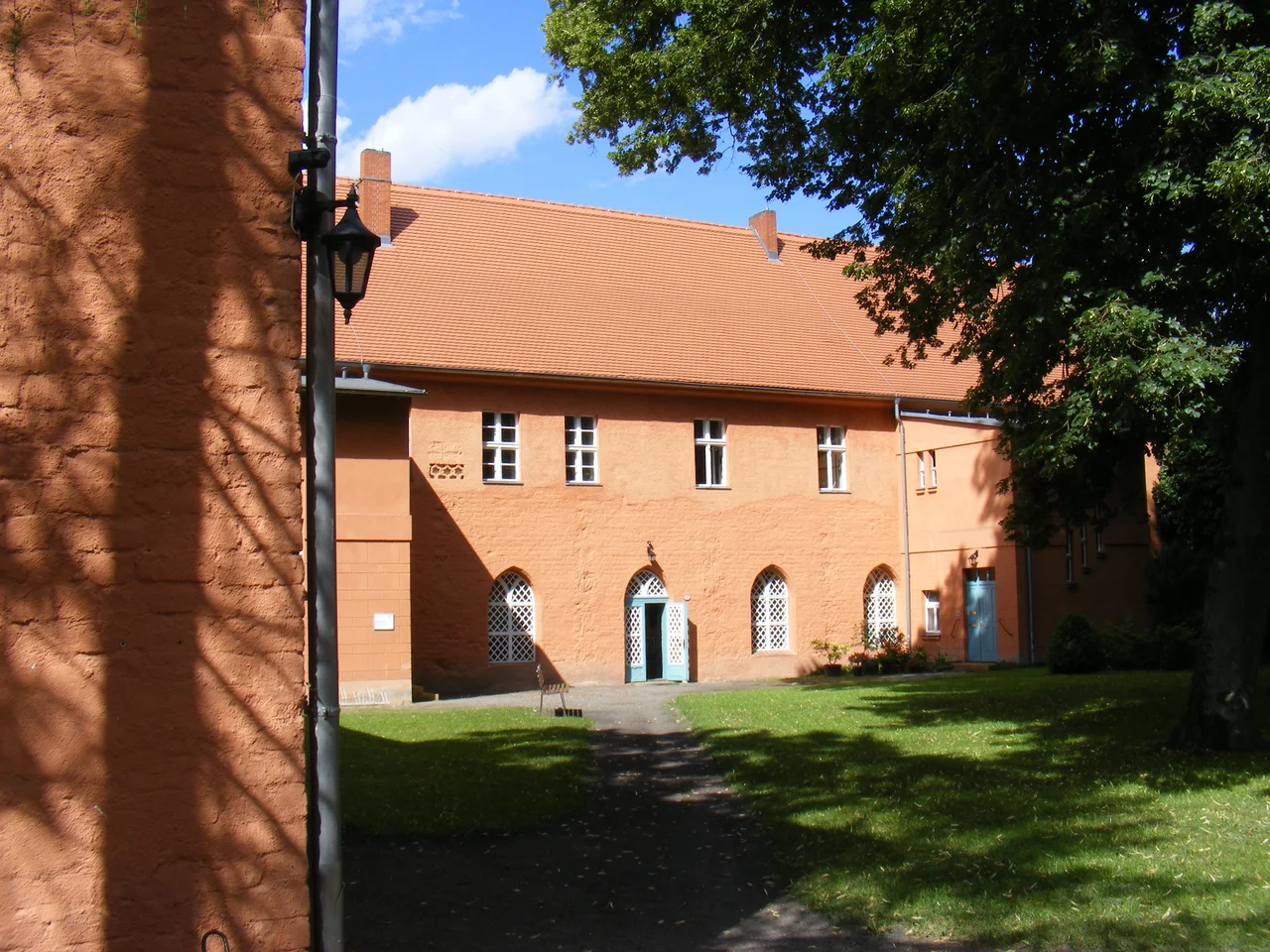

Zehdenick Abbey
The story that built this place begins in a beer cellar. In 1249, according to a legend written down centuries later by the Brandenburg chronicler Andreas Angelus, a woman who kept an inn at Zehdenick buried a consecrated communion host in the earth beneath her beer barrel, hoping God might improve her guests' thirst. Her conscience got the better of her; she told her priest; the priest had the host dug up. Blood, the story goes, welled from the ground in several places. It was caught in a vessel and set on the church altar, a chapel was raised over the spot, and pilgrims began walking to a small town on the Havel to see where the ground had bled.
Twelve Women on a Frontier
Within a year the Margraves of Brandenburg had acted. Otto III, Johann I and their sister Matilda, Duchess of Brunswick-Lüneburg, founded a Cistercian nunnery here in 1250 or shortly after. The pilgrims were part of the reason. The larger part was that the Ascanian dynasty had recently acquired the Uckermark and needed institutions on the ground to hold it — an abbey was a claim staked in stone and prayer.
It began with twelve nuns, who moved into a completed dormitory in 1252. Pope Alexander IV confirmed the foundation in 1254. Building money followed: from Bishop Otto of Brandenburg in 1255, from Erich of Brandenburg, Archbishop of Magdeburg, in 1287. The house was first dedicated to the Virgin Mary and Saint George; by 1409 the dedication had shifted to the Holy Cross, a change recorded in a letter from the Antipope Alexander V — the kind of paperwork that reminds you how tangled Christendom's chain of command could get.
Sixteen Villages and Thirteen Lakes
Cistercian houses had a talent for accumulation, and Zehdenick was no exception. By the time the Reformation arrived, the abbey owned sixteen villages outright, held interests in two more, controlled forests, and possessed fishing rights on thirteen lakes and a river — almost certainly the Havel. In a landscape where fish were protein and lakes were roads, that was real power.
The Reformation reached Mark Brandenburg in 1541, and the abbey did not so much close as change form. It became an Adliges Frauenstift, a secular college for noblewomen: residents entered without taking any religious vows. The estates passed to the rulers of Brandenburg, and a government agency decided who was admitted and paid for their upkeep. For daughters of the lesser nobility with no marriage prospects and no inheritance, a place at Zehdenick was security — a room, an income, a life among women, allotted by an office in the capital rather than by a calling.
Fire, and Fire Again
The Thirty Years' War did to Zehdenick what it did to most of Brandenburg. The town burned almost completely in 1631, and the abbey buildings were largely destroyed. What survived, and survives today, is fragmentary but substantial: the outer walls of the dormitory, the north and west wings, parts of the cloister, and the long structure known as the abbey barn — originally the infirmary, the school and the lodging for pilgrims, all under one roof.
The church was rebuilt in 1768. Thirty-three years later lightning struck it and it burned down to its outer walls, and it was never raised again. The fire of 1801 was a catastrophe for the town as well, leaving 3,123 people without homes. Seven women were still living at the Stift; the north wing was converted for them, and the institution went on in reduced form until 1945 — nearly seven centuries after twelve nuns first moved into a new dormitory.
Brass Choirs and Brickworks
In 1946 what remained was placed under the Evangelical Church of Berlin-Brandenburg, and it is administered today by that church's successor body, providing housing for people connected to it. The buildings have found the kind of modest second life that keeps old stone standing: two vaulted rooms in the north wing display a copy of the Zehdenicker altar cloth, whose original is in the Märkisches Museum in Berlin; a family and marriage counselling service works out of the premises; the town's branch of Germany's Protestant brass-choir movement rehearses here; and the abbey barn holds a gallery run by a regional cultural society.
Outside the walls, Zehdenick had one more boom. Clay turned up during railway construction in 1887, and by 1900 this stretch of the Havel was among the largest brick-producing regions in Europe — more than thirty brickworks, over five thousand migrant workers, and as many as two hundred million bricks a year floated down to build Berlin on a fleet of more than a hundred electrically powered barges. The Ziegeleipark Mildenberg keeps that story. The abbey, older by six centuries, keeps the other one.
From the Air
Zehdenick Abbey stands at 52.98°N, 13.34°E on the Havel in Oberhavel, roughly 60 km north of Berlin. From the air the town is a compact grid straddling the river, and the abbey complex reads as a distinct walled block on the edge of the old centre — long low ranges around an open court, quite different in grain from the surrounding streets. The Havel here is canalised and busy with pleasure craft in summer; follow it northwest and the flooded clay pits of the old brickworks appear as a striking chain of rectangular pools around Mildenberg, unlike any natural lake and the clearest evidence from above of the town's industrial century. Fly at 1,500–2,500 ft AGL. Nearest fields: EDAV (Eberswalde-Finow) about 30 km southeast, EDDB (Berlin Brandenburg) roughly 75 km south, EDBK (Kyritz) around 65 km west. Low morning sun in autumn throws the abbey's surviving wall lines into relief; summer haze over the lake district can wash out the detail.
Nearby Stories
- Friesack Camp 5.8 km away
- Battle of Prenzlau 12 km away
- Swiss International Air Lines Flight 850 12 km away
- Das Buddhistische Haus 14 km away
- Neustrelitz Palace 14 km away
- Eberswalde Hoard 17 km away
- Battle of Wittstock 22 km away
- Ludwigslust Palace 78 km away