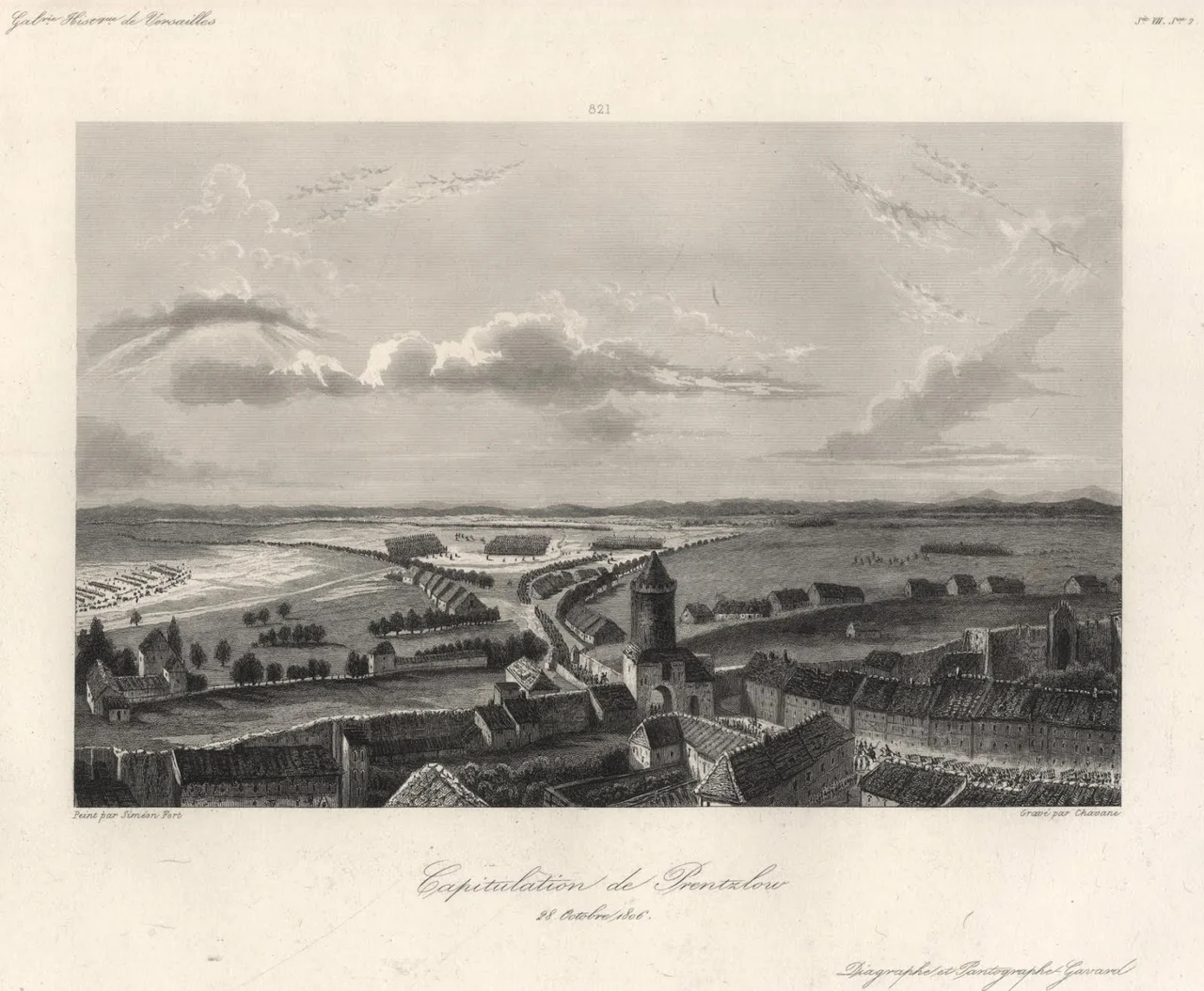

Battle of Prenzlau
Joachim Murat had cavalry, twelve guns and no army behind him. He told Prince Frederick Louis of Hohenlohe-Ingelfingen that a hundred thousand Frenchmen had closed around him, and he gave his word of honour on it. It was untrue in every particular. Apart from a single brigade of infantry, the only French troops within reach of Prenzlau that morning were horsemen, and at the moment of the parley perhaps four or five thousand of them stood between the Prussians and open road. Hohenlohe surrendered his entire corps. Two weeks after Jena-Auerstedt, the Prussian army was being dismantled not by battle but by conversation.
A Column That Had Not Eaten
The retreat had been going badly for a fortnight. After the double disaster at Jena and Auerstedt on 14 October, the Prussian armies ran north for the Elbe, crossed it near Magdeburg, and turned northeast hoping to get behind the Oder before the French caught them. Hohenlohe left Magdeburg on 21 October and pushed on through Genthin, Rathenow and Neustadt an der Dosse, splitting his command into columns simply so the countryside could feed them. It did not feed them enough. On 26 October Antoine Lasalle's hussars caught General-Major Schimmelpfennig's 1,300 men at Zehdenick; the Königin Dragoons charged and briefly held, then Emmanuel Grouchy's dragoons arrived and all but destroyed the regiment, which lost a colour and some 264 officers and men. The next afternoon at Boitzenburg, Count von Arnim had food waiting at his manor for exhausted soldiers. French cavalry got there first and were looting it when the Prussians arrived. It took three hours to drive them out.
Eight Kilometres and Three Wasted Hours
At four in the morning on 28 October the head of the column reached Schönermark, eight kilometres short of Prenzlau. Hohenlohe called a council of war, and his officers argued: east into Prenzlau, or north to Pasewalk? A cavalry patrol reported at six that Prenzlau was clear of French. The march resumed - but three hours had gone, and getting a starving column moving again took longer still. Angry protests came up from the ranks. These were men who had walked more than two hundred kilometres in a fortnight on whatever they could find, and they knew as well as their generals did that every hour handed the initiative to the horsemen behind them. When they finally moved off, dragoons riding flank guard drifted back onto the road and pushed into the line of march, which stretched the column out along the causeway exactly where it could least afford to be strung thin.
The Town Between Two Gates
Prenzlau sits with the long Unteruckersee at its back and the Uecker running north along its western side. Two roads approach from the west across marshland, raised on causeways through a kilometre of suburbs, entering the town by gates about five hundred metres apart. It is not ground on which a tired army wants to be intercepted. Hohenlohe posted General-Major von Tschammer with two grenadier battalions astride the Berlin highway to cover the passage, and pushed the rest through the town toward a supply train on the far side. French horse artillery silenced Tschammer's cannon quickly. Then General Boussart's dragoons forded a stream west of the town and struck the marching column from the south, riding straight over a substantial part of it and capturing Tschammer. Cut off at the rear, Prince Augustus of Prussia found his command pinned against the Uecker from two directions and surrendered. Grouchy's dragoons broke down the town gate and rode through to find ten thousand Prussians drawn up on the Pasewalk road.
A Wonderful Tissue of Lies
The deception had begun earlier that morning, when a French officer named Captain Hugues rode out of the mist under a flag of truce and was taken to Hohenlohe. Hugues claimed Murat had thirty thousand men to hand and that Marshal Lannes waited on the Stettin road with sixty thousand more; one historian called it a wonderful tissue of lies. Hohenlohe refused to surrender, but sent his chief of staff, Oberst von Massenbach, back with Hugues to see what he could learn. Massenbach returned thoroughly taken in and reported that the French now lay between the corps and Stettin. Murat asked for a face-to-face parley, and there gave his word of honour that Lannes, Soult and Bernadotte had a hundred thousand men around them. At that moment a munitions wagon exploded somewhere in the distance. A quick-thinking French officer said it was Soult's signal gun, announcing that the retreat was closed. Hohenlohe asked for terms.
The Surrenders That Followed
The terms were hard: officers and the Royal Guards released on parole, the rank and file made prisoners. Digby Smith counted 10,000 men, 1,800 cavalry horses and 64 guns taken; Francis Loraine Petre put total Prussian losses near 12,000, and reckoned the three days from Zehdenick to Prenzlau cost close to 13,500. General Beaumont, given the job of escorting them, later reported 9,534 prisoners, so some evidently slipped away on the road. Worse followed within the week. Pasewalk capitulated on 29 October with four thousand men, to a force smaller than itself. At Stettin, Lasalle's light cavalry brigade bluffed a garrison of five thousand out of a fortress. Küstrin fell on 1 November. Petre judged the surrender unnecessary, blaming Massenbach and arguing that a commander of Blücher's temperament would have cut his way through to Stettin. Blücher, finding the northeast closed, turned toward Lübeck, where he would fight on 6 November.
From the Air
Prenzlau lies at 53.32 N, 13.87 E in the Uckermark of northeastern Brandenburg, about 26 nm east of Neubrandenburg and 58 nm north of Berlin. Best viewed between 2,000 and 4,000 feet AGL. The battlefield reads clearly from the air because the water has not moved: the long Unteruckersee stretches southwest from the town, the Uecker drains north along its western edge, and the low ground either side of the two western approach roads is still visibly wetter and emptier than the farmland around it. The medieval town walls and the twin towers of St Mary's mark the centre. Nearest airports are Neubrandenburg (EDBN) about 26 nm west-northwest and Berlin Brandenburg (EDDB) about 58 nm south; Szczecin lies roughly 40 nm east-northeast across the Polish border, on the road Hohenlohe never reached. Autumn morning mist over the Uckermark lakes is common and was itself a factor in the battle, hiding French patrols from the marching column.
Nearby Stories
- Battle of Cedynia 12 km away
- Zehdenick Abbey 12 km away
- Kingdom of Prussia 12 km away
- St. Mary's Church, Chojna 14 km away
- Hohenlychen Sanatorium 17 km away
- Historical Technical Museum, Peenemünde 59 km away
- Lilleø 189 km away
- Stutthof Concentration Camp 320 km away