.JPG)
Battle of Cedynia
Everything anyone knows for certain about the Battle of Cedynia comes from three sentences. They sit in chapter nineteen of the second book of Thietmar of Merseburg's chronicle, written decades after the event by a bishop whose own father had fought in it, and they say roughly this: that the margrave Hodo attacked Mieszko, who was loyal to the emperor and paid tribute as far as the river Warta; that on 24 June, at a place Thietmar calls Cidini, the Germans had the better of it at first; and that Mieszko's brother Czcibor then turned on them and killed the best of their warriors. That is the whole record. From it grew monuments, postage stamps, a national anniversary and an argument about a border that ran for most of the twentieth century.
A Margrave's Private War
The frontier had been moving east for a generation. Around 937 the Saxon margrave Gero pushed German power beyond the Elbe, subduing the Polabian Slavs until his marches reached the Oder and the western edge of Mieszko's young Polish realm. Clashes were settled in 963 by an agreement under which Mieszko paid recurring tribute to Emperor Otto I. When Gero died in 965 his enormous march was carved into smaller ones, and the men who inherited the pieces were largely unsupervised. Mieszko used the gap to take the lightly held mouth of the Oder, an economically valuable stretch that pulled his influence north through Pomerania as far as Wolin. Hodo, invested with the Saxon Eastern March, was the man responsible for collecting tribute from exactly the tribes Mieszko was absorbing. He gathered his forces and attacked - not on the emperor's orders, but in direct breach of the agreements Otto had made, while Otto himself was tied up securing his rule in Italy. Hodo expected to win.
24 June 972
Estimates put perhaps four thousand men under Mieszko against something like three to four thousand Saxons, though numbers this old are guesses dressed as figures. Thietmar's account gives no terrain, no formation, no casualty count - only a sequence. The Germans advanced and were winning. Then Czcibor, Mieszko's brother, brought his force against them and the day reversed. Thietmar writes that the flower of the German warriors was killed, and since his father Siegfried had ridden with Hodo, the loss was one his family felt directly. That is a striking thing about the only source: it is German, it is close to the event, and it concedes the defeat plainly. Whether any of it happened near the modern town of Cedynia is another matter entirely - recent scholarship has raised real doubts, and the site remains unfixed.
The Bill at Quedlinburg
Otto I came back from Italy and did what emperors do with subordinates who start wars without permission: he imposed a settlement. At the Quedlinburg diet of 973 the two sides were reconciled on terms that cost Mieszko his young son. Boleslaw - later Boleslaw the Brave, the first crowned king of Poland - went to the imperial court as a hostage. Weeks later Otto died, and the arrangement lost its guarantor. The frontier kept smouldering. Mieszko involved himself in the quarrel between Otto's son and successor Otto II and the Bavarian duke Henry the Wrangler, and in 979 German forces attacked Poland again, without success. Relations only steadied when Mieszko married Oda of Haldensleben, daughter of the margrave of the Northern March - a border dispute closed, as they often were, by a wedding.
The Battle Becomes Useful
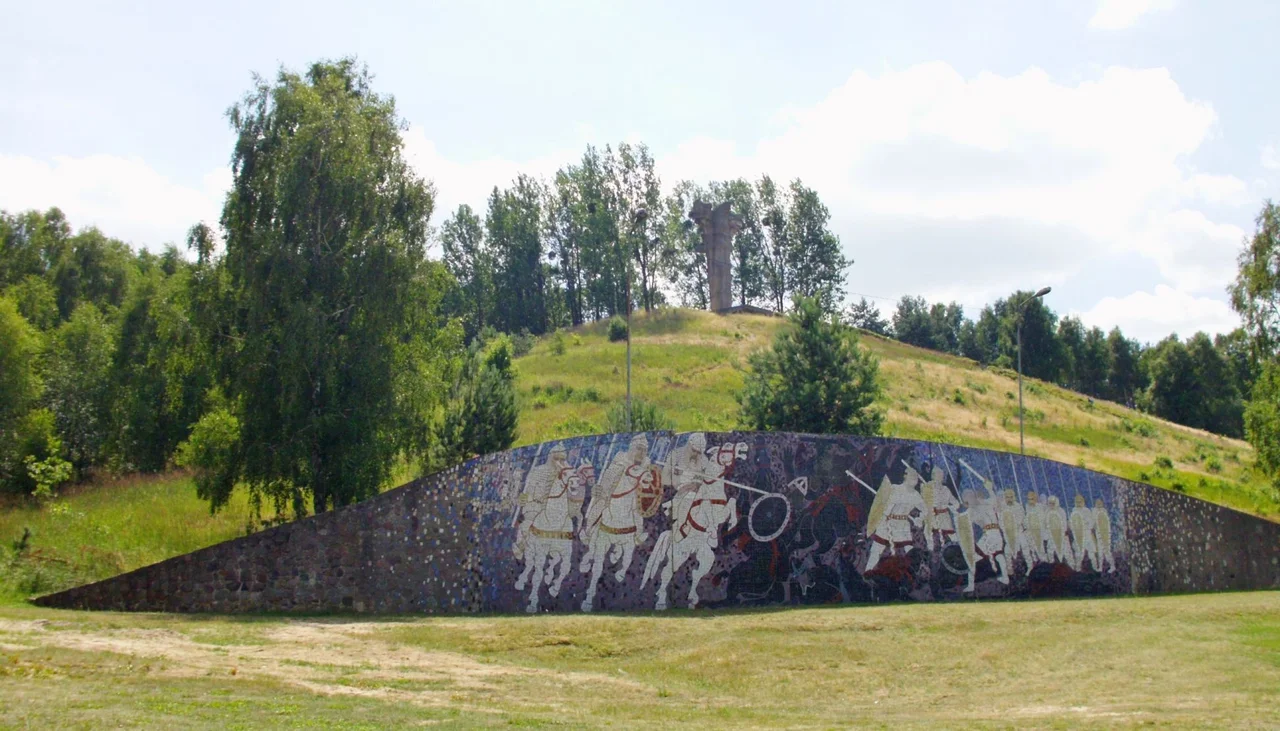
For most of a thousand years almost nobody in Poland had heard of it. Then in 1945 the Oder-Neisse line moved the German town of Zehden into the People's Republic of Poland, renamed Cedynia, and the country's new western border needed a history. A three-sentence tenth-century skirmish was ideal: it was early, it was a Polish victory, and it happened somewhere near the right river. The campaign that followed was thorough. Rallies, monuments, press features, popular science, travel guides, poems and novels, films, a commemorative medal, postage stamps, printed envelopes - even special matchbox designs carried the battle to households that had never encountered it. In 1972, for the thousandth anniversary, a fifteen-metre concrete eagle mounted on a sword went up on the hill above the town, and mosaics at its foot showed white knights encircling and defeating black ones. The subtext was not subtle: an eternal German-Polish enmity, running unbroken from 972 to the present, of which the new border was simply the latest chapter.
Just a Border Town Again
The historian Pawel Migdalski has put the afterlife bluntly: Cedynia has lost its propaganda value and is now one of several small border towns. About 1,480 people live in it, and it holds the distinction of being the westernmost town in Poland, a few kilometres from the Oder and the German frontier. The battle is still marked, but the marking has changed character - an annual festival and re-enactments rather than rallies, a regional museum in the centre of town, hikers on the wooded slopes of the Cedynia Landscape Park. The concrete eagle still stands on its hill, a monument to an event nobody can locate, raised for reasons that no longer apply. In Warsaw the inscription CEDYNIA 24 VI 972 is cut into the Tomb of the Unknown Soldier alongside the names of battles with far better documentation, which is its own kind of comment on how history gets chosen.
From the Air
The article's mapped point sits on the lower Oder at 53.25 degrees north, 14.48 degrees east, near Gryfino - reasonable given that the battle's actual location is disputed, but the town of Cedynia itself lies about 45 km upstream to the south, at 52.88 north, 14.20 east. Fly the river and you cover both. Best viewed at 2,000-4,000 ft AGL. Below Gryfino the Oder splits into the braided wetland channels of the Miedzyodrze, a green maze of islands and cuts that runs north toward Szczecin; upstream past Widuchowa the valley narrows and the wooded moraine hills of the Cedynia Landscape Park rise on the Polish bank, with the 15-metre eagle monument on the hilltop above Cedynia town. The German bank is flat polder the whole way. Nearest airports: Szczecin-Dabie (EPSD), a grass aeroclub field about 25 km north of Gryfino, Szczecin-Goleniow Solidarnosc (EPSC) about 45 km north-northeast, and Berlin Brandenburg (EDDB) about 75 km southwest of Cedynia. Morning fog sits in the river valley well into late spring.
Nearby Stories
- Niederfinow Boat Lift 11 km away
- Lituanica 18 km away
- Kingdom of Prussia 20 km away
- Gorzów Wielkopolski 22 km away
- Historical Technical Museum, Peenemünde 80 km away
- Stalag Luft III 176 km away
- Lilleø 260 km away
- Stutthof Concentration Camp 283 km away