
Lituanica
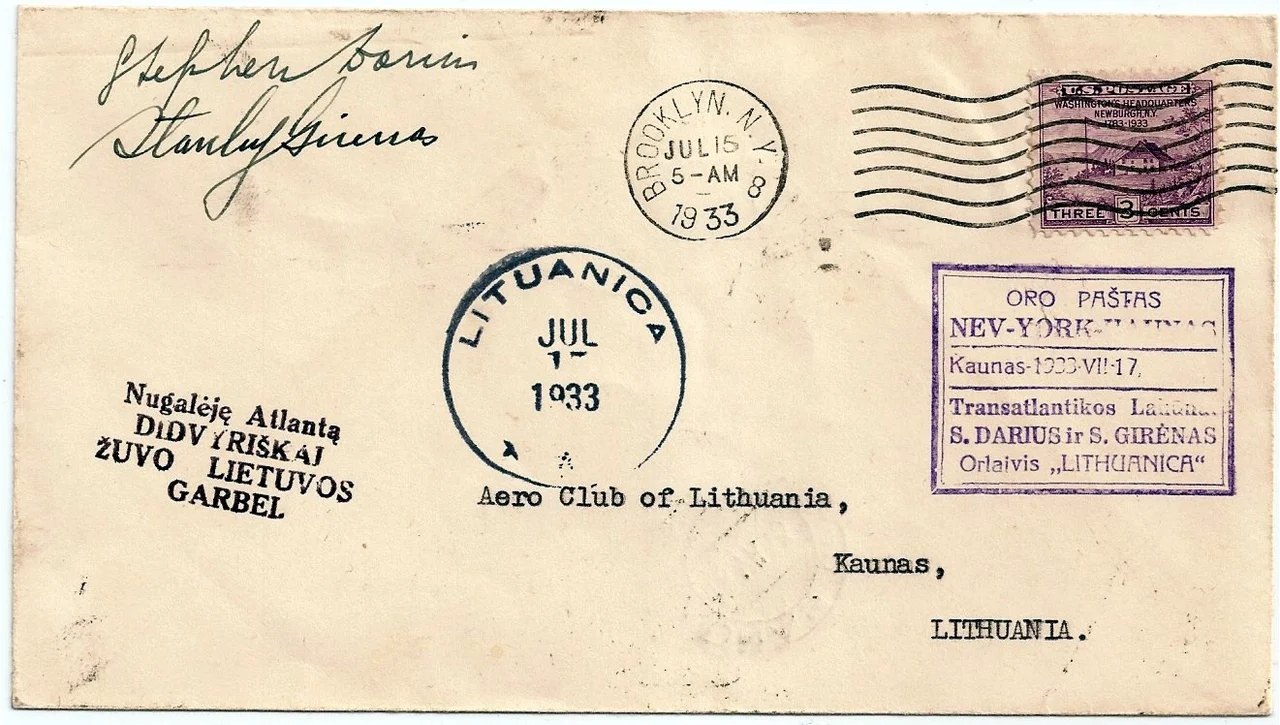
The donors' names were painted onto the airplane. Along both flanks of the orange fuselage ran scrolls listing the sponsors — Lithuanian clubs and societies scattered across the United States, immigrant families who had passed the hat at picnics and air shows so that two of their own could try the Atlantic. When Steponas Darius and Stasys Girėnas lifted off from Floyd Bennett Field on the morning of 15 July 1933, they carried a whole community into the air with them, lettered on the skin of the plane. Thirty-seven hours later the aircraft came down in a forest near the German town of Soldin — now Pszczelnik, near Myślibórz in Poland — 636 kilometres short of Kaunas.
Thirty-Two Hundred Dollars
They bought her on 18 June 1932 from the Pal-Waukee Company for $3,200: a Bellanca CH-300 Pacemaker, serial number 137, registered NC-688E. Only forty of the type were ever built — a single-engine, six-seat high-wing monoplane with a welded chromoly tube fuselage under fabric, spruce-and-plywood wings, and a nine-cylinder Wright radial putting out 300 horsepower. In January 1933 the plane went into E. M. Laird's workshops in Chicago's Clearing Industrial District and came out something else entirely. Longer wings. Two additional fuel tanks in the fuselage, 220 and 185 gallons, each fitted with an emergency dump valve. A 25-gallon oil tank under the pilot's seat with twelve cooling tubes. Wheel fairings, new fabric, a longer horizontal stabilizer, and a higher-compression 365-horsepower Wright Whirlwind J6-9E. The rebuild finished on 29 March 1933. She was re-registered NR-688E, painted orange, and named Lituanica — Latin for Lithuania.
Thirty-Seven Hours, Eleven Minutes
They rolled at 6:24 in the morning, Eastern time. The planned route ran New York, Newfoundland, the Atlantic, Ireland, London, Amsterdam, Swinemünde (now Świnoujście, Poland), Königsberg (now Kaliningrad, Russia), and finally Kaunas airport — 7,186 kilometres in all. Weather over Ireland pushed them north, so they came into Germany the long way round, by Scotland and the North Sea. They had no navigational equipment at all. They flew 6,411 kilometres without landing, more than 7,000 along their actual track, averaging 107 miles an hour. For sheer non-stop distance the flight ranked second in the world at that moment, behind only Russell Boardman and John Polando, and fourth for duration. An ordinary unmodified aircraft of that class still cannot approach it — a Cessna 152 has a range of about 1,200 kilometres.
Kuhdamm, 0:36
They went down at thirty-six minutes past midnight on 17 July, in woods by the village of Kuhdamm outside Soldin. Both men died. In Kaunas a crowd was already gathering at the airfield to meet them. Before leaving New York the two had written that either a successful flight or a catastrophe would be significant enough to make the attempt worth it — a sentence that reads one way as bravado before takeoff and quite another afterward. They had flown the hardest 6,411 kilometres of the journey and were within a couple of hours of the easiest.
What the Commission Could Determine
A Lithuanian board of investigation went over everything. It found the pilots properly qualified and the aircraft properly outfitted, and noted that the most difficult portion of the flight had been executed with great precision. The engine had been running at impact — the propeller was turning — and there was still fuel aboard. Its conclusion was difficult weather compounded by engine defects, with the crash most likely the result of a failed emergency landing. Pilot error appears in some accounts, but Darius had never been in an accident in his entire flying career, and in 1931 Girėnas had taken first prize at a Chicago flying festival for gliding his aircraft to a landing with a dead engine. Rumors persisted that the plane had been shot down as a suspected spy aircraft because its track passed near a German camp; the autopsies found no bullet wounds. The two men lie in the Military Cemetery of Šančiai in Kaunas.
How a Country Keeps Two Men
Chicago's Lithuanian community, which had helped pay for the plane, raised an Art Deco monument to the pair in Marquette Park in 1935; it is still standing. That same year Feliksas Vaitkus flew Lituanica II in their memory. In 1943 the sculptor Bronius Pundzius carved their faces into Puntukas, then the largest known boulder in Lithuania — a nation putting two pilots into a glacial erratic because it needed somewhere permanent to put them. Brooklyn got a granite flagstaff bearing them in bas-relief in 1957, in Lithuania Square. Kaunas named its national stadium for them, and their flight appeared on the 10 litų banknote. There is a Lituanica Avenue in Chicago's Bridgeport and a Lituanica Park in Beverly Shores, Indiana, opened by the American Lithuanian Club in 1968 and given a sculpture by J. Barkis in 1971.
The Forest at Pszczelnik
The place where they actually came down is the quietest of all of it. A monument stands in the woods at Pszczelnik, a few kilometres from Myślibórz, in a corner of Poland that was German when the Lituanica fell out of the sky and had never heard of either man. A local school named for Steponas Darius and Stasys Girėnas looks after the memorial, and its students and neighbours gather there each July. Ninety years on, Polish schoolchildren keep the ground where two Lithuanian airmen died over Germany — which is a stranger and better ending than any of the bronze.
From the Air
The crash site is at 52.85°N, 14.84°E, in wooded, gently rolling country of West Pomeranian Voivodeship about 3 km from Myślibórz. Best viewed at 1,500-3,000 ft AGL. Navigate on Myślibórz and its lake, with the Oder valley about 25 km to the west; the terrain here is forest and farmland with no dominant landmark, which is part of why the pilots had so little to work with on a dark, weather-bound night. Nearest airports: Szczecin-Goleniów Solidarność (EPSC) about 80 km north, Berlin Brandenburg (EDDB) about 105 km southwest, Zielona Góra-Babimost (EPZG) to the southeast. Kaunas, where they were headed, lies roughly 640 km east-northeast — the leg the Lituanica never flew. Low cloud, drizzle and night fog are common in this area in summer, exactly the conditions the 1933 board of investigation blamed.
Nearby Stories
- Battle of the Seelow Heights 2.9 km away
- Operation Solstice 14 km away
- Oderbruch 18 km away
- Battle of Kunersdorf 33 km away
- Battle of Prenzlau 45 km away
- Lubiaz Abbey 160 km away
- Battle of Leuthen 206 km away
- Stutthof Concentration Camp 279 km away