
Operation Solstice
More than twelve hundred tanks were allocated to the attack. There were no trains to carry them to the start line. Three days of ammunition and fuel were on hand, for an operation whose stated goal lay some ninety kilometres off in a straight line - and a good deal further by the route planned - through a Soviet army group. That was the state of German logistics in February 1945, and it is the shortest explanation of what happened when the Eleventh SS Panzer Army rolled south-east out of Stargard in Pomerania on the fifteenth of that month. Four days later it was over. The Germans called it Sonnenwende - solstice - and the operation did nothing it was designed to do, yet it still rearranged the last three months of the war in Europe.
The Argument About Who Would Command
The Soviet Vistula-Oder Offensive, launched on 12 January 1945, had torn a gap hundreds of kilometres wide in the German line and carried the Red Army from the Vistula to the Oder in a fortnight. As the advance ran out of momentum its leading edge narrowed, leaving long exposed flanks into which retreating German formations were feeding. Heinz Guderian proposed cutting off Zhukov's spearheads with converging attacks from Stargard in the north and Glogau and Guben in the south. To do it he wanted the Courland Pocket evacuated, troops brought from Italy and Norway, and Sepp Dietrich's 6th Panzer Army released from Hungary. Hitler refused all three, and the meeting degenerated into a shouting match. A second row followed over who would run the reduced version. Guderian insisted on Walther Wenck rather than Heinrich Himmler, who commanded Army Group Vistula and had no business directing an armoured offensive. Hitler, according to Guderian, was almost screaming - and gave in.
Fifty Kilometres of Front
What survived the argument was modest: three corps of Felix Steiner's Eleventh SS Panzer Army, assembling in Pomerania, attacking on a fifty-kilometre front around Stargard toward Arnswalde, where a small German garrison was cut off, with the eventual object of relieving Kustrin on the Oder. Both sides were wrecked. German forces between the Baltic and the Carpathians admitted 198,000 dead and missing across January and February. The Soviets were in no better shape: rifle divisions of the 1st Belorussian Front averaged around four thousand men, the 2nd Belorussian Front could field only 297 worn tanks in early February, and the two fronts had taken 77,342 and 159,490 casualties in the preceding weeks. Zhukov knew a German force was building opposite him - Stavka had counted thirty-three divisions in Pomerania against thirteen between his armies and Berlin - but not when or where it would come.
Four Days
Not everything was ready on the fifteenth, since the units had to funnel across the bridges at Stettin, so the SS Division Nordland went in alone that day, took the 61st Army by surprise and reached the encircled garrison at Arnswalde. The general attack opened next morning. III SS Panzer Corps widened the corridor and pushed the Soviet line back eight to twelve kilometres. On the right, XXXIX Panzer Corps retook Pyritz and recovered ground on the eastern shore of Lake Madu, then ran into the 2nd Guards Tank Army short of Plone Lake and stopped - about seventy kilometres from Kustrin, which is to say nowhere near it. Gruppe Munzel made four kilometres to Liebenow. III SS Panzer Corps made one, to Reetz. Tiger II heavy tanks knocked out Soviet armour and were knocked out in turn. Every one of those place names is a Polish town today - Pyrzyce, Recz, Lubieniow, Lake Miedwie - and every one was fought over by men who had three days of fuel and knew it.
Asleep at the Wheel
On 17 February the operation lost its commander in the most banal way imaginable. Wenck was being driven back from a briefing in Berlin by a driver who had been awake and on duty for forty-eight hours. He took the wheel himself to spare the man, fell asleep, and was seriously injured in the crash. Hans Krebs replaced him, but whatever initiative the attack had was already gone, and Zhukov spent that same day committing the 3rd Shock Army against it. Army Group Vistula called Sonnenwende off on the eighteenth. The Soviets attacked on the nineteenth, aiming at Stettin, and got bogged down in street fighting to take Arnswalde back. On the twenty-first the German command began pulling formations west behind Army Group Centre, effectively conceding eastern Pomerania. When Zhukov threw in the 70th Army on the twenty-third the retreat became general, and tanks that could not be fuelled were left where they stood.
The Six Weeks It Bought
Judged against its own aims the operation was a complete failure. Judged by its effect it was the most consequential thing the Germans did that winter. The appearance of a serious armoured force on his northern flank convinced Stavka that Pomerania had to be cleared before anyone marched on Berlin, and the assault on the capital was pushed from February to April. On 24 February Rokossovsky's 2nd Belorussian Front opened the East Pomeranian Offensive, which ran until 4 April. Those six weeks were paid for on the ground the offensive had crossed. Stargard, where the tanks started, lost more than three-quarters of its buildings and had to rebuild its Gothic church and town hall from rubble. It is Stargard again now, on the Ina, a city of some 67,000 people about 35 km east of Szczecin, and the flat farmland and shallow lakes between it and Choszczno give no sign at all of what crossed them in four days of February 1945.
From the Air
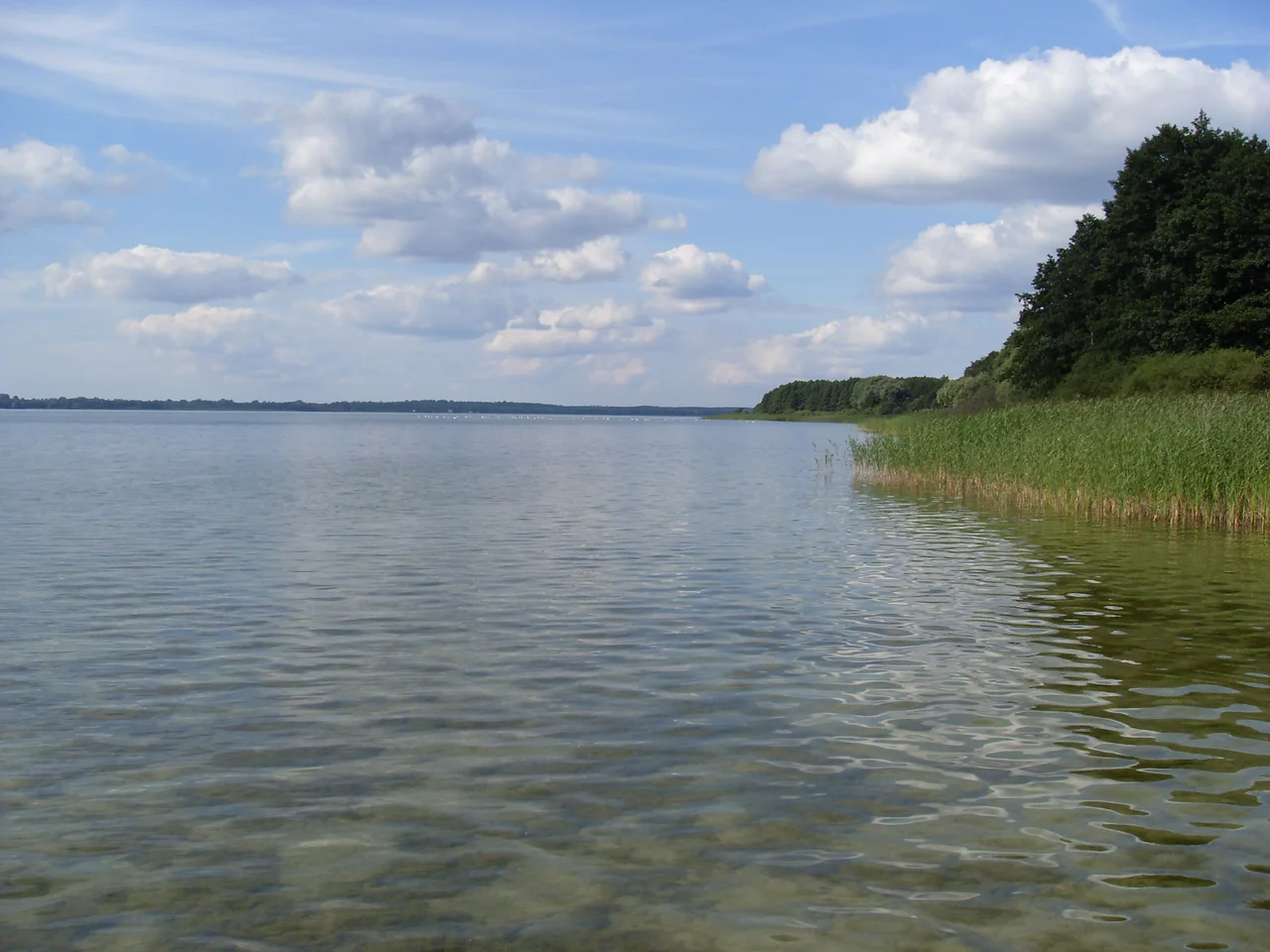
The article's point sits in the middle of the battlefield at 53.20 degrees north, 15.02 degrees east, in West Pomeranian Voivodeship. Best viewed at 3,000-6,000 ft AGL, high enough to hold the whole corridor in one view. The geography is legible from the air: Stargard on the Ina river at 53.34 north, 15.05 east marks the jumping-off point; Choszczno, the Arnswalde the Germans were trying to reach, lies about 27 km east; Pyrzyce sits some 10 km south-west; and the long dark sheet of Lake Miedwie - German Lake Madu, and one of the largest lakes in Poland - fills the western edge of the picture. Kostrzyn nad Odra, the Kustrin the offensive never came close to relieving, is roughly 70 km south-west on the Oder at the Polish-German border. Nearest airports: Szczecin-Dabie (EPSD), a grass aeroclub field about 35 km west-north-west, Szczecin-Goleniow Solidarnosc (EPSC) about 45 km north-north-west, and Berlin Brandenburg (EDDB) about 140 km south-west. Winter here delivers exactly what it delivered in 1945: low cloud, slush and short days.
Nearby Stories
- Lituanica 9.4 km away
- Oderbruch 26 km away
- Kingdom of Prussia 34 km away
- Historical Technical Museum, Peenemünde 89 km away
- Lubiaz Abbey 196 km away
- Battle of Leuthen 241 km away
- Stutthof Concentration Camp 261 km away
- Lilleø 278 km away