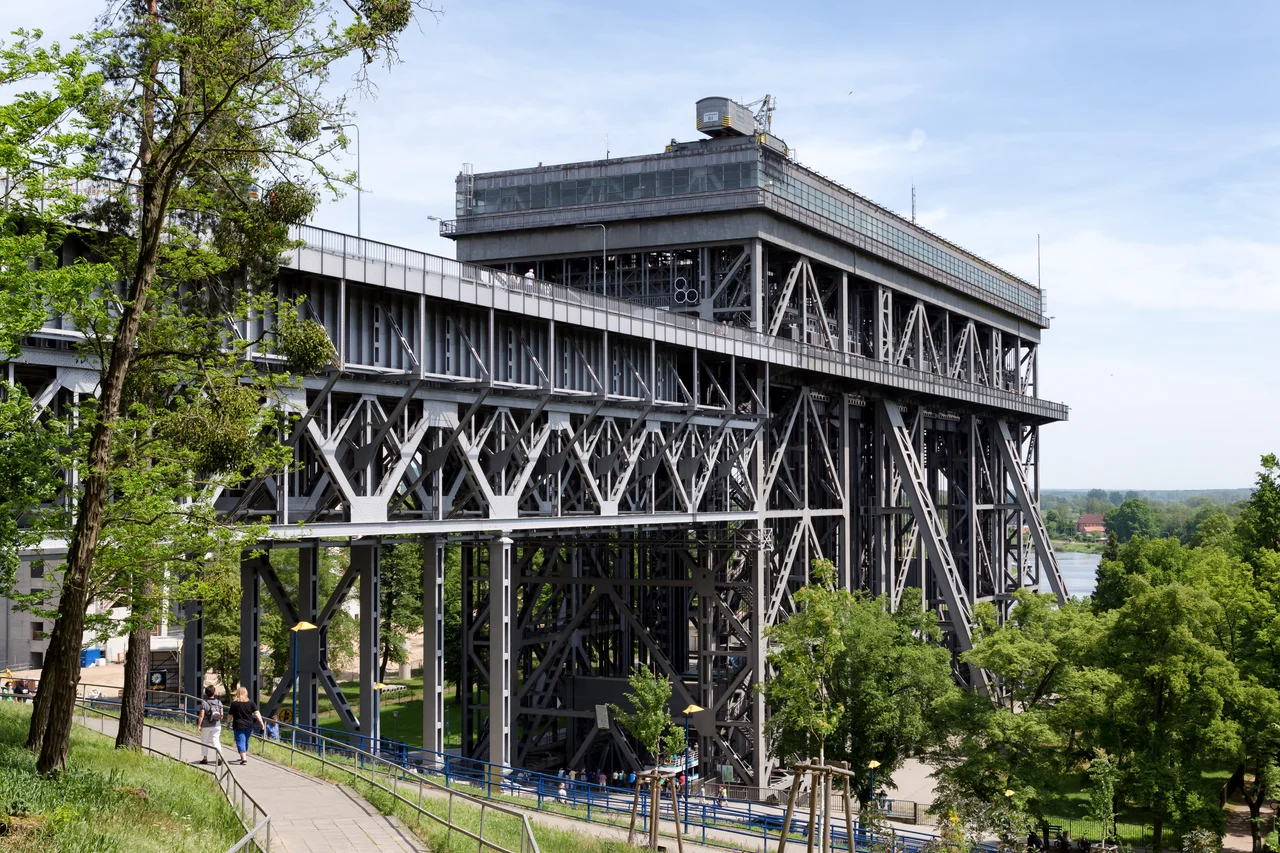

Niederfinow Boat Lift
In September 1930, Popular Science ran a headline that read like a stunt: 'Canal Ship Raised 118 Feet In Five Minutes.' The machine then under construction near the Brandenburg village of Niederfinow was exactly that literal. A loaded barge steers into a steel trough. Gates close at both ends. The trough — water, boat and all — rises bodily 36 metres up the side of a hill and sets the vessel down in the canal at the top. Five minutes, start to finish. The lock staircase it replaced took nearly two hours. More than ninety years later the thing is still doing it, which makes Niederfinow the oldest working boat lift in Germany.
Four Chambers Weren't Enough
The problem was a hill. When the big navigation canal between Berlin and Stettin opened on 17 June 1914, the ground near Niederfinow dropped 36 metres away toward the Oder valley, and the engineers dealt with it the traditional way — a staircase of four lock chambers, filled and drained in sequence. Fragments of them are still findable in the woods.
Traffic outran the staircase almost at once. Work on a replacement began in 1927 and ran seven years, and the boat lift was inaugurated on 21 March 1934: 60 metres high, 94 metres long, a lattice of riveted steel standing in flat farmland and visible for kilometres in every direction. By 26 January 1939, fewer than five years into service, its hundred-thousandth boat had passed through. In the inaugural year alone it moved 2,832,000 tonnes of cargo.
Balanced, Not Lifted
The trick is that the lift barely lifts anything. Its 85-metre trough weighs about 4,300 tonnes with the water in it, and it hangs from 256 steel cables that run up over sheaves at the top of the frame and down again to counterweights on the far side. Because a floating barge displaces exactly its own weight in water, the trough weighs the same whether it is carrying a fully loaded ship or nothing at all — so the counterweights can be matched to it permanently. The motors are not hauling 4,300 tonnes up a hillside. They are nudging a balanced system gently out of equilibrium and then governing the ride.
Redundancy is built into the geometry. Half the cables carry the load while the other half hang slack in reserve, ready to take up the weight. The lift was given a general overhaul in 1980, and its cables were renewed in 1984 and 1985.
Too Small for Modern Barges
For most of a century the lift was adequate, and then the boats grew. Modern barge trains are longer than the trough will take, so they arrive at Niederfinow, uncouple, and go up in pieces. Around 11,000 vessels a year pass through, close to the structure's practical ceiling, and in 1997 the decision was taken to build something bigger.
Meanwhile the old lift had acquired a second career entirely. About 500,000 people a year come to Niederfinow to watch it work — from the viewing gallery on the upper canal, from the banks below, and from excursion boats that ride up inside the trough themselves. Riveted 1930s steel doing something that looks impossible turns out to be a dependable attraction.
The New One Next Door
It took a quarter of a century from decision to ribbon. The replacement, built by Bilfinger in partnership with Johann Bunte, was finished in October 2022 and opened to traffic on the 4th, with regular service beginning the following day. The structure stands 55 metres high, 46 metres wide and 133 metres long, immediately alongside its ancestor.
The numbers belong to a different era. The new trough is 125.5 metres long and 15 metres wide, with usable inner dimensions of 115 by 12.5 metres and four metres of water depth — enough for vessels up to 110 metres without breaking them up first. Empty it weighs 2,785 tonnes; filled, around 9,800. The final bill came to €520 million, close to twice the original estimate.
The 1934 lift has not been retired. It is scheduled to keep working alongside the new one until at least 2030, which leaves Niederfinow with two boat lifts side by side, ninety years apart, doing an identical job — one in riveted lattice steel, one in concrete.
From the Air
Coordinates 52.849°N, 13.941°E, on the Oder-Havel Canal at Niederfinow in the Barnim district, about 55 km northeast of central Berlin. This is one of the easiest visual finds in Brandenburg: the canal runs dead straight across flat farmland and then simply stops at the edge of a 36-metre escarpment, where two enormous structures stand side by side — the black riveted steel frame of the 1934 lift and the pale 55-metre bulk of its 2022 successor. Best viewing altitude is 1,500–3,000 ft AGL, low enough to see the height difference between upper and lower canal. Eberswalde-Finow (EDAV) lies about 15 km west along the same canal; Strausberg (EDAY) is roughly 30 km south and Berlin Brandenburg (EDDB) about 65 km southwest. Airspace here is largely uncontrolled beneath the Berlin TMA. Morning light from the east throws the old lift's lattice into sharp relief; winter fog settles readily in the Oder valley below the escarpment.
Nearby Stories
- Afrikanisches Viertel 1.5 km away
- Oranienburg 11 km away
- Hohenlychen Sanatorium 13 km away
- St. Mary's Church, Chojna 16 km away
- Battle of Cedynia 19 km away
- Gigafactory Berlin-Brandenburg 19 km away
- Wikipedia Monument 25 km away
- Templin 26 km away