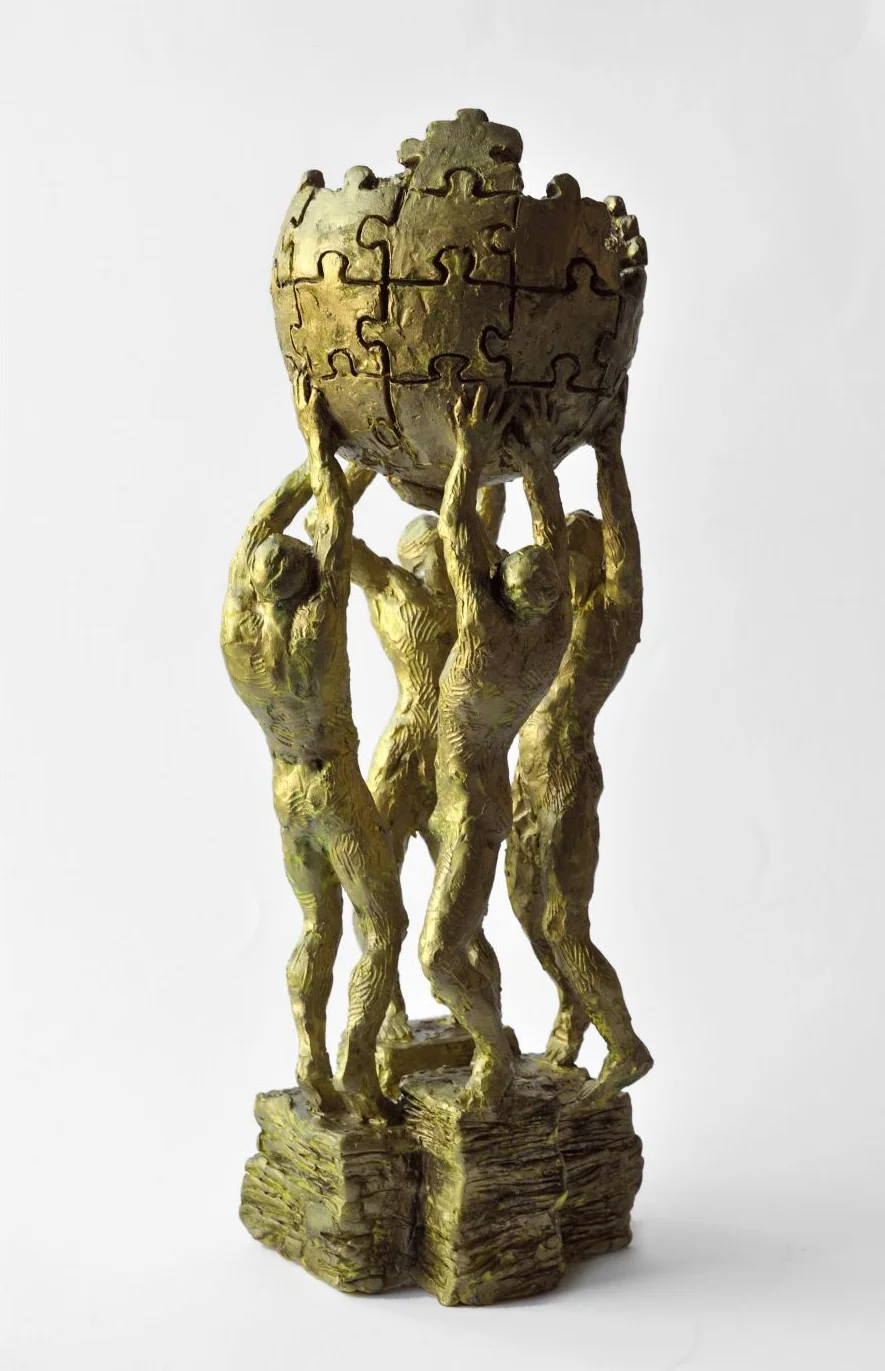

Wikipedia Monument
Monuments name people. That is very nearly their entire function: a general on a horse, a poet in bronze, a parish plaque listing the dead. The statue on Frankfurt Square in Słubice names nobody at all. Four figures, cast in fiberglass and standing over two metres tall, hold a globe of jigsaw pieces above their heads, and the inscription running along the base is addressed to thousands of anonymous editors around the world. Unveiled on 22 October 2014, it was the first monument anywhere to Wikipedia — and it is, on purpose, a monument to people whose names you will never learn.
The Globe with Pieces Missing
The sphere the four figures are lifting is the Wikipedia logo made solid: a puzzle globe with gaps still in it. That incompleteness is the whole argument of the piece. An encyclopedia that anyone can edit is never a finished object, only a thing currently being held up. The figures themselves are nude and undecorated, without period clothing or attributes to fix them to any nation or century, and the final version includes both men and women — the initial model had featured only male editors, and it did not survive to casting. The commission cost about 50,000 złotys, roughly $13,500 or €11,700 at the time, paid by Słubice's regional authorities. As municipal art budgets go, this is close to pocket change.
The Sculptor from the Local College
The design came from Mihran Hakobyan, an Armenian sculptor who knew the town from the inside: between 2010 and 2013 he studied Polish philology at the Collegium Polonicum in Słubice. So the world's first Wikipedia monument was made by a foreign student of a language he had come there to learn, for a town whose case for itself rests on the college he attended. It is difficult to think of a more fitting provenance for a statue about strangers building something in common.
Half a Town Becomes a Whole One
Słubice has an unusual biography. Until 1945 it was Dammvorstadt, the eastern suburb of the German city of Frankfurt (Oder) directly across the river. When the postwar border was drawn down the Oder, the suburb woke up in a different country and became a Polish town in its own right, with 685 inhabitants at the end of that year. A border crossing to Frankfurt opened in 1972. The Collegium Polonicum, a joint Polish-German university institution, opened its doors in 1998. Deputy mayor Piotr Łuczyński said the memorial "will highlight the town's importance as an academic centre" — a place that spent centuries as somebody else's outskirts making its own claim, and choosing knowledge as the ground to make it on.
22 October 2014
The idea had been floating around since about 2010. When the unveiling finally came, representatives of the local Wikimedia chapters and of the Wikimedia Foundation stood in Frankfurt Square together, and Dariusz Jemielniak gave the opening address — a professor of management, a longtime Wikimedia activist, and that same year the author of Common Knowledge? An Ethnography of Wikipedia, a book written from years inside the community the statue honors. Polish Wikipedia had passed a million articles by then and was among the largest language editions in the world. None of the people who wrote those articles were named from the podium, which was the point.
Why a Statue at All
Stand in the square with the Oder a few hundred metres west and Germany on the far bank, and the sculpture makes a small, sincere case. The encyclopedia most of the planet consults daily is not a machine and not a company. It is an enormous number of unpaid strangers, most of whom will never meet, holding something up together and arguing about it constantly. Public art has always struggled with collective anonymous labor — you cannot put a crowd on a plinth. Hakobyan's answer was to put four people up there and refuse to say who they are. The globe above their hands still has holes in it. So does the work.
From the Air
The monument stands at 52.35°N, 14.56°E, on Plac Frankfurcki in Słubice, on the Polish east bank of the Oder. This is a low-altitude landmark — best appreciated at 1,000-2,000 ft AGL, or on foot. From the air the feature to fly is the twin-city pair: Frankfurt (Oder) on the German bank and Słubice on the Polish one, joined by the city bridge that carries the border crossing, with the Oder running dead straight north-south between them. Nearest airports: Berlin Brandenburg (EDDB) about 70 km west, Zielona Góra-Babimost (EPZG) about 85 km southeast. The terrain is flat river plain with no obstacles of note; river fog is common in the Oder valley on autumn mornings.
Nearby Stories
- Kostrzyn nad Odrą 6.2 km away
- Spreewald 6.5 km away
- Storkow Castle 10 km away
- Villa Wolf 12 km away
- Swiss International Air Lines Flight 850 21 km away
- Gorzów Wielkopolski 21 km away
- Stalag Luft III 50 km away
- Czocha Castle 141 km away