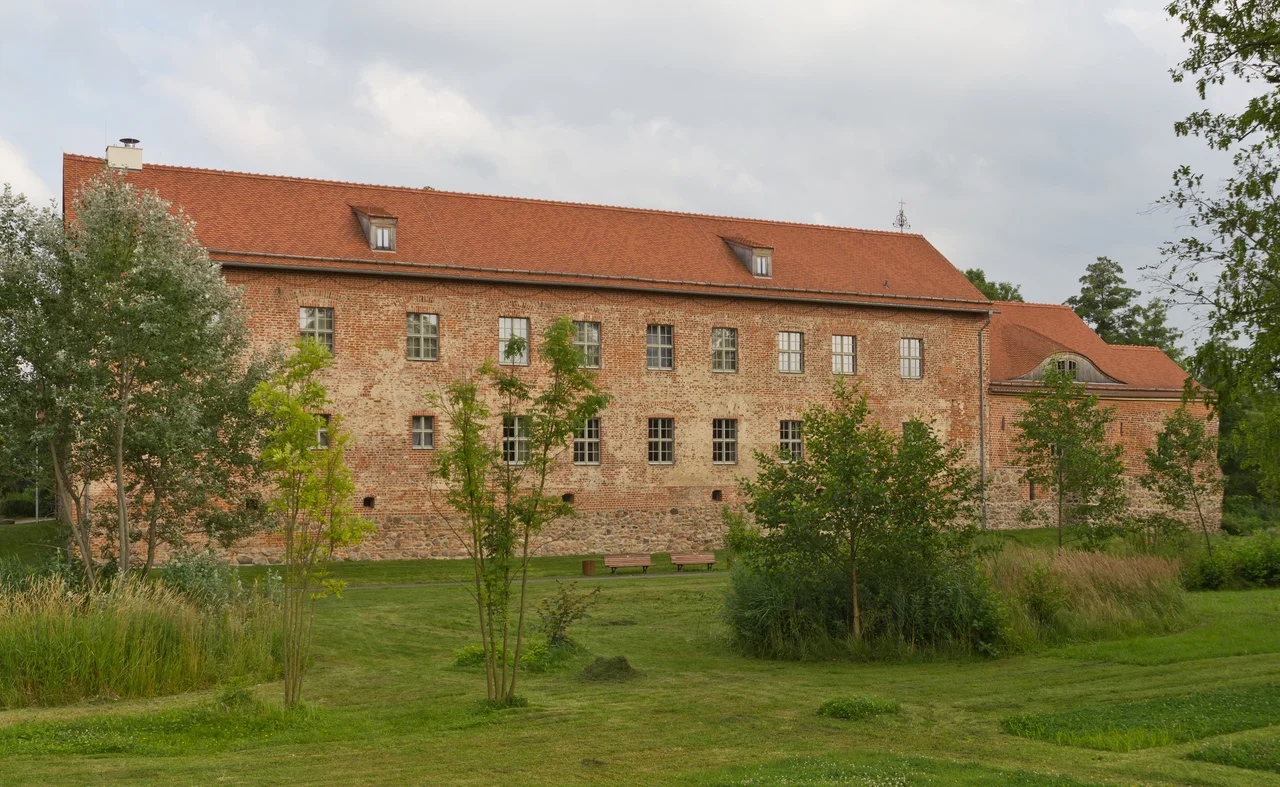

Storkow Castle
On 16 December 1978 the castle at Storkow caught fire for the second time in two centuries, and this time it took the town archive with it. A building that had stood on its patch of wet ground since the middle of the twelfth century managed, in a single night, to destroy the written memory of the place it had been put there to guard. Twenty-two years passed before anyone began rebuilding it, and nine more before the work was finished. The reopening was timed for Pentecost 2009, which was also the year Storkow celebrated eight hundred years since the first surviving document that mentions its castle at all.
Wet Ground, Good Ground
Storkow sits in a landscape of shallow lakes and sandy pine, and the castle was built to exploit exactly that. It went up around the middle of the twelfth century during the German settlement of the region, almost certainly on the site of an earlier Slavic marsh castle — a fortification that used standing water instead of stone as its outer defence. Its builder is likely to have been Margrave Conrad I of Meißen.
The first documentary sighting comes in 1209, when Storkow is recorded as being given to the monastery at Pforte. In the century that followed it served as a frontier work in a contested zone, which is the usual reason a castle in flat country is worth its maintenance. From roughly the middle of the thirteenth century the Saxon ministerial family of Strehla held the Beeskow-Storkow lordship and lived here; the lords of Bieberstein took over in the 1380s.
The Bishop Who Had Seen Italy
On 15 June 1518 Ulrich of Bieberstein enfeoffed the castle to Dietrich of Bülow, Bishop of Lebus, and Storkow abruptly changed character. Bülow had studied at Bologna and come home with strong opinions about what a building should look like. He expanded the fortress into an episcopal residence on three floors — administrative rooms at ground level, noble chambers above them, a great hall on top — and kept the moat, adding outbuildings around it.
It was a bishop's house for less than four decades. In 1555 John VIII of Horneburg, the last Roman Catholic bishop of Lebus, died within these walls on 16 June, a few years into the Reformation's reordering of the region and after only four years in office. The lordship passed in 1556 to Margrave John of Brandenburg-Küstrin, and after his death the castle and estate ended up, permanently, with the electors of Brandenburg.
What Happened in the Tower in 1538
Between the bishop's arrival and the bishop's death, the castle was used for something it is less comfortable to describe. Hans Kohlhase was a Cölln merchant whose horses had been seized in 1532 by servants of a Saxon nobleman on the road to the Leipzig fair. Denied redress in any court he could reach, he declared a private feud and spent years raiding across Saxony; he was broken on the wheel in Berlin in 1540, and Heinrich von Kleist would later build the novella Michael Kohlhaas loosely on his life.
Stefan Meiße was Kohlhase's friend and comrade-in-arms. In 1538 he was tortured to death in the medieval tower at Storkow. Nothing in the record suggests he was anything other than a man on the losing side of a quarrel between a merchant and a state, and the tower is still standing.
Fire, and Then Fire
The Thirty Years' War found Storkow in 1627 and left it badly damaged. It was patched back together as a modest Renaissance residence, which lasted until 1775, when fire destroyed the upper storey and effectively ended its career as anyone's palace. For well over a century afterwards it was a ruin with a view.
Then in 1910 the architect Johann Emil Schaudt bought the site for 25,000 marks. Three years earlier he had completed the Kaufhaus des Westens in Berlin, the department store Germans still shorten to KaDeWe; here he did something quite different, remodelling the ruin in a romantic, historicising Romanesque manner — a castle rebuilt to look the way the early twentieth century thought castles ought to look.
Uses a Castle Cannot Choose
From 1934 to 1945 the National Socialist state took the building over as a Jugendburg, a Hitler Youth training castle, which is what happened to a good many picturesque German ruins in those years: the past was useful, and boys were brought to it to be shaped. From 1945 until the 1978 fire, far less dramatically, it housed municipal offices.
The rebuilding between 2000 and 2009 was paid for with state and European Union money, and the result is neither a restoration nor a replica but a working building with a medieval core. Since May 2009 it has held the visitor information centre for the Dahme-Heideseen Nature Park, and its permanent exhibition, "People and Nature — a Journey Through Time," is about the lakes and woods outside rather than the castle itself. After eight centuries of being fought over, garrisoned, requisitioned and burned, Storkow's castle now spends its days explaining the water it was built on.
From the Air
Storkow Castle stands at 52.2528 N, 13.9333 E, in the small town of Storkow in the Oder-Spree district of Brandenburg, roughly 50 km southeast of central Berlin. The navigation cue here is water, not stone: Storkow sits at the neck between the Storkower See and the Groß Schauener lake chain, in the middle of the Dahme-Heideseen nature park, where a hundred small lakes are set into unbroken pine forest and the whole landscape reads from the air as dark green stitched with silver. The castle itself is a compact rectangular complex with a squat tower and pale rendered walls at the edge of the old town — small, so plan a slow pass at 1,000–2,000 ft AGL rather than a cruise-altitude look. Berlin Brandenburg (EDDB) is about 32 km northwest and its airspace dominates the approach from Berlin; Schönhagen (EDAZ), roughly 53 km west, is the friendlier general-aviation base. Morning light on still water gives the sharpest lake outlines; summer haze over the Spreewald basin to the south can soften everything to a uniform grey-green, in which case follow the Storkower Kanal and the rail line in from Fürstenwalde.
Nearby Stories
- Schloss Tegel 6.9 km away
- Battle of Großbeeren 7.3 km away
- Frankfurt (Oder) 11 km away
- Spreewald 11 km away
- Swiss International Air Lines Flight 850 11 km away
- Kostrzyn nad Odrą 17 km away
- Villa Wolf 23 km away
- Lichtenburg Concentration Camp 50 km away