.jpg)
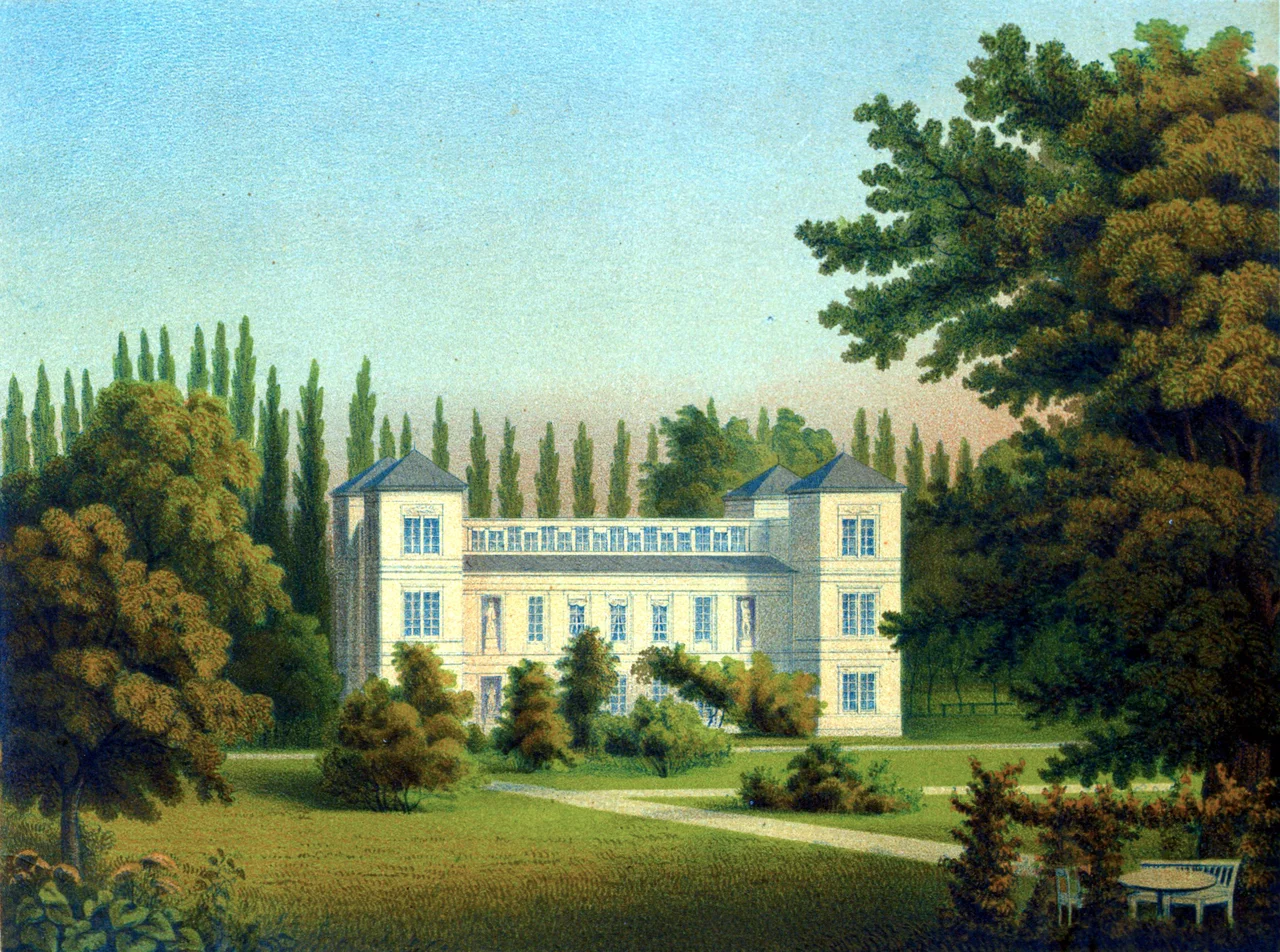
Schloss Tegel
The oldest thing on the estate is a tree, and the Humboldts named it after their cook. Dicke Marie - Fat Marie - stands near the shore of the Tegeler See at the western edge of the park, an oak sometimes credited with eight hundred years. The house it belongs to has been three different buildings. It went up as a Renaissance manor in 1558, was converted into a hunting lodge for a Brandenburg elector, and then in the 1820s was taken apart and put back together by Karl Friedrich Schinkel for a man who had spent his childhood summers in the earlier version. Two centuries after that rebuilding, the same family still owns it, still lives in it, and is still burying its dead in the garden.
Dicke Marie
The park came before the present house. Gottlob Johann Christian Kunth laid it out between 1777 and 1789, which tells you something about how this household worked: Kunth was the Humboldt boys' tutor, and the man who taught the children also designed the grounds they grew up in. From 1802 Wilhelm von Humboldt kept developing it, working to designs by Peter Joseph Lenné, the landscape architect who shaped most of the Prussian court's gardens. The park runs almost the whole way down to the Tegeler See, and the oak stands near the water at the western end. Since 1983 the grounds have carried monument protection in their own right, which in German law puts the trees on roughly the same footing as the walls.
Two Brothers, One Estate
Around 1645 Frederick William, the Great Elector of Brandenburg, turned the Renaissance manor into a hunting lodge. The Tegel estate reached the Humboldt family in 1766, by marriage, when Marie-Elisabeth von Holwede married Alexander Georg von Humboldt. Their sons grew up between here and the city. Wilhelm became a linguist, a diplomat, and the founder of the university in Berlin that now carries the family name; Alexander became the naturalist who spent five years measuring the Americas and came back with a way of seeing the world as a connected system. After their mother's death Wilhelm took over the estate in 1797. It stayed his for the rest of his life, and it is where he died in 1835.
Schinkel's Commission
Between 1820 and 1824 Wilhelm had the old house rebuilt in the classical style to Schinkel's designs - not demolished and replaced, but reworked, with the earlier structure still inside the new one. It is a small building by the standards of Prussian country houses, and that is the point; Schinkel was working for a scholar, not a court. The house then passed down the female line. Wilhelm's daughter Gabriele inherited it and married Heinrich von Bülow, the Prussian foreign minister; after her death it went to their daughter Constanze von Heinz, and the Heinz descendants hold it still. In the 1960s the Deutsche Bundespost put the building on a postage stamp in a series on twelve centuries of German architecture, which is roughly the level of national familiarity it had reached.
The Column and the Bench
Caroline von Humboldt died in 1829, and she had chosen where she wanted to lie. The monument in the park is a tall granite column carrying a figure of Spes, the Roman goddess of hope, by the Danish sculptor Bertel Thorvaldsen - a work Caroline had admired, which Wilhelm bought after her death. Schinkel framed it from behind with a stone exedra, a curved bench, plainer than his usual manner. Wilhelm was buried beside her in 1835. Alexander joined them in 1859. Their children and their descendants lie under uniform unornamented stones and rows of flat grave mounds, in unbroken sequence down to the present day. It is not a monument to the Humboldts so much as a family cemetery that happens to contain two of them.
Still a Private House
Theodor Fontane walked through here for his Wanderungen durch die Mark Brandenburg and gave the schloss a chapter, which fixed it in the German imagination as a place you visit on foot, from the lake side, in the afternoon. That is more or less still how it works. The Humboldt-Museum inside is private, opening for guided tours in the summer months, and the rest of the year the house does what it has done since 1766: it is where a family lives. Very few Berlin monuments are like this. The Schinkel buildings that survive in the city are museums, churches, or ministries. This one has a doorbell.
From the Air
Schloss Tegel stands at 52.595°N, 13.276°E in Berlin's Reinickendorf district, on rising ground east of the Tegeler See and roughly 10 km northwest of the city centre. The lake is the navigation feature: a broad north-south basin of the Havel with the Tegeler Forst on its western shore. The decommissioned Tegel airfield (formerly EDDT, closed 2020) lies about 5 km south, its parallel runways and hexagonal terminal still intact and easy to identify. Berlin Brandenburg (EDDB) is roughly 35 km southeast. Recommended viewing altitude 1,500-2,500 ft; the house shows as a pale block in mature parkland between the lake and the built-up district, most legible with leaves off the trees. Berlin control zone restrictions apply.
Nearby Stories
- Swiss International Air Lines Flight 850 4.3 km away
- Einstein Tower 8.2 km away
- Schloss Meseberg 8.9 km away
- Friesack Camp 11 km away
- Storkow Castle 21 km away
- Kingdom of Prussia 22 km away
- Battle of Wittstock 30 km away
- Stork Farm Loburg 49 km away