.jpg)
Schloss Meseberg
In 1774 Prince Henry of Prussia had a problem at Rheinsberg Palace, where he kept court some twenty kilometres to the northwest. His brother, King Frederick II, had ordered him to remove a certain Christian Ludwig von Kaphengst from that court — and Heinrich, rather than send his lover away empty-handed, bought him a Baroque palace on a lake. Kaphengst moved into Meseberg in 1775 and set about furnishing it far beyond his means, commissioning ceiling frescoes from the painter Bernhard Rode. One of them shows Prince Henry ascending into heaven. Two and a half centuries later, the same rooms are where German chancellors take heads of state to dinner.
Built Twice, Given Away Once
The Wartensleben family put up the present palace in 1739, replacing an earlier building on the site that had burned down. It is a stucco block with Ionic half-columns and a high mansard roof — modest by the standards of Prussian royal architecture, generous by the standards of a country estate in the sandy Oberhavel. The property passed to the von der Gröben family in the second half of the century, and then, in 1774, to Prince Henry, who bought it along with adjoining land and three neighbouring estates.
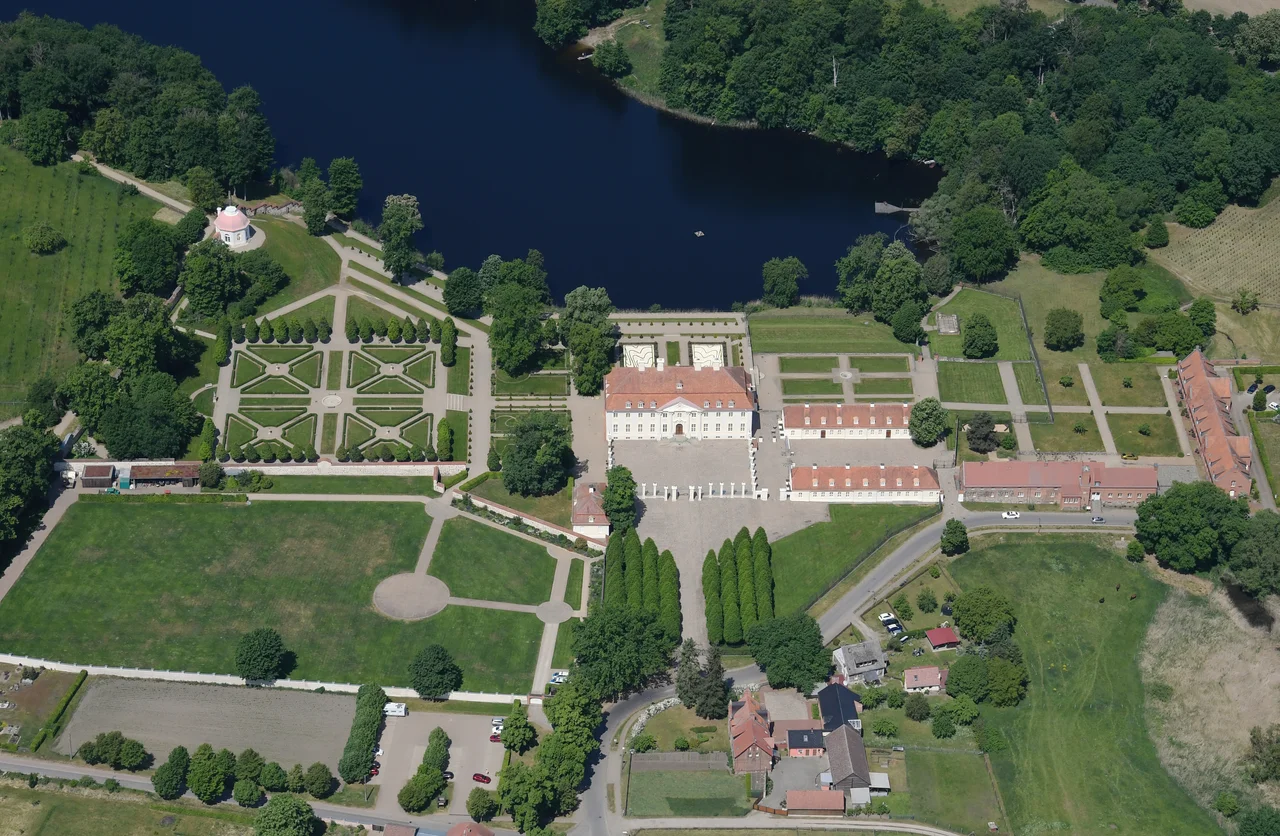
Kaphengst was not a careful custodian, but he was an enthusiastic one. He decorated lavishly, extended the estate with new buildings including the stables, and left behind Rode's ceilings. The Baroque garden grew under him and his successors. Later still, Peter Joseph Lenné — the landscape architect who shaped Sanssouci and half the parks of Berlin — laid out an English garden running along most of the Huwenowsee shore, so that the formal terraces dissolve into what looks like accidental countryside.
Newspaper, Reichsmarschall, Grocery Store
The estate was later bought by the Lessing family, proprietors of the Vossische Zeitung, one of Berlin's great liberal newspapers. Under the Nazis it was taken from them by force and became Hermann Göring's. In 1945 the Soviet occupation took it in turn.
What happened next is the reason the building still exists. East Germany had little use for a Baroque palace and less money to maintain one, but instead of demolishing Meseberg it filled it — a grocery store, school rooms, and the local agricultural cooperative's kitchen in the basement. Ordinary use is the best preservative there is. A plan to renovate the increasingly dilapidated house into a conference centre for the Academy of Sciences was drawn up and never carried out. By reunification the palace was in bad condition but standing.
Thirty Million Dollars, One Euro a Year
In 1995 the Messerschmitt Foundation, which exists to rescue historic buildings, bought the estate. Restoration took eleven years and more than thirty million dollars — stucco, columns, mansard roof, frescoes, gardens, the lot.
The foundation then leased the finished palace to the German federal government for a symbolic annual rent of one euro, on a twenty-year term running from 2007 to 2027. The government spent about seventeen million dollars of its own installing security and communications systems and filling the rooms with period furniture and paintings. Since 2007 Meseberg has served as the chancellor's retreat and the official guest house of the Federal Republic. The basement kitchen that once fed the collective farm is now the chancellor's wine bar, with seating for thirty.
Eight Days a Year
For a building with that pedigree, Meseberg is used surprisingly little. Between 2015 and 2018 it averaged eight days of use a year, two of which were public: an open house and a Christmas tree lighting.
The guest list on the other days is another matter. Dmitry Medvedev came in 2010, Wen Jiabao that autumn, David and Samantha Cameron in 2013, Shinzō and Akie Abe in 2016, Narendra Modi in 2017. In June 2018 Angela Merkel and Emmanuel Macron used a Franco-German ministerial council here to commit publicly to reinvigorating European integration; two months later Vladimir Putin arrived for a visit that was watched rather closely. Olaf Scholz held cabinet retreats here with Nordic and Spanish counterparts, and the Emir of Qatar came in 2024. Since taking office in 2025, Chancellor Friedrich Merz has tended to prefer Villa Borsig instead.
Which leaves Meseberg where it has usually been: a beautiful house on a quiet lake, waiting for someone important to want it.
From the Air
Schloss Meseberg sits at 52.97°N, 13.10°E in Oberhavel, about 75 km north-northwest of central Berlin and a few kilometres southeast of the small town of Gransee. From the air the palace is easy to identify: a compact rectangular block with a steep mansard roof, formal terraces stepping down toward the Huwenowsee, and Lenné's English garden wrapping most of the lake shore in a band of mature trees distinct from the surrounding pine plantation and arable fields. The village of Meseberg is tiny; the palace is the only substantial structure. Note that this is a working federal guest house — temporary flight restrictions can be issued around state visits, so check NOTAMs before routing overhead, and avoid loitering. Best viewing at 2,000–3,000 ft AGL. Nearest fields: EDAV (Eberswalde-Finow) roughly 40 km southeast, EDAX (Rechlin-Lärz / Müritz Airpark) about 45 km northwest, EDDB (Berlin Brandenburg) around 75 km south. Autumn colour on the Lenné plantings is the best time to see the garden's structure from above.
Nearby Stories
- Friesack Camp 5.8 km away
- Battle of Prenzlau 12 km away
- Swiss International Air Lines Flight 850 12 km away
- Das Buddhistische Haus 14 km away
- Neustrelitz Palace 14 km away
- Eberswalde Hoard 17 km away
- Battle of Wittstock 22 km away
- Ludwigslust Palace 78 km away