.jpg)
Neustrelitz Palace
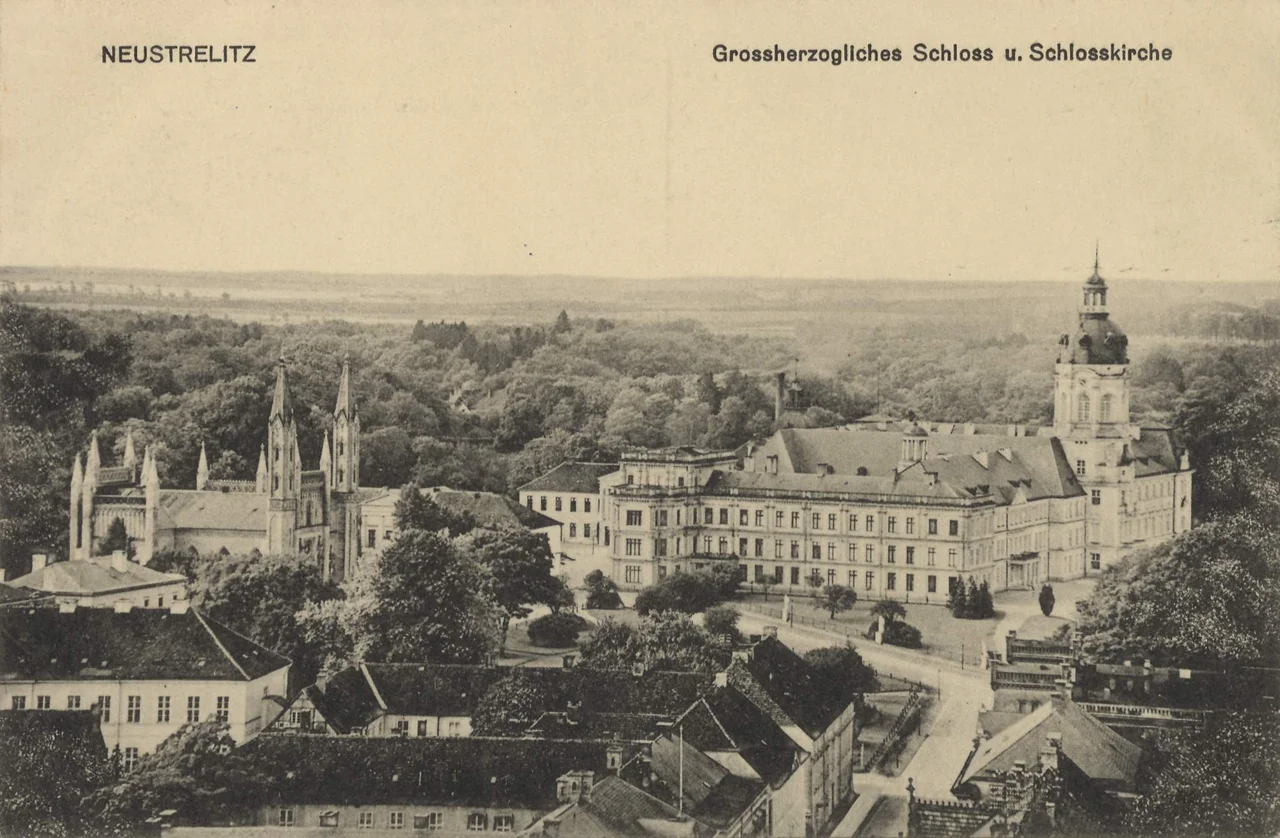
Neustrelitz is arranged around something that is not there. Streets radiate from the market square in a pattern set out in the 1730s, and they were set out that way because a duke's palace stood at the head of the axis on rising ground above the Zierker See. The palace burned in the last days of the Second World War. What the fire left standing, the new East German authorities pulled down four years later. The streets still point at it. The park is still there too, its terraces and temples and orangery composed for a building that vanished, which makes this one of the odder town plans in Germany: a capital city arranged around an absence.
The Fire That Made It
The whole thing started with a different fire. On the night of 24 October 1712 the ducal residence at Strelitz burned down, and the family of Mecklenburg-Strelitz found itself living in hunting lodges for years. One of those lodges was a half-timbered house that Duke Adolf Friedrich III had put up on the Glienecke estate by the Zierker See around 1709. Between 1726 and 1731 his wife, Duchess Dorothea Sophie of Schleswig-Holstein-Sonderburg-Ploen, commissioned the architect Christoph Julius Loewe to turn it into something a court could occupy: a three-storey baroque palace with three wings. The court moved in around 1733, a new town went up on the ground below it, and Neustrelitz became the capital of the duchy. Historians of the family credit Dorothea Sophie as the town's real founder.
A Small Duchy with a Long Reach
Mecklenburg-Strelitz was minor by any measure of territory or revenue, and it exported daughters. Charlotte, born at Mirow a few miles west on 19 May 1744, married George III on 8 September 1761 and was crowned queen at Westminster Abbey a fortnight later. Louise, another princess of this house, married the crown prince of Prussia and became the queen whose reputation survived the Napoleonic catastrophe better than her husband's did. The Luisentempel, a small Greek temple raised in the palace park in 1891, keeps her memory in the landscape she came from. It is a peculiar sort of eminence for a duchy whose capital amounted to a market square and a fan of streets laid out in the sand.
The Tower
The palace kept growing. Its last major addition came between 1905 and 1909, when the architect Albert Geyer added a tower fifty-one metres high, modelled on the one at Charlottenburg in Berlin, giving the long low baroque block a vertical it had never had. Nine years later the German monarchies ended. The palace passed to the new Free State of Mecklenburg-Strelitz and served as its parliament building and museum, which is roughly the fate of a hundred German residences after 1918 - the furniture stayed, the dynasty did not, and the public was let in through the front door.
One Night in April
On the night of 29 to 30 April 1945 the palace caught fire and burned out. The cause has never been settled; accounts blame arson or fire from German aircraft, and by that week in Mecklenburg either is plausible. Parts of the structure could have been restored. In 1949 the ruins were demolished instead, and the clearance was finished the following year, on the reasoning that the new state had no use for the traces of a junker class it intended to abolish. Only the foundations and the cellar were left, buried under sand and then under grass, and for the next forty years the head of the town's main axis was an empty green terrace.
The Park and the Cellar
What survived is the setting. The Schlosspark, begun in 1731 and 1732, still runs its baroque central axis down toward the Zierker See, with the Hebetempel and the Luisentempel among the trees, an eighteenth-century orangery, a neo-Gothic palace church built between 1855 and 1859, and a population of stone gods and goddesses, some of them by the Berlin sculptor Albert Wolff. After ten years of restoration the gardens reopened to the public in the summer of 2019. That December the state of Mecklenburg-Vorpommern and the town agreed to dig the sand out of the surviving cellar, cast a concrete deck over it, and begin planning the reconstruction of the tower, with three million euros from the state and one million from the town. No opening date has been set. For now the cellar is the palace, and the streets go on pointing.
From the Air
The palace site sits at 53.359 N, 13.058 E on the northeastern edge of Neustrelitz, in the Mecklenburg Lake District. From 2,500-4,000 ft AGL the town's radial plan is the standout feature - a compact grid of streets fanning out from a central square, unusual enough in northern Germany to serve as a positive fix - with the Zierker See immediately west and the empty palace terrace and its formal park at the head of the axis. Neustrelitz also marks the gap between the two halves of Muritz National Park, dark forest to the west and the Serrahn beech woods to the east. Rechlin-Larz (EDAX) lies about 20 km west, Neubrandenburg (EDBN) about 30 km northeast, and Berlin Brandenburg (EDDB) about 110 km south. Flat lake country with limited relief; morning fog off the Zierker See is common in autumn.
Nearby Stories
- Forest Swastika 5.9 km away
- Schloss Meseberg 14 km away
- Kingdom of Prussia 22 km away
- Battle of Wittstock 24 km away
- Friesack Camp 40 km away
- Historical Technical Museum, Peenemünde 58 km away
- Lilleø 163 km away
- Copenhagen City Hall 233 km away