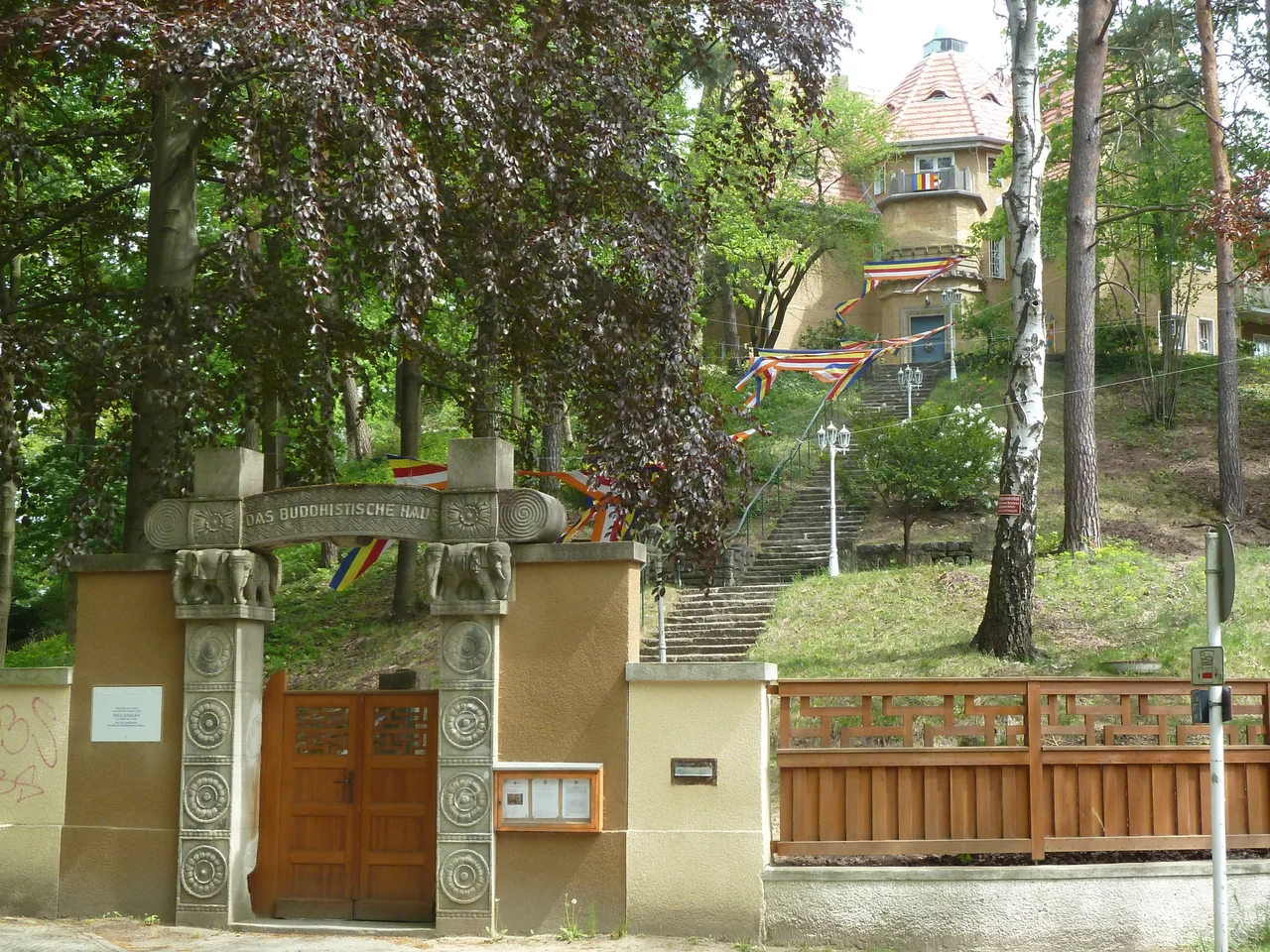

Das Buddhistische Haus
Frohnau is the top of Berlin, a quiet garden suburb of pines and villas that runs up against the Brandenburg border and then stops. Nothing much is supposed to happen there. Then the road bends, and there is a gate flanked by elephants in the Sinhalese manner, and behind it a long flight of steps climbing through the trees toward a white building with a roofline that belongs several thousand kilometres away. Das Buddhistische Haus has stood on this hillside since 1924, which makes it the oldest Theravada Buddhist centre in Europe and, by most measures, the largest. A Berlin physician built it after travelling in Asia. Three decades later, when it was half-ruined and being discussed for demolition, it was rescued by a man in Colombo who had simply heard it existed.
The Doctor Who Went East
Paul Dahlke was a physician with a practice in Berlin, and he was also, from 1900, a Buddhist - a conversion that followed his travels in Asia and several journeys to Ceylon (now Sri Lanka) before the First World War. He learned Pali and translated its texts into German, which at the time was work with almost no audience. What he wanted in the end was not a study group but a place: somewhere the teaching could be lived in rather than debated. In 1923 he began building one on roughly 36,500 square metres of pine woodland at the northern edge of the city. By August 1924 the house was finished enough to move into. A temple building followed in 1926.
Steps Through the Pines
The architect was Max Meyer, and the brief was unusual for Berlin in the 1920s: a German building that reads as Sri Lankan. Elements of Sinhalese Buddhist architecture run through the whole compound - the elephant gate at the road, the long ascending stair, a reflecting pond, the roof profiles. The climb is deliberate. You do not arrive at this house, you approach it. Dahlke's own motto is set into the fabric of the place and says what he thought a religious house should be: what we are doing, anybody shall be able to see; what we are saying, anybody shall be able to hear; what we are thinking, anybody shall be able to know. It is not a mystical statement. It is a standard of conduct, and it is posted where visitors read it on the way in.
The Years of Silence
Dahlke died in 1928, four years after moving in. The house passed to his relatives, and the Buddhists who had gathered around him met in a house nearby instead. By 1941 the Nazi government had prohibited Buddhist meetings and publications altogether, and the place went quiet. After the war it filled with refugees, who lived in the quarters because there was nowhere else in the city to put them. The building deteriorated under the weight of that, and by the mid-1950s demolition was being considered. What saved it was distance. Asoka Weeraratna, who had founded the German Dharmaduta Society in Sri Lanka in 1952 to carry Buddhist teaching to Europe, learned that the house was there and that it was about to be lost.
December 1957
Weeraratna bought the building from Dahlke's nephew in December 1957, on behalf of the Society's trustees. The result was something new: the first Buddhist mission on German soil run not by Germans but by Sinhalese monks from Sri Lanka. The house was renovated as a working temple complex, and Dharmaduta monks came from Colombo to live in it and to teach across Western Europe from it. There is a neat reversal in this that is easy to miss. A German doctor had gone to Ceylon to learn, and built a Sri Lankan house in Berlin to hold what he brought back. A generation later, Sri Lankans arrived to keep it standing and to teach in it themselves.
What Frohnau Keeps
The compound is now a listed national heritage site, its gardens separately protected as a garden monument, which in German practice means the trees and the stairway are as legally untouchable as the walls. The temple is open to the public - about 5,000 people came through in 2006 - and since 2000 it has been managed by Tissa Weeraratna, a nephew of the founder. It remains a functioning vihara rather than a museum: monks live here, services are held here, and the building does the work it was put up to do. The elephants at the gate have been watching the same suburban street for a century now, through a Nazi ban, a war, a partition, and the reunification of the city behind them.
From the Air
Das Buddhistische Haus sits at 52.636°N, 13.303°E on the Edelhofdamm in Frohnau, the northernmost locality of Berlin, directly against the Brandenburg state line. The surrounding terrain is flat sandy pine country dotted with lakes. The clearest navigation features are the Tegeler See about 7 km south-southwest and the wooded belt running north into Brandenburg. The decommissioned Tegel airfield (formerly EDDT, closed 2020) lies roughly 9 km south, its parallel runways and hexagonal terminal still visible from the air. Berlin Brandenburg (EDDB) is about 40 km south-southeast. Recommended viewing altitude 1,500-2,500 ft - the compound reads as a white roof in dense pine, best picked out in low winter sun. Berlin control zone restrictions apply.
Nearby Stories
- Swiss International Air Lines Flight 850 4.3 km away
- Einstein Tower 8.2 km away
- Schloss Meseberg 8.9 km away
- Friesack Camp 11 km away
- Storkow Castle 21 km away
- Kingdom of Prussia 22 km away
- Battle of Wittstock 30 km away
- Stork Farm Loburg 49 km away