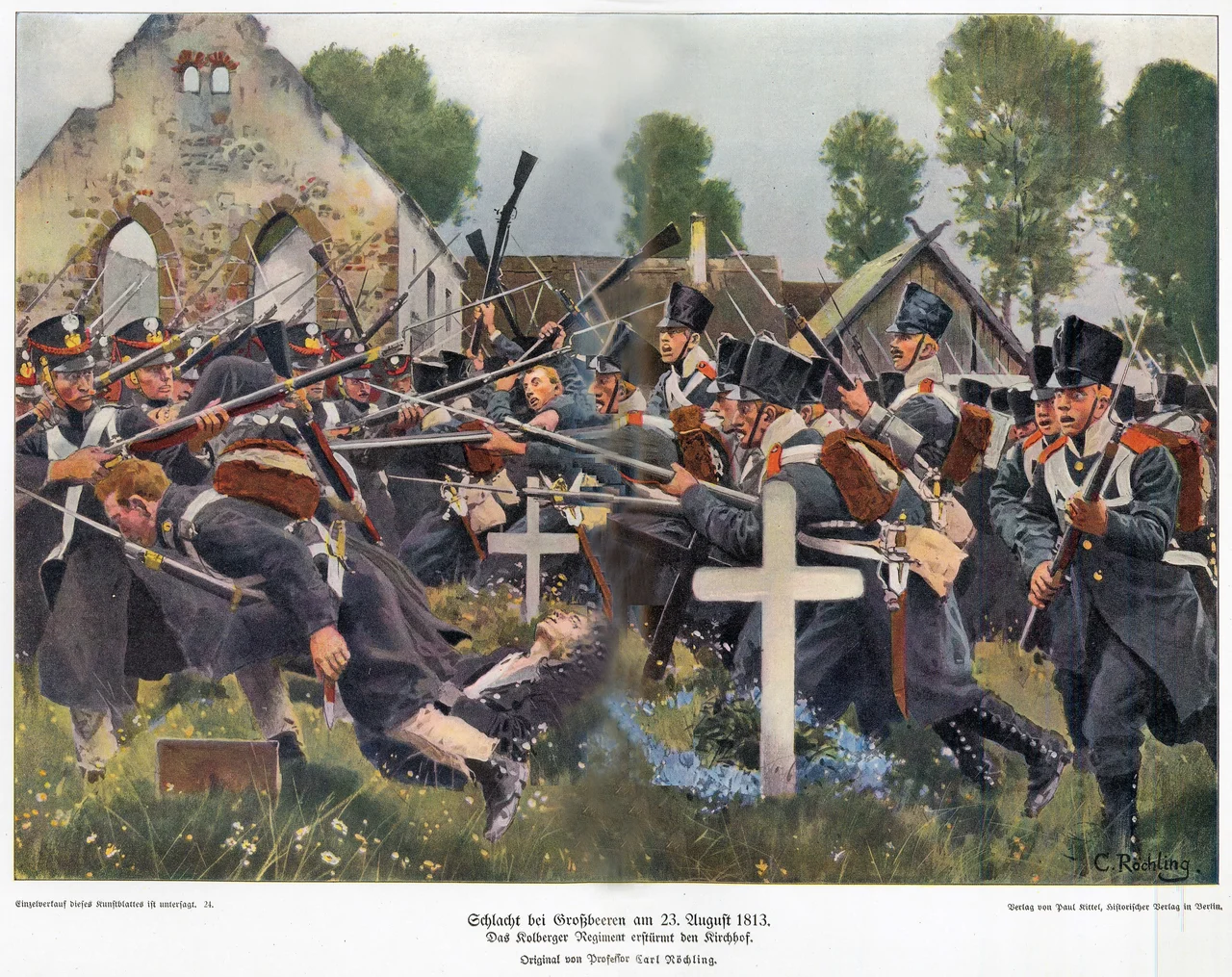

Battle of Großbeeren
It rained so hard on 23 August 1813 that the guns stopped working. Flintlocks need dry powder and a dry pan, and by the afternoon neither side south of Berlin had either, which turned a Napoleonic battle into something closer to a brawl. One East Prussian reserve regiment had never been trained with the bayonet, so its men swung their muskets by the barrel and used the butts, shouting as they came on. They were nicknamed the Hacketäuer for it, and streets in the Rhineland still carry the name. Napoleon had sent 70,000 men to take the Prussian capital. What stopped them was a marsh, a downpour, and a general who refused an order to retreat.
The Emperor Wants Berlin
After the Battle of Bautzen in May 1813, both sides in the War of the Sixth Coalition agreed to a seven-week truce to rebuild. When fighting resumed in August, Napoleon kept his main army in the south, watching the large Austrian force gathering in southeastern Germany, and detached a separate offensive to take Berlin. Capturing the capital, he calculated, would knock Prussia out of the war. He gave the task to Marshal Nicolas Oudinot, one of his bravest commanders, who tried to turn it down. Oudinot had been wounded repeatedly during the catastrophic Russian campaign the year before and had not recovered. The emperor insisted. Oudinot marched north with three corps and about 70,000 men, expecting no serious opposition, and without enough cavalry to find out whether he was right.
A Plan to Avoid Napoleon
The Allies had already decided how to beat him, and the method was almost insultingly simple. The Trachenberg Plan, drawn up during the truce and shaped largely by Bernadotte - the former French marshal now Crown Prince Charles John of Sweden - held that no Allied army should engage Napoleon in person until the coalition had overwhelming strength. His marshals, operating separately, were another matter. Bernadotte's own instinct was that Berlin could not be held: there are no natural barriers south of the city, and a defeat would cut his line of retreat to Swedish Pomerania. Prussian insistence changed his mind. They would defend Berlin alone if they had to, and so he stayed, positioning his corps to hold the few north-south roads long enough for the rest of the Army of the North to arrive across the many east-west ones.
Roads Turned to Soup
The French advance began on 19 August, and the storms broke the same day. Roads dissolved. Artillery could barely be moved. The country south of Berlin was already laced with small lakes and swamps, offering only a couple of usable approaches in good weather, and the rain converted the Prussian positions into fortified islands. Oudinot was forced to split his force along three separate roads with almost no communication between the columns. Bertrand's IV Corps, 13,000 men and 32 guns, took the right. Guilleminot's XII Corps of 20,000 held the left - mostly raw recruits, the young conscripts the army called the Marie-Louises. The centre column was Jean Reynier's VII Corps, 27,000 strong and largely Saxon. None of them knew where the enemy was.
Bones Before Berlin
Reynier's corps walked into the bulk of the Army of the North drawn up at Großbeeren. He attacked anyway, without orders and without support, and struck Friedrich von Bülow's corps, freshly reinforced by the Swedes to 38,000. Bülow had already refused an order to fall back to Berlin's customs wall, answering that his bones should bleach in front of Berlin rather than behind it. In the wet the muskets were useless on both sides and the fighting went to the bayonet, the butt and the gun crews still able to fire. Reynier was thrown back with heavy losses: 20 Saxon officers and 1,918 Saxon enlisted men, 1,138 Frenchmen, 14 guns and 52 loaded ammunition carts, with around 1,500 taken prisoner. Bülow's own losses came to roughly 1,100 killed, wounded and missing. Oudinot arrived too late in the day to change anything, just as the Saxons began to break.
The Pursuit That Never Came
Bülow and Tauentzien wanted to chase the wrecked French south and finish them, and complained to Blücher and to the King of Prussia when Charles John refused. His reasons were strategic rather than timid - moving away from Berlin risked isolating his army, left Davout's 35,000 men at Hamburg behind him, and drew him toward Napoleon's main body - but the Prussians never forgave it. Oudinot fell back to Jüterbog and then to Wittenberg, which enraged the emperor less for the defeat than for the direction: 'It is truly difficult to have fewer brains than the Duke of Reggio!' Ney took over the second attempt on Berlin, with the same battered corps, and lost at Dennewitz on 6 September. Twenty years later a fourteen-year-old boy named Theodor Fontane visited the battlefield and wrote a school essay about it - the first surviving work of a writer who became one of Germany's greatest. His mother had been a young woman in Berlin in 1813, and she nursed the wounded of both armies afterwards; her family were Huguenots who still spoke French at home, so she was able to speak to the dying Frenchmen in their own language.
From the Air
The battlefield lies at 52.35 N, 13.30 E, about 18 km south of central Berlin on flat, ditched farmland barely above the water table - the terrain that decided the battle is still exactly what you see from the air. From 2,000-3,500 ft the village of Großbeeren shows its church and the stone memorial tower dedicated on 23 August 1913, the battle's centenary, and Schinkel's cast-iron obelisk of 1817 stands at the former churchyard. The Teltowkanal runs north of the field, the A10 Berlin ring and the B101 cross the area, and Berlin's built edge is clearly visible to the north. Berlin Brandenburg (EDDB) is 14 km east and its controlled airspace covers much of this ground, so check before transiting; Schönhagen (EDAZ) lies about 19 km south-southwest. Annual re-enactments are held on the site. Best light is low sun, which brings out the drainage ditches and old field boundaries.
Nearby Stories
- Karlslust Dance Hall Fire 1.3 km away
- Swiss International Air Lines Flight 850 9.2 km away
- Gigafactory Berlin-Brandenburg 12 km away
- Brandenburg Euthanasia Centre 15 km away
- Wittenberg 18 km away
- Friesack Camp 20 km away
- Spreewald 23 km away
- Lutherhaus 41 km away