_Vergn%C3%BCgungslokal_Karlslust.jpg)
Karlslust Dance Hall Fire
In Berlin in February 1947, a winter coat was not something you could replace. Ration stamps did not cover one. Shops did not have them. The winter of 1946-47 was the coldest ever observed in Europe, and on the night of 8 February the thermometer in Spandau was reading twenty to twenty-five degrees below zero. So when fire took hold in the roof beams of the Karlslust dance hall at about a quarter to eleven, and the hall emptied into the snow, some of the people who had just got out went back inside for their coats. Three minutes after the first flames showed, the whole roof was burning. Around eighty people died there, most of them young, at what had been advertised as Berlin's first proper costume ball since the war.
The Coldest Winter Anyone Remembered
Berlin in early 1947 was a city living on paper. Food came against ration stamps, fuel was scarce enough that people burned furniture, and the four occupying powers each ran a sector of the ruins. Hakenfelde, on the eastern bank of the Havel in Spandau, lay in the British sector. The bridges over the river had been destroyed in the fighting two years earlier and had not been rebuilt, so getting anywhere from Hakenfelde meant going the long way round. That winter is remembered in Germany as the Hungerwinter, and it earned the name. What made a costume ball worth attending in those conditions is not hard to understand. It was the first one, and people went in the clothes they had.
The First Ball
The Karlslust had been the largest restaurant and dance hall in Spandau through the first half of the century - a two-storey building with a ballroom and a bowling alley, the kind of place a district organises its evenings around. In the last months of the war it had been pressed into service as a prison. Windows were barred. Doors were bricked up. Nobody had undone any of that by February 1947. Estimates of the crowd that night run from 750 to 800 and, in some accounts, as high as a thousand, most of them young, with a number of British Army staff among them. Because the building had no working heating, three potbelly stoves were set up inside to keep the hall warm enough to dance in.
Three Minutes
At around 22:45, with the party at its height, the wooden overhead beams caught fire - most likely, investigators concluded afterwards, from the heat of the stovepipes. Within three minutes the entire roof was alight. A side door had frozen shut. The barred windows and the walled-up doorways left over from the building's months as a prison did exactly what such things do to a crowd trying to get out. Many people made it into the snow, and several of them turned round and went back for the cloakroom. Then the roof came down on everyone still inside. Julius Loebel, who ran the place, was killed trying to save the cashbox. British soldiers went into the wreckage after survivors; three of them died, or six, depending on which account you follow.
Forty Minutes
Berlin Fire Brigade crews and British Army personnel began arriving roughly ten minutes after the alarm went up. The bulk of the German firefighters took forty. There was no single emergency number in the city - each station had to be telephoned in turn. The engines were poor and needed time to warm in the cold. Civilian vehicles were held to 40 km/h so that Allied traffic had priority on the roads. And the Havel bridges were still down. Every one of those failures was fixed afterwards, which is its own kind of verdict: on 13 March the speed limit and the Allied traffic priority were both lifted, and on 20 October 1947 Berlin got a standard emergency number again. It was 02.
Loebel Field
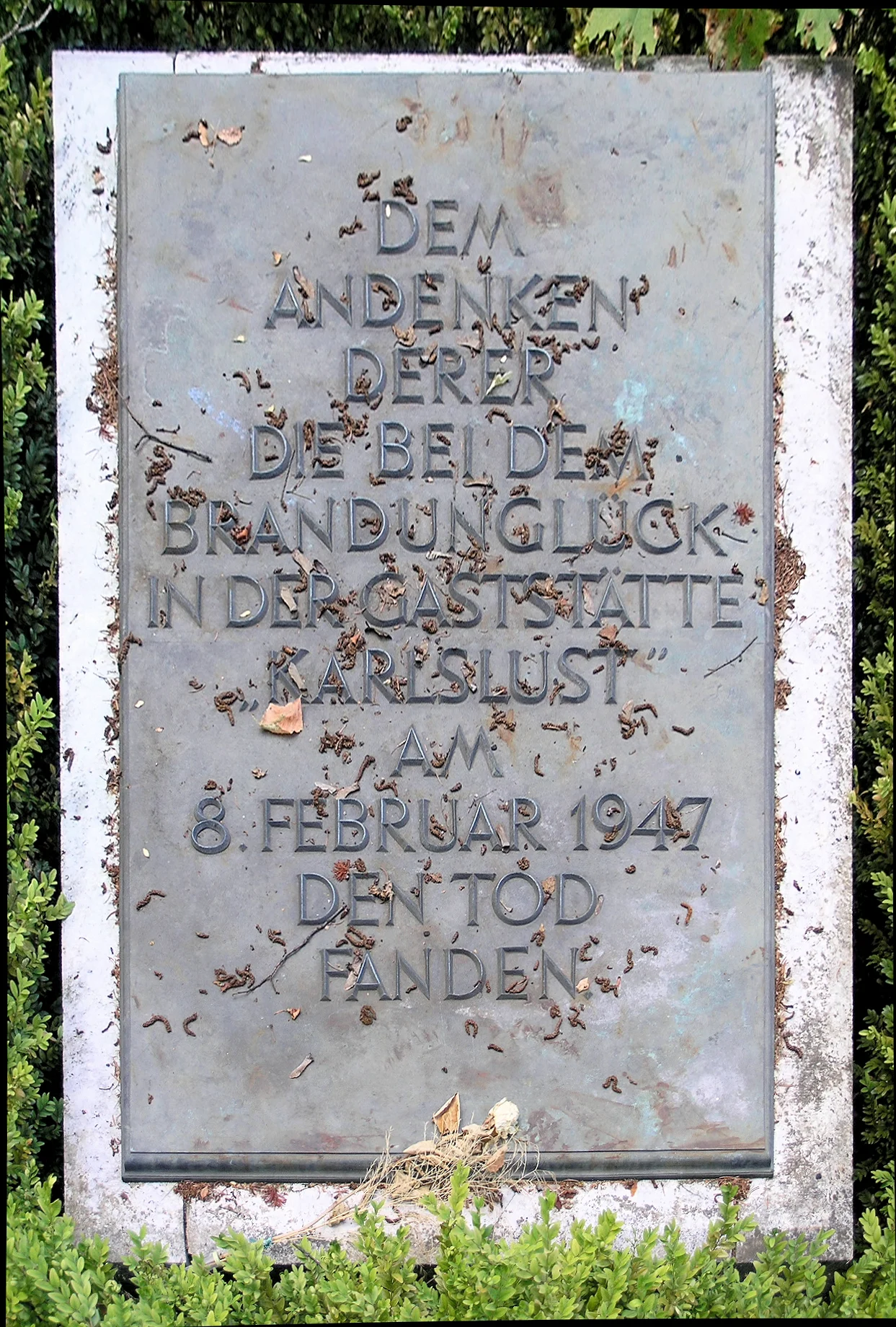
In the days after the fire, Der Spiegel reported 88 bodies recovered and 108 people still missing. Later accounts settle at 80, 81 or 82 dead, with 150 injured and 40 of those needing hospital treatment. On 25 February 1947, seventy-seven of them were buried together at the In den Kisseln cemetery, in a plot the city named Loebel field after the landlord who had died in his own hall. Until that day, every dance and every celebration in Berlin was cancelled. The Magistrat, the civilian government of the whole city, ordered cloth for 800 winter cloaks and reissued the ration stamps that had burned. The Christian Democrats, the Social Democrats and the Socialist Unity Party all collected donations for the families - one of the few things Berlin's parties did together that year. A memorial stone at In den Kisseln carries the date. Where the Karlslust stood, at 8 Hakenfelder Strasse, there is now a high-rise.
From the Air
The site lies at 52.567°N, 13.197°E in Hakenfelde, a northern corner of Spandau on the east bank of the Havel, about 12 km northwest of central Berlin. From the air the reference points are the river widening into the Spandauer See immediately west, the Tegeler See about 5 km east, and the runways of the decommissioned Tegel airfield (formerly EDDT, closed 2020) about 6 km east-southeast. Berlin Brandenburg (EDDB) is roughly 35 km southeast. Recommended viewing altitude 1,500-2,500 ft; the Havel lake system reads clearly at that height, and Hakenfelde's postwar apartment blocks stand out against the older street grid to the south. Berlin's inner-city airspace restrictions apply - check current charts before overflying.
Nearby Stories
- Swiss International Air Lines Flight 850 4.3 km away
- Einstein Tower 8.2 km away
- Schloss Meseberg 8.9 km away
- Friesack Camp 11 km away
- Storkow Castle 21 km away
- Kingdom of Prussia 22 km away
- Battle of Wittstock 30 km away
- Stork Farm Loburg 49 km away