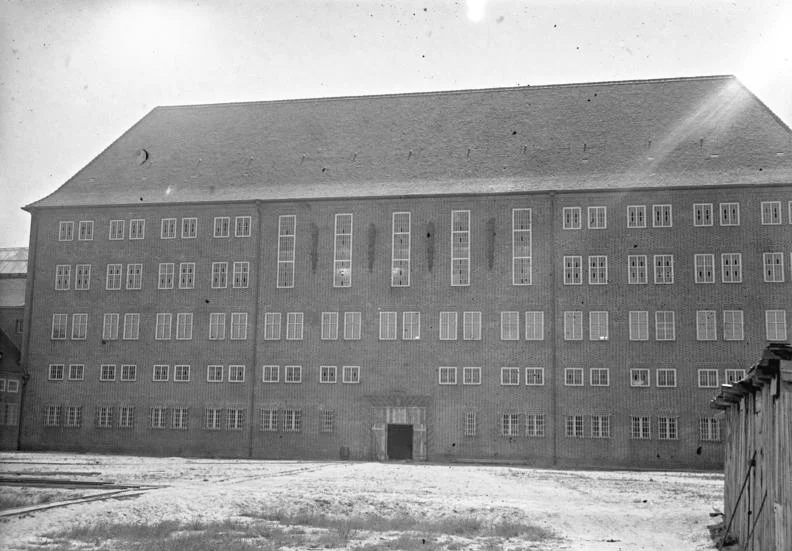

Brandenburg Euthanasia Centre
The building on Neuendorfer Straße was put up in 1790 to shelter people who had nowhere else to go — a royal house for the destitute and for soldiers who had come home unable to work. By 1820 Prussia had turned it into a penitentiary. When a new prison opened out at Görden in 1931, the old place stood mostly empty, apart from six months in 1933 and 1934 when it held one of the first concentration camps in Germany. Then, in 1939, men from an office at Tiergartenstraße 4 in Berlin came to look at the walled yard behind it. They were not interested in the cells. They wanted a room they could seal.
The Room They Could Seal
A shed in the yard was fitted out to look like a communal shower, with fixtures on the walls and pipes running to it. The pipes carried carbon monoxide. Christian Wirth worked on the installation and the tests. In January 1940 roughly fifteen men gathered to watch it used on human beings for the first time: Philipp Bouhler, who ran the killing programme, Karl Brandt, who was Hitler's physician, the chemist Albert Widmann, the gas specialist August Becker. Systematic murder began the following month. The doctor in charge from February to November 1940 was Irmfried Eberl, an Austrian physician who worked under the cover name Dr. Schneider, assisted by Aquilin Ullrich and Heinrich Bunke. The physicians turned the valves themselves.
The Transports
The victims were collected from psychiatric hospitals and care homes across northern and central Germany, people whose families had entrusted them to institutions and were told they were simply being moved to another one. On 27 September 1940 about 158 Jewish patients were brought from the asylum at Wunstorf, near Hanover. The paperwork said they were being transferred to a hospital at Chełm in occupied Poland. There was no hospital at Chełm any more; the SS had murdered its patients in January of that year and the address existed only to be written on forms. The Wunstorf group were murdered at Brandenburg. Children were among the dead here too.
Paul Goesch
One of the dead has a catalogue raisonné. Paul Goesch was born in Schwerin on 30 August 1885 and became an architect, painter and lithographer of real standing — a member of the November Group and the Arbeitsrat für Kunst, part of the Glass Chain circle around Bruno Taut, a contributor to the Expressionist journal Frühlicht. He was first hospitalised in 1909 and later diagnosed with what was then called dementia praecox, and from the early 1920s he lived largely in psychiatric care. In 1934 he was moved to the institution at Teupitz, where he was forbidden to paint and put to manual labour. In 1940 SS personnel took him from Teupitz to Brandenburg, and he was murdered there on 22 August, eight days short of his fifty-fifth birthday. The Canadian Centre for Architecture in Montreal holds 234 of his drawings. More are in the Prinzhorn Collection at Heidelberg.
Certificates, Urns and Smoke
A registry office called Sonderstandesamt Brandenburg II operated inside the killing centre for the sole purpose of falsifying the record. It issued death certificates giving plausible natural causes — pneumonia, heart failure — with dates and places that had nothing to do with what had happened. Families received a letter of condolence and, if they asked, an urn of ashes that was not necessarily their relative's. The bodies were burned on site at first. From July 1940 mobile furnaces were set up at the isolated Immenhof farm near Paterdamm, southeast of the city, because the smoke over the old town had become a problem. Neighbours complained about it anyway. The complaints were not investigated; enquiries into the centre were closed down from above.
What Left Brandenburg in October
In October 1940 the whole operation — equipment, doctors, drivers, clerks, the entire staff — was moved to a newly prepared site at Bernburg. The table of figures the administrators compiled in 1942, found by investigators in 1945 and known as the Hartheim Statistics, records 9,772 people murdered at Brandenburg between January and October of 1940. Hitler's order of 24 August 1941 halted that first phase; the killing of disabled patients continued afterwards by starvation and overdose, in the institutions themselves. What had been worked out in the yard on Neuendorfer Straße went east with the men who learned it. Eberl became the first commandant of Treblinka. Wirth became inspector of the camps of Aktion Reinhard. The main building at Nicolaiplatz 28/30 now houses municipal offices; the former directors' house is a day nursery. A bronze plaque dedicated in 1963 marks the ground where the shed stood, and since 17 August 2012 the old workshop building has held a memorial and a small permanent exhibition about the nine months of 1940.
From the Air
The site lies at 52.411°N, 12.551°E, in the old town of Brandenburg an der Havel, roughly 60 km west of Berlin. Best viewed at 2,000-4,000 ft AGL. The navigational anchor is the Havel, which splits the town into islands — the cathedral on its own island to the northeast, the Old and New Towns on either bank, and the lakes of the Havel chain opening west and southwest. Neuendorfer Straße runs through the Old Town on the western side; the memorial address is Nicolaiplatz. Nearest airports: Berlin Brandenburg (EDDB) about 58 km east, Schönhagen (EDAZ) about 45 km southeast, Leipzig/Halle (EDDP) about 110 km south. Terrain is flat; haze over the Havel lakes is common in summer and low stratus in winter.
Nearby Stories
- Döberitzer Heide 4 km away
- Silvio Gesell 15 km away
- Stalag III-A 15 km away
- Battle of Fehrbellin 21 km away
- Jahrtausendturm 21 km away
- Holy Blood of Wilsnack 25 km away
- Stork Farm Loburg 29 km away
- Magdeburg Water Bridge 32 km away