
Döberitzer Heide
The reason there are European bison here is that nobody was ever allowed to farm it. Soldiers used the sandy heath west of Berlin for the better part of three hundred years — Prussian regiments from 1713, then the imperial army, the Reichswehr, the Wehrmacht, and finally the Red Army until 1991 — and whatever else armies do to a landscape, they do not drain it, fertilise it or plant it in rows. When the Soviet garrison left, some 5,000 hectares of open sand, dry grassland and heather lay there unimproved. It was also thick with unexploded ordnance, which kept people out for years longer. Ecologically, both facts were a gift.
Three Hundred Years of Boots
The first recorded exercises around the village of Döberitz took place in 1713 under Frederick William I. In September 1753 Frederick II held a grand manoeuvre here with some 44,000 men. But it was the 1890s that made the heath what it is. Berlin and Potsdam troops had been shooting at Tegel, the ranges there were inadequate, and the general staff went looking for permanent ground. Surveying and negotiation with the local villages ran from 1893, and by 1894 the military treasury had acquired roughly 4,400 hectares. Three-quarters of the woodland was then felled — partly, in the frank calculation of the day, to produce something resembling steppe and desert for troops expected to deploy to the colonies. The village of Döberitz was cleared of its last inhabitants in 1895, and on 1 April that year Wilhelm II attended the handover of the new training ground. Between 1903 and 1911 the Heerstraße was driven west from the Berlin Palace to serve it.
Where German Military Flying Began
In 1910 an airfield and flying school opened on the heath under the Royal Prussian Flying Corps, and it is fair to call this the point from which German military aviation grew. Then it became something darker. From the outbreak of the First World War a prisoner-of-war camp stood at the western edge of the ground, extended from 1915 into two further camps at Rohrbeck and Dyrotz that the prisoners themselves were made to build. By October 1918 more than 30,000 men from seven nations had been held there. After the war the heath belonged to the Reichswehr, the clandestine Black Reichswehr and the nationalist paramilitaries. In November 1919 the Ehrhardt Freikorps brigade was transferred to the Döberitz camp; when the order came in March 1920 to disband it, its officers refused, and on the night of 12-13 March the brigade marched down the Heerstraße into Berlin and seized the city in the Kapp Putsch.
Games, Tanks and Camps
During the 1936 Olympics the heath hosted the cross-country phase of the three-day event and the riding leg of the modern pentathlon. The same year the Regiment General Göring was raised and trained here, and Germany's parachute troops were built from its men. Dry sandy ground turned out to be ideal for armour trials, and the site was expanded for it; the Großdeutschland panzer corps grew out of the Berlin guard regiment on this soil. From 1944 until the end of the war there were subcamps of Sachsenhausen for men and of Uckermark for girls and young women at Dallgow-Döberitz, along with a forced-labour camp holding Soviet prisoners of war — people worked to the edge of survival within sight of the parade grounds. The last unit raised here was the Potsdam infantry division, formed on 29 March 1945 out of whatever was left.
The Quiet After
The Soviet army took the site over in 1947 and kept up to 20,000 soldiers on it. Military use ended in 1992. The barracks were stripped from 1994 and demolished piece by piece, and the new housing built over them still follows the old camp street plan. The Bundeswehr kept about 600 hectares in the south as a local training area for vehicles. The rest went to nature: the Ferbitzer Bruch reserve, the wetter and lower ground, was designated in 1996, and the Döberitzer Heide reserve of some 3,415 hectares followed in 1997. Together with land held by the Heinz Sielmann Foundation they make up roughly 3,600 hectares of what the foundation calls Sielmann's Natural Landscape — a wilderness project without parallel in Europe. Since 2004 the levelled airfield has been run as a wildlife enclosure.
Six Thousand Seven Hundred Species
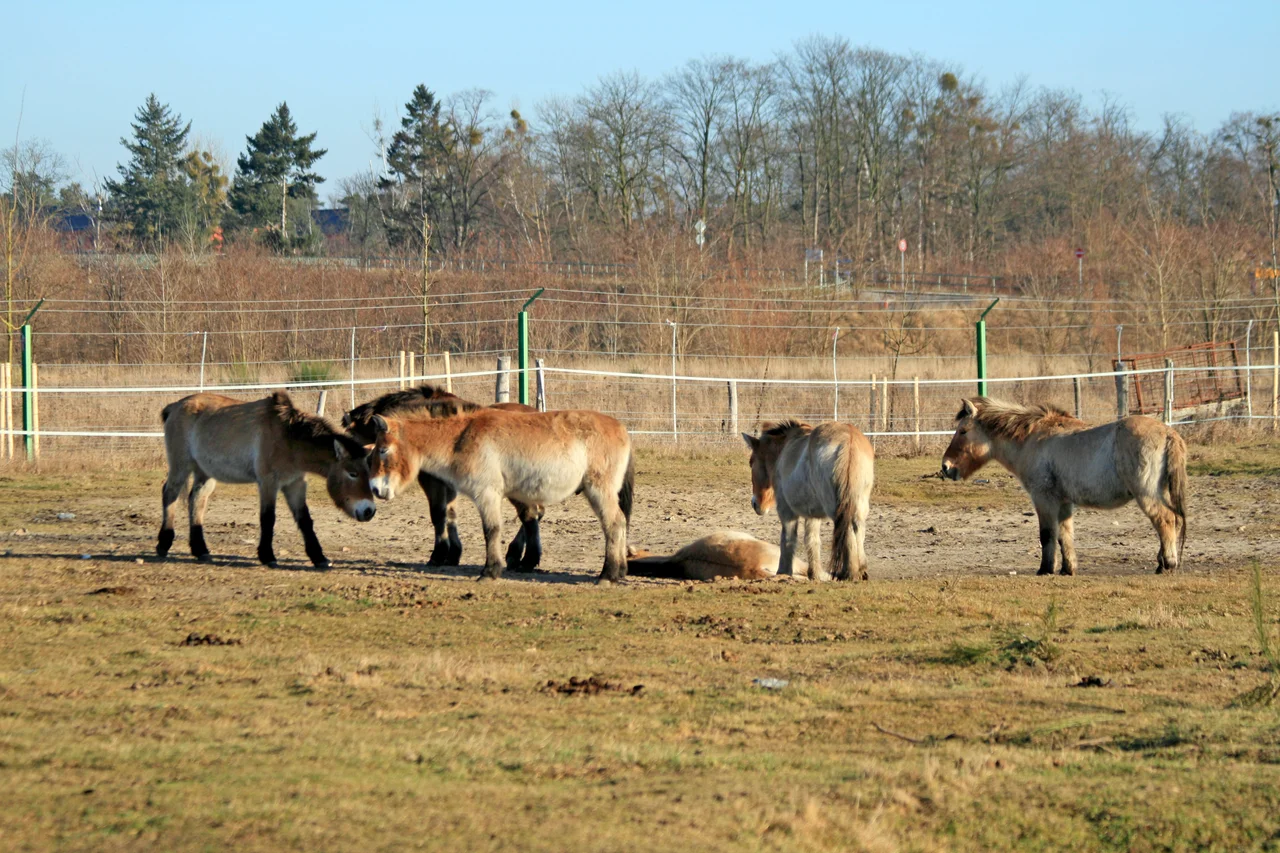
The core zone covers 1,860 hectares behind a triple fence — wire mesh plus two electrified lines at 1.5 and roughly 2 metres. The first Przewalski's horses were released in January 2008, the first wisents that March. By September 2023 the enclosure held about 130 wisents, two dozen Przewalski's horses and 100 red deer, all of them entirely on their own: not fed, not vaccinated, and grazing the heath open so the forest cannot close over it. Surveys have recorded close to 6,700 species of plants, fungi and animals here. Nearly a thousand are ferns and flowering plants, among them the marsh orchid and the marsh gentian. There are around 1,762 beetle species, 1,223 butterflies and moths, 312 spiders, 197 birds and 52 mammals; white-tailed eagles hunt here and otters use the wet ground. Two prehistoric-looking crustaceans, Branchipus schaefferi and Triops cancriformis, appear in the temporary pools. The 1,800-hectare ring zone around the core is grazed by Galloway and Heck cattle, sheep, goats, water buffalo, Sardinian donkeys and Konik horses, threaded with walking trails, and since March 2024 a nature centre near Elstal explains what all of it is for.
From the Air
52.4982°N, 13.0456°E, on the Nauen Plateau between Dallgow-Döberitz, Elstal, Priort and Seeburg, west of the Berlin city boundary and south of the B5. From the air the heath is the obvious thing for miles: a large pale opening of sand, grass and heather in an otherwise wooded and cultivated landscape, with the ruler-straight firebreaks cut in 2008 marking out the core zone and the flat scar of the former airfield still legible. The B5 runs along the northern edge and the Havel lakes lie to the east and south. Berlin Brandenburg (EDDB) is about 18 nm east-southeast and Schönhagen (EDAZ) about 18 nm south-southeast. This is a nature reserve and a designated important bird area with large free-ranging animals below, so keep passes high — 2,000 ft AGL or more — and quiet. Spring gorse turns whole sections yellow; low winter sun picks out the dune relief best.
Nearby Stories
- Silvio Gesell 3.3 km away
- Brandenburg an der Havel 9.4 km away
- Gigafactory Berlin-Brandenburg 10 km away
- Sperenberg Airfield 11 km away
- Eberswalde Hoard 13 km away
- Tropical Islands Resort 19 km away
- Wittenberg 38 km away
- Battle of Wittstock 49 km away