.jpg)
Chwarszczany
In 1232 Władysław Odonic, Duke of Greater Poland, gave away a thousand hides of land — something on the order of seventeen thousand hectares — to a military order whose headquarters lay in the crusader states of the eastern Mediterranean. The grant was centred on the Kostrzyn region, and it was not primarily an act of piety. A frontier that nobody governed was a frontier somebody else would take, and the Knights Templar were the medieval answer to both problems at once: they would hold the ground and they would settle it. About 220 people live in Chwarszczany today. Their parish church is the building the Templars put up, and it has been standing since 1280.
A Duke Buys Insurance
Nobody knows where the first Templars of Chwarszczany came from. The likeliest source is the order's Silesian commandery at Oleśnica Mała, but the records simply do not say. What the records do show is that the endowment grew fast: in 1241 a Polish magnate named Włast added the villages of Lubno and Oborzany. They were building on contested ground, and everyone involved knew it. The dukes of Pomerania insisted the whole district belonged to their castle at Kinice, not to Kostrzyn and Santok, and the claim was never really settled by argument. It was settled by who arrived, built, and stayed.
The Deal at the Border
By the middle of the thirteenth century the Ascanian margraves of Brandenburg had taken control of the territory, and the Templars had a choice between a fight they could not win and a bargain. They took the bargain. In 1261 the two sides came to terms: the knights surrendered their rights to a commandery at Myślibórz and gave up the lands along the road from Kostrzyn to Gorzów, and in return had their possession of Chwarszczany confirmed, with ten villages attached and Kaleńsko added on top. The arrangement worked. In 1286 Otto VI, Margrave of Brandenburg-Salzwedel, entered the order's house here — a ruling prince taking vows in a village monastery raised its standing considerably. By the 1290s Bernhard von Eberstein was running Templar affairs for Poland, the Neumark, Bohemia and Moravia, and doing it from this bend in the Myśla.
Granite, Then Brick
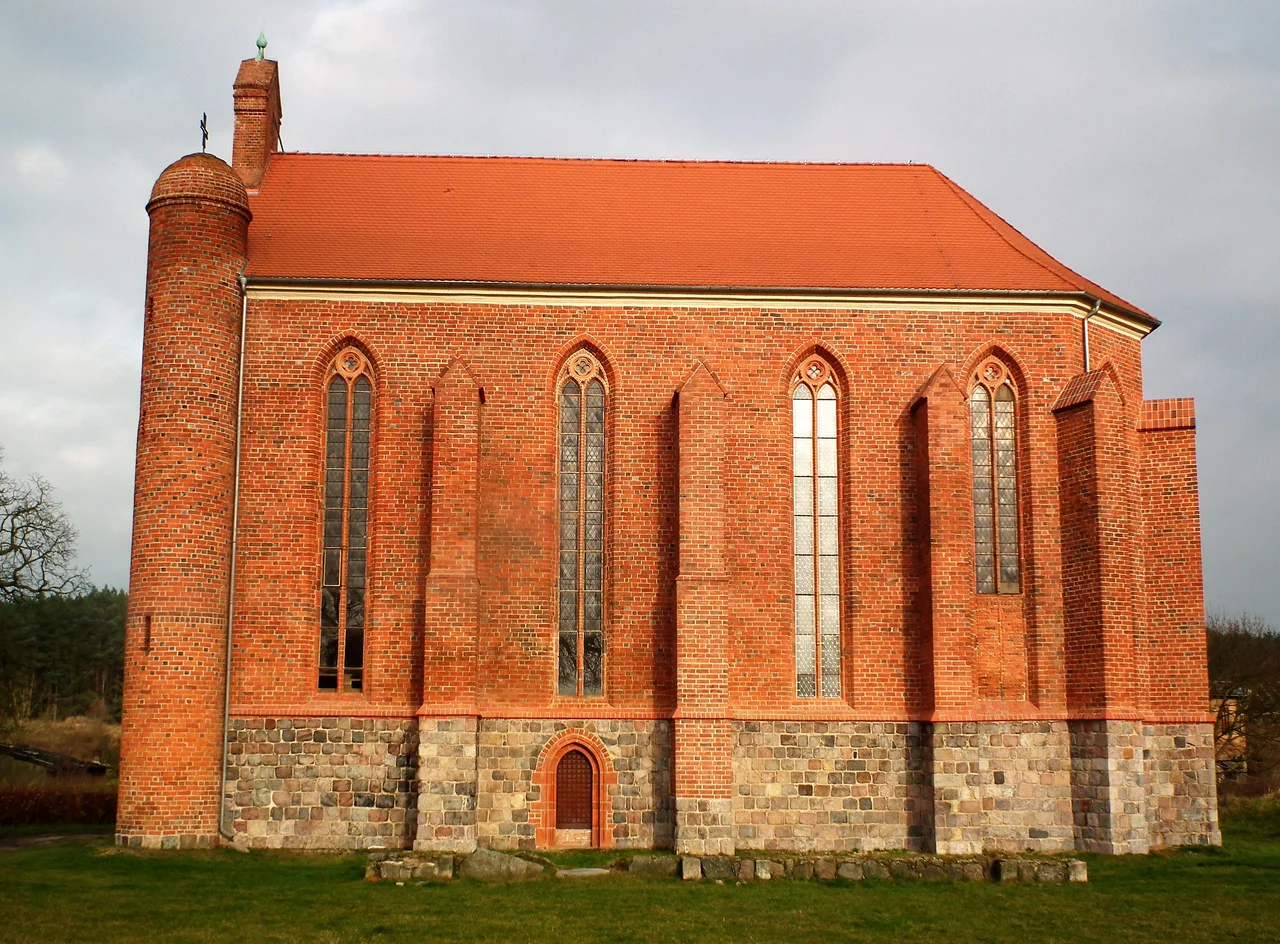
The chapel was consecrated on 23 April 1280, replacing an earlier Romanesque building from around the middle of the century. It sits on an elliptical rise roughly 100 by 150 metres, and it is built the way frontier churches were built when stone was what the fields gave you: granite blocks below, Gothic brick above, in the stripped-down style Polish scholars call reduced Gothic — the vocabulary of a cathedral spoken by masons who had one village's worth of money. The presbytery closes in a polygon. Nineteenth-century restorers were not shy about it; the window tracery dates from 1859, and a neo-Gothic sacristy was added during campaigns in 1870 and 1898. What survives is not a ruin dressed up for visitors. It is a working building that has never stopped being one.
The Order Disappears
In 1308 a brother named Günther von Köthen sold the village of Cychry to two brothers of the wealthy Hokemann family of Frankfurt an der Oder. That transaction is the last documented trace of the Templars in this district. Within four years the order was gone everywhere, suppressed in 1312 after the arrests, torture and confessions that had begun in France in 1307. At Chwarszczany the transfer was administrative rather than dramatic: the Knights Hospitaller took the commandery over and held it until 1540, when Margrave John of Küstrin seized the property. In the sixteenth century the chapel became a Protestant prayer house. Five owners, four confessions, and the granite did not move.
Under the Whitewash
Sometime in the early fifteenth century, painters covered the interior walls with Apostles, Holy Virgins, and a Saint Christopher carrying the Christ child across his shoulder. After 1949 the frescoes were whitewashed over, and there they stayed until conservators began uncovering them in 1996 and 1997. The chapel had been reconsecrated in 1948 as a filial church of the parish at Sarbinowo — the village a couple of kilometres south that used to be called Zorndorf, where Frederick the Great and the Russian army spent the bloodiest day of the eighteenth century. Today it is the Church of Saint Stanislaus Kostka, the centrepiece of a designated cultural park, and routinely described as one of the most valuable monuments in Western Pomerania. Treasure legends have attached themselves to it, as they attach to every Templar site — the Holy Grail gets mentioned, and international travel writers have made the pilgrimage to say so. Nothing has ever been found. The building is the treasure.
From the Air
Chwarszczany lies at 52.687°N, 14.636°E, on the river Myśla in Myślibórz County, West Pomeranian Voivodeship — about 11 km north-northeast of Kostrzyn nad Odrą and roughly 6 km southeast of Boleszkowice. This is a low-and-slow target: 1,000 to 2,000 ft AGL, because the chapel is a single stone building in open farmland and you will miss it from any higher. Navigate by the junction of voivodeship road 127 and national road 31, and by the Myśla's wooded corridor; the low elliptical rise the chapel stands on reads as a slight swelling in otherwise flat fields, with the church's dark granite mass unmistakable against pale cropland. The Oder and the Polish-German border run about 8 km west, so watch the airspace boundary. Nearest airports: Berlin Brandenburg (EDDB) about 85 km west, Szczecin-Goleniów (EPSC) about 100 km north, Zielona Góra-Babimost (EPZG) about 100 km southeast. Clearest light on the stonework is late afternoon; morning fog off the Oder and Warta valleys can linger here well past sunrise.
Nearby Stories
- Słubice 4 km away
- Kingdom of Prussia 11 km away
- St. Mary's Church, Chojna 12 km away
- Gorzów Wielkopolski 13 km away
- Storkow Castle 17 km away
- Swiss International Air Lines Flight 850 20 km away
- Stalag Luft III 88 km away
- Stutthof Concentration Camp 309 km away