
Słubice
Poland's register of traditional foods includes a smoked pork loin named after a town that did not exist under that name until 1945. Schab tradycyjny słubicki turns up on Christmas tables, and Słubice itself is something of a late arrival too. Until the last months of the Second World War this was the Dammvorstadt, the eastern suburb of the German city of Frankfurt (Oder) - a short walk across the bridge from the market square, no more foreign than any other neighbourhood. Then the border was drawn down the middle of the Oder, and a suburb had to work out how to be a town.
Zliwitz, and the Name That Came Back
There was something here long before Frankfurt. Zliwitz was a West Slavic settlement east of the causeway across the Oder, part of the Polish Lubusz Land until 1249, and it was granted staple rights by the Piast duke Henry the Bearded in 1225. Frankfurt's town charter of 1253 names it. Control then went the way control went in this part of Europe: Brandenburg by 1324, the lands of the Bohemian crown from 1373 to 1415, back again. The settlement was eventually absorbed as Frankfurt's Dammvorstadt and stayed that way for centuries. When Poland took the east bank in 1945 and needed a Polish name, the answer was already in the archive. Słubice is a modern Polish reworking of that medieval Zliwitz - a thirteenth-century word revived for a twentieth-century town. The population stood at 16,705 in 2019; counted together with Frankfurt across the water, the two make an urban area of around 85,000.
The Bridge as a High Street
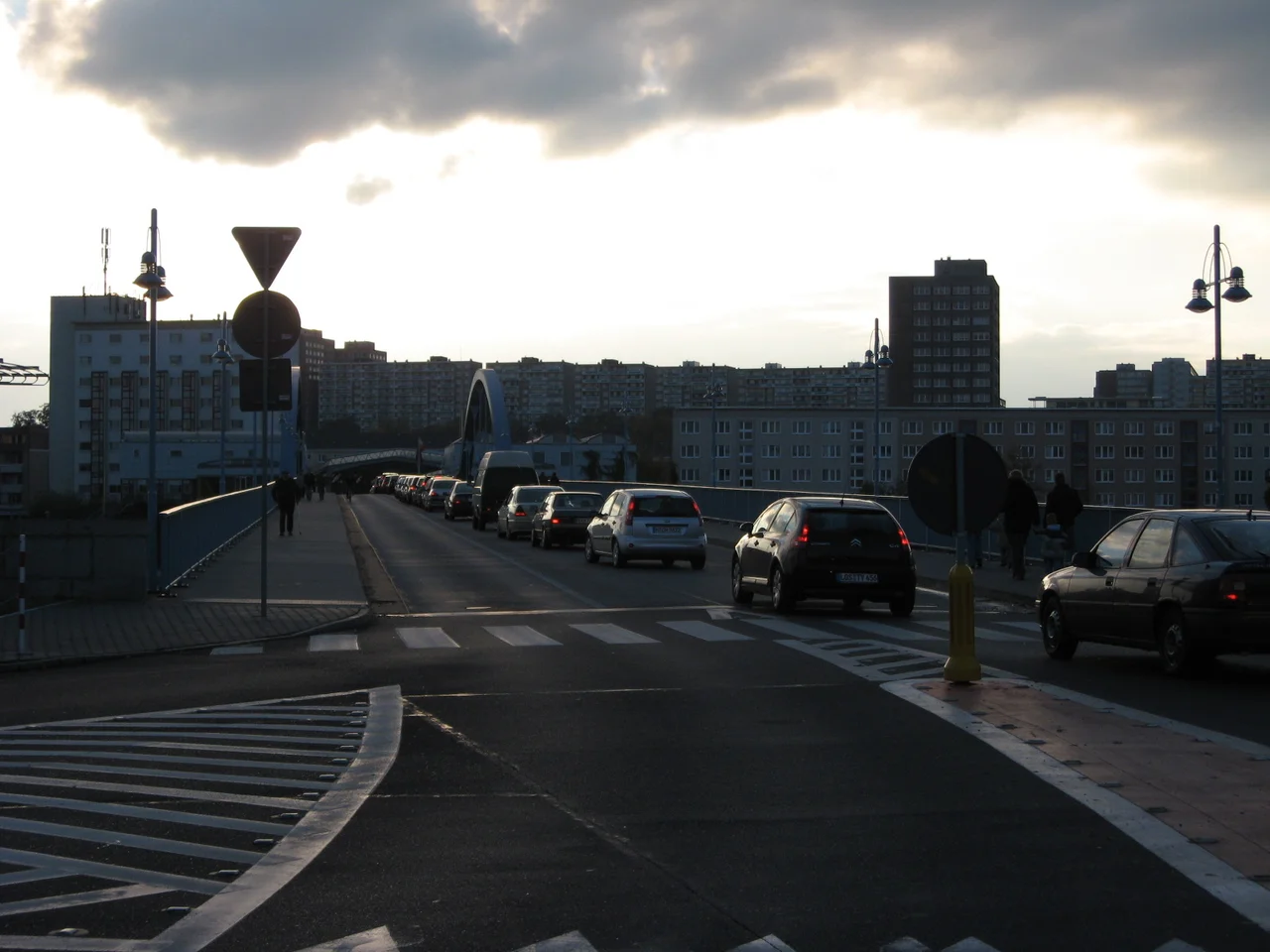
Everything in Słubice is arranged around the crossing. Money-changing stands and shops crowd the Polish end of the bridge, Germans come over for cheaper cigarettes and for lunch, and card payment is more usual here than it is on the German side - a small reversal of the stereotype that locals enjoy pointing out. Poland joined the European Union in 2004 and the Schengen area at the end of 2007, and the permanent controls came down; you can now walk from one country to the other in the time it takes to cross a river. In 2025 both governments stepped up checks at their borders amid European argument over irregular migration, so it is worth carrying a passport. The inspections are quick and the staff are professional, but the bridge is no longer quite the non-event it was for fifteen years.
A University Building Poland Owns and Germany Staffs
The Collegium Polonicum is the reason a town of sixteen thousand has a lecture hall seating a thousand. Established in 1992 and run jointly by Adam Mickiewicz University in Poznań and the European University Viadrina across the river, it occupies a building by the Polish architect Tomasz Durniewicz, raised between 1995 and 2001: 20,546 square metres, some thirty-two seminar rooms, two conference halls, a library wing of nearly six thousand square metres. The financing arrangement, formalised by an inter-ministerial treaty on 2 October 2002, is the genuinely unusual part. Poland pays for the building and its upkeep. Germany pays for five professorial chairs. Two states split a single institution along the line between bricks and brains, and it has worked for a quarter of a century.
Pierogi, Kebab and a Statue to Strangers
The town is small - twenty minutes on foot end to end - and its case for a visit is mostly a plate. Pierogi cost very little here and are worth crossing a border for; kebab shops are scattered through the centre, and the Karczma Koliba and the Ramzes serve traditional Polish cooking to tables of Germans working through menus in a language they do not read. There is a park with a fountain in the middle of town. On Plac Frankfurcki stands the world's first monument to the editors of Wikipedia, unveiled on 22 October 2014 - four anonymous figures holding up a puzzle globe with pieces missing, designed by a sculptor who had studied Polish philology at the Collegium Polonicum. Street signs are in Polish only. Some older residents speak rudimentary German; students speak some English.
Trenches Under the Trees
Five minutes north of the main bridge the town runs out and a large nature reserve begins - proper forest, good for walking, for picking mushrooms in autumn, for fishing. Under the undergrowth are earthworks. The trenches dug along this bank in the last war are still traceable, softened by seventy years of leaf litter and root, and nobody has tidied them away. It is a fair image of the place as a whole. Słubice is a town assembled out of what the twentieth century left on the east bank of a river: a Slavic name, a German street plan, a Polish population that arrived after 1945, a binational college, and a set of holes in the ground that were dug for a battle the town could not have stopped.
From the Air
Słubice lies at 52.35 N, 14.57 E on the east bank of the Oder, directly opposite Frankfurt (Oder) and about 85 km east of Berlin. From the air the two towns read as a single interrupted urban footprint with the river running dead straight north-south between them and the city bridge carrying the border crossing; the Collegium Polonicum is the large modern block on the Polish bank near the water. Best seen from 2,500-4,000 ft, when the bridge, the twin centres, the nature reserve north of town and the flat farmland east - the Kunersdorf battlefield of 1759 - all resolve together. The A2 motorway, part of European route E30 from Warsaw to Berlin, passes south of the town and continues west as the German A12. Nearest airports: Berlin Brandenburg (EDDB) about 85 km west, Zielona Góra-Babimost (EPZG) about 85 km south-east, Eisenhüttenstadt (EDAE) about 25 km south-west. This is international airspace on both sides of a narrow river - brief German and Polish requirements together. Flat river plain, no obstacles of note, autumn river fog common at dawn.
Nearby Stories
- Kostrzyn nad Odrą 6.2 km away
- Spreewald 6.5 km away
- Storkow Castle 10 km away
- Villa Wolf 12 km away
- Swiss International Air Lines Flight 850 21 km away
- Gorzów Wielkopolski 21 km away
- Stalag Luft III 50 km away
- Czocha Castle 141 km away