.jpg)
Wernigerode Castle
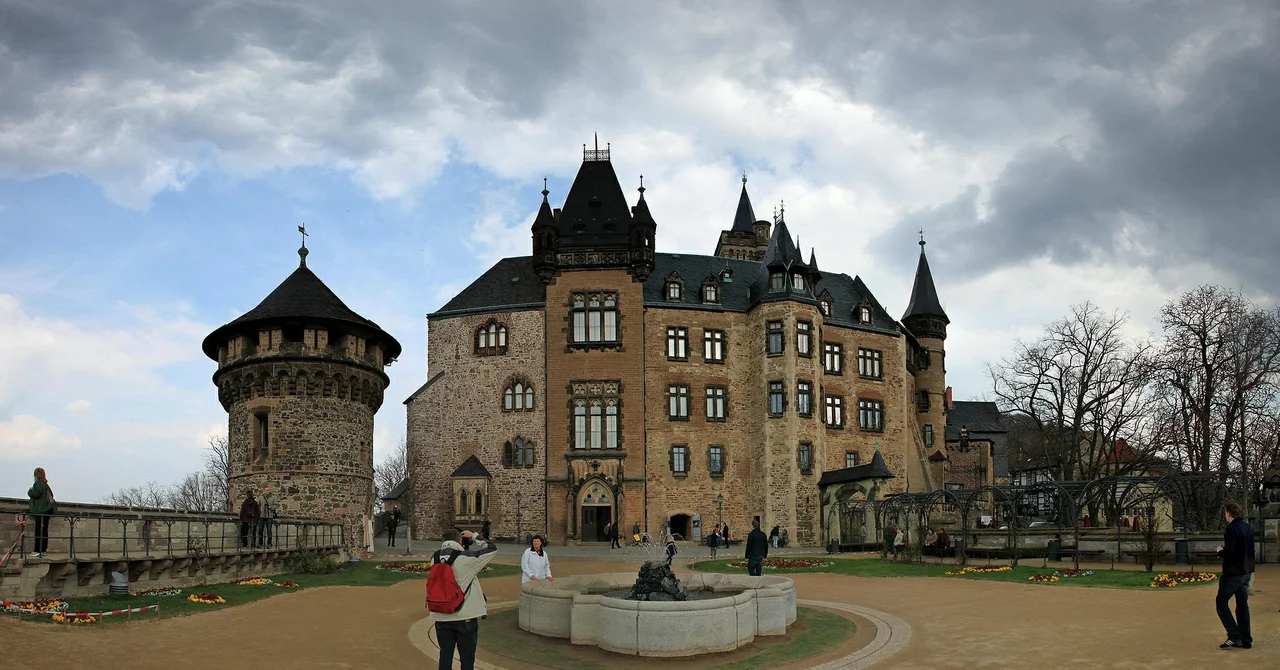
The man who gave this castle its skyline was, for a few years, the second-ranking figure in the government of the German Empire. Otto, Count of Stolberg-Wernigerode, had been the first president of the Prussian Province of Hanover from 1867 and president of the Prussian House of Lords from 1872, and he became vice-chancellor of Germany in 1878, serving under Bismarck. He also had opinions about architecture. The schloss on the ridge above his town was already seven centuries old and had been rebuilt in every style that passed through, and Otto had it rebuilt again — half timber, half stone, bristling with turrets, finished in 1893, a Romantic idea of the Middle Ages assembled at the height of the industrial age. It is often compared to Neuschwanstein, and the comparison is fair: both are nineteenth-century buildings wearing much older clothes.
A Place to Stop While Hunting
The first structure here went up between 1110 and 1120, a Romanesque fortress meant to give German emperors somewhere secure to break their journey while hunting in the Harz. Very little of that masonry survives. The written record starts in 1121, in a deed naming the Saxon noble Adalbert of Haimar, Count of Wernigerode — the same document that gives us the first mention of the settlement below, which had been founded about a century earlier as the forest was cleared. The counts put their residence on the slope south of the town, and in 1213 it appears in the sources as a castrum. Everything about the siting is practical rather than picturesque: high enough to see the approaches, close enough to keep the town in hand.
Every Style That Came Through
At the end of the fifteenth century the castle was enlarged in Gothic, with large arched windows. In the sixteenth it was reworked as a Renaissance fortress, and a spiral staircase tower from that campaign is still standing. The politics were less continuous than the building. The Wernigerode line died out in 1429 and the lands passed to the neighbouring County of Stolberg, after which the castle became the seat of a subordinate administration and was pledged to creditors more than once. When the Stolberg-Stolberg line split in 1645, Wernigerode became a capital again. The Thirty Years' War then wrecked both the building and the counts' relationship with their own citizens, and they withdrew to Ilsenburg House nearby. Only in 1710 did Count Christian Ernest bring the seat of government back and rebuild the place as a Baroque schloss. He ruled for sixty-one years, though from 1714 he did so as a vassal of King Frederick William I of Prussia.
The Chapel and the Silhouette
Otto's rebuilding was thorough enough to swallow most of what came before it, and it was carried out in the style called historicism — not a restoration but a composition, using medieval vocabulary to express nineteenth-century confidence. Once he became a German ambassador, the schloss came to be read as a showpiece of North German historicism, which is roughly what it was designed to be. The chapel is the most carefully handled part of the complex. The original had stood on the northwestern side of the castle circle, dedicated to Saint Pantaleon and Saint Anna, and had kept its Baroque form until it was demolished in 1870. The replacement went up on exactly the same ground, built from 1880 by the architect Carl Frühling to drafts by Friedrich von Schmidt of Vienna, and inaugurated in 1883. Built-in galleries line the hall; the choir carries stained glass designed by Carl Christian Andrea.
From Family Seat to Feudalmuseum
The family stopped living here permanently in 1929, and in April 1930 the castle opened to the public. It drew more than forty thousand visitors a year until 1943. In 1945, under the land reform carried out in the Soviet occupation zone, Botho, Prince of Stolberg-Wernigerode, was expropriated as owner, and in 1946 the building passed to the town of Wernigerode, which reopened it as a Feudalmuseum — a museum of feudalism, the social order the new state was defining itself against. The label was ideological, but it had one unintended effect: the interiors were preserved rather than cleared. What visitors walk through today is a remarkably complete record of how a very rich German aristocratic family lived in the last decades before the family stopped being able to live that way at all.
From the Air
The castle stands at 51.8303°N, 10.7950°E, on a ridge immediately south of Wernigerode on the northeastern flank of the Harz. From the air the town reads as a dense patch of red roofs at the point where the mountains meet the flat Harz Foreland, with the castle's cluster of steep towers detached from it on the wooded high ground above. It is a genuinely useful visual fix, since it marks the northern end of the Brocken railway line: the narrow-gauge track leaves Wernigerode and climbs southwest toward the Brocken dome about 12 km away. Recommended sightseeing altitude is 2,000-3,500 ft AGL, which keeps the towers and the timber-framed town centre legible together. Nearby airports include EDVE (Braunschweig-Wolfsburg) to the north, EDDV (Hannover) to the northwest and EDDP (Leipzig/Halle) to the southeast. Watch for rapidly rising terrain to the south and southwest — the ground climbs more than 800 metres between the town and the Brocken — and for the low cloud that habitually sits on that slope.
Nearby Stories
- Battle at the Harzhorn 9.5 km away
- Asse II mine 11 km away
- Hildesheim Cathedral 21 km away
- Sack of Magdeburg 28 km away
- Kyffhäuser Monument 29 km away
- Nebra sky disc 31 km away
- Eisleben 35 km away
- Kassel 53 km away