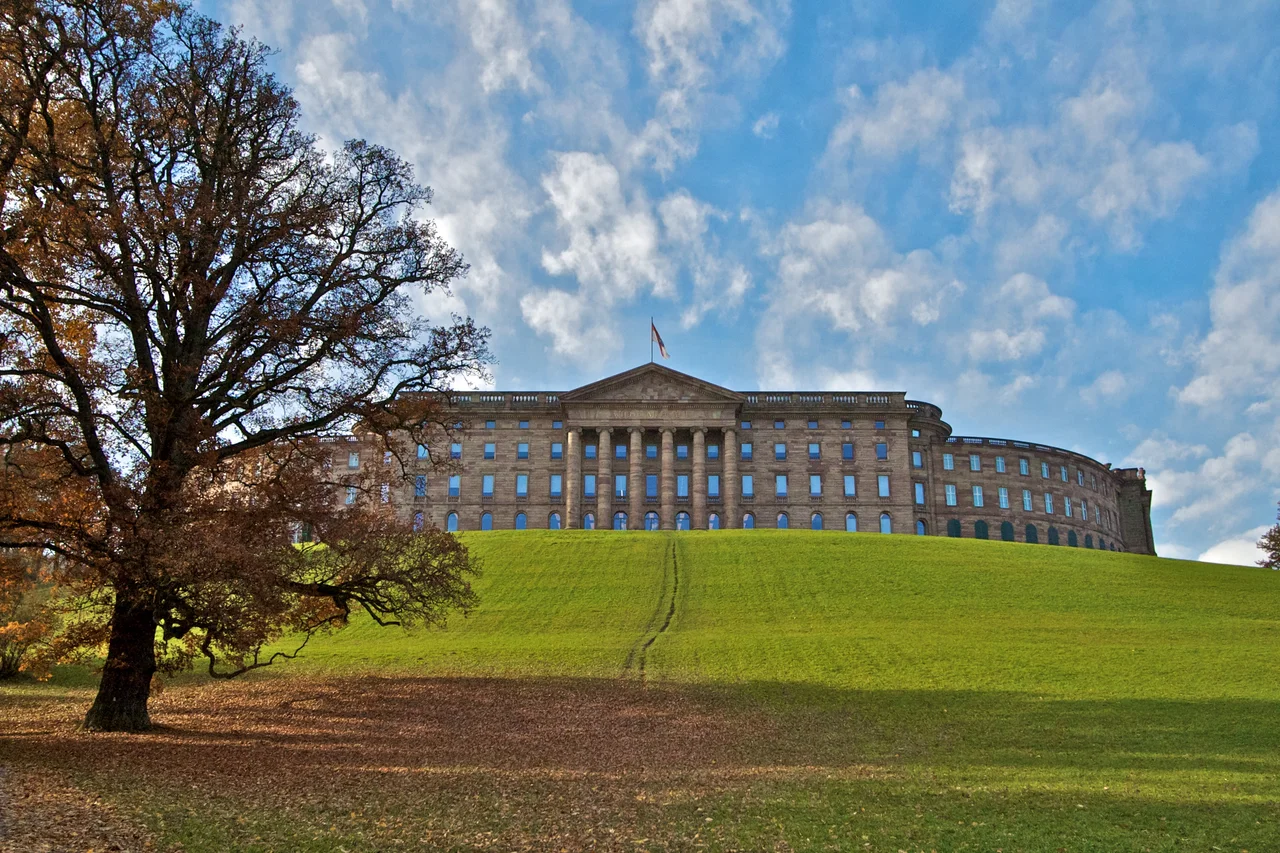

Kassel
On the night of 22 October 1943, 569 Royal Air Force bombers put their loads into the middle of Kassel and started a fire that did not go out for seven days. The old town was half-timbered - oak frames, plaster panels, centuries of dry wood standing shoulder to shoulder down narrow streets - and it burned the way such places burn. Around ten thousand people died in a few hours. A hundred and fifty thousand had nowhere to sleep the following night. Ninety per cent of the city centre simply ceased to exist. Everything in central Kassel today, every bank facade and shopping arcade and pedestrian crossing, stands on top of that night.
Nine Centuries Before the Fire
The written record begins in 913, though archaeologists have found people living here well before that. What made the place was the Landgraviate of Hesse, which used Kassel first as a centre and then as its residence, and a princely seat generates the things princes want: a court, a theatre, collections, gardens, and eventually a hillside park that would take a century and a half to finish. Hesse-Kassel also came down firmly on the Protestant side, which mattered enormously later, because when Louis XIV revoked the toleration of France's Protestants, thousands of Huguenots went looking for a landgrave who would have them. They arrived with trades, skills and capital, and they stayed. Walk the centre now and you find their surnames on the street signs - one of the few things in the middle of Kassel that survived 1943 intact, because names are not flammable.
Steam, Before Watt
Among those Protestant exiles was Denis Papin, a French physician and inventor who ended up in Hessian service and who built, in Kassel, a pressure vessel that could throw a jet of water into the air using nothing but heat. He was working on the steam engine roughly a century before the steam engine happened. The local telling goes further: that Papin put an engine in a boat and left Kassel under steam power years before James Watt had a working prototype, which is a claim historians treat with more caution than Kassel does. Either way, the machinery survives in spirit at the Orangerie in the Karlsaue park, where a superb collection of Enlightenment instruments - clocks, globes, astronomical devices, calculating machines - shows what a small German court could buy and build when it decided that natural philosophy was worth money.
What the City Made
By the twentieth century Kassel was making locomotives. Then, under the Nazi regime, it was making tanks and aircraft as well, and that is the whole explanation for what happened in October 1943. The bombing was not incidental to the city's character; it was a consequence of it. Kassel was hit repeatedly through the war by British and American aircraft, but the October raid was the one that broke it. Something worth holding onto: the ten thousand who died were overwhelmingly not the men who ran the factories. They were families sheltering in cellars beneath centuries-old half-timbered houses, in streets too narrow to escape down once the fire took hold and began pulling air in behind it.
Rebuilt Fast, and Cheaply
West Germany reconstructed Kassel at speed and on a budget, and the result is one of the more honest ugly city centres in Europe - honest because nobody in Kassel pretends otherwise, and contemporaries said so at the time. There was no money for reconstruction in the old manner and, in the 1950s, not much appetite for it either. What went up instead was plain, functional and cheap, and the inner city today is largely banks, offices and shopping galleries. The consolation is that the city works. Kassel is a major node on the German high-speed network, sitting on the first purpose-built ICE line between Würzburg and Hanover; Kassel-Wilhelmshöhe station handles the fast trains four kilometres west of downtown, while the handsome old Hauptbahnhof has been repurposed as the Kulturbahnhof, a station given over to culture because the trains no longer need all of it. Every five years documenta arrives and fills the whole place with contemporary art, and on the first Saturday of September the museums stay open past midnight for Museums Night - sixty-one venues took part in 2025, on one ticket.
The Brothers Who Wrote It Down
Jacob and Wilhelm Grimm lived and worked in Kassel, and it was here that they assembled the collection published in December 1812 as Kinder- und Hausmärchen: Hansel and Gretel, Rapunzel, Snow White, Sleeping Beauty. The fairy tales made them famous. Their real life's work did not. The Deutsches Wörterbuch was to be a complete dictionary of the German language, every word traced to its root, and the brothers had no realistic idea what they were starting. The first volume appeared in 1854. Jacob died in 1863 with the work stalled somewhere in the letter F, and it was finished - by other hands, generations of them - in 1961. The city keeps a museum devoted to the brothers, and the countryside around still trades on them: the German Fairytale Road runs through, the Reinhardswald north of the city holds the castle of Sababurg that people insist is Sleeping Beauty's, and the Habichtswald forest presses right up against the western edge of town. Two brothers spent their lives insisting these stories came from ordinary German people. The landscape has been happily agreeing with them ever since.
From the Air
Kassel sits at 51.316°N, 9.498°E in a basin on the river Fulda, ringed by wooded hills in northern Hesse. From 2,000-4,000 ft the orientation is straightforward: the Fulda curls along the eastern side of the centre, the big green wedge of the Karlsaue park runs southeast toward the water, and away to the west the Habichtswald ridge carries the Bergpark Wilhelmshöhe with the Hercules monument on its crest - the single most useful landmark in North Hesse, visible for many kilometres, with the cascades below it pointing like an arrow back at the city. The rebuilt centre reads as a pale, regular block of postwar construction, noticeably different in grain from the older suburbs around it. Kassel-Calden (EDVK) lies about 12 km northwest of the city; Hanover (EDDV) and Frankfurt (EDDF) are the major alternates roughly 150 km north and south. Terrain is hilly on every side, so expect ridge cloud, valley fog in the Fulda basin on autumn mornings, and mechanical turbulence downwind of the Habichtswald.
Nearby Stories
- Wartburg 7.9 km away
- Edersee Dam 8.5 km away
- Sababurg 10 km away
- 1st German Bratwurst Museum 15 km away
- Fulda Gap 15 km away
- Stadtallendorf 18 km away
- Unicorn Cave 21 km away
- Niederhagen concentration camp 35 km away