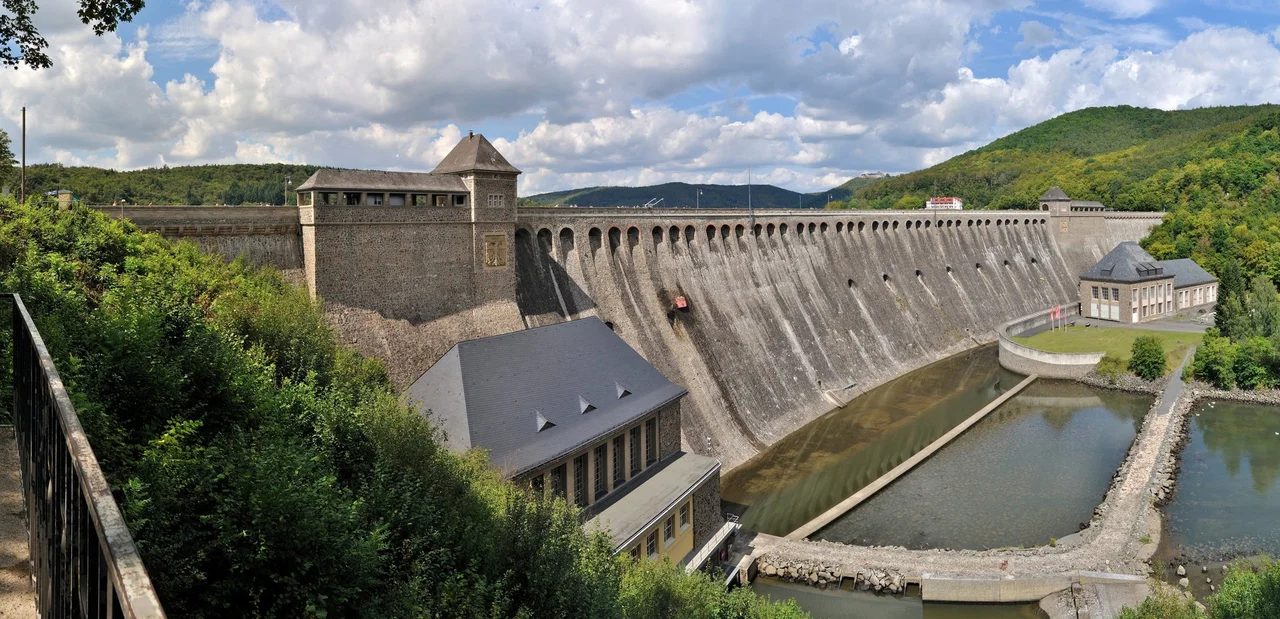

Edersee Dam
In a dry late summer the lake goes down and the villages come back. First the bridge, still spanning the old riverbed it was built for. Then walls, then street lines, then the outlines of Asel, Bringhausen and Berich, which have been under water since 1914 and are made of mud now. People walk out across the flats to find the graves of their great-grandparents. It is one of the strangest recurring events in German tourism and it is entirely the fault of a masonry wall 48 metres high standing across the valley at the northern edge of the Kellerwald - a wall that has been famous twice, once for what it drowned and once for what happened when somebody knocked a hole in it.
What the Water Covered
The dam went up between 1908 and 1914 near the small town of Waldeck, and it is built the way big dams were built before concrete took over: a curved wall of masonry, 400 metres along the crest, six metres thick at the top and thirty-six at the base, holding back everything the River Eder brings down out of the hills.
When they closed it and let the valley fill, three villages went under. Asel, Bringhausen and Berich had been farming settlements on the river; the reservoir took their land, their churchyards and the bridge that connected them. The people were moved. The lake that replaced them covers 11.8 square kilometres and runs to 41.7 metres deep, and for most of any given year the villages are simply gone. In drought years the water withdraws far enough to expose them, and their descendants come.
The Small Hours of 17 May 1943
The Eder was one of the targets of Operation Chastise. Lancasters of No. 617 Squadron RAF flew that night against the great German water reservoirs carrying a weapon built for exactly this problem: a cylindrical bomb, spun backwards and released low so that it skipped across the surface, struck the wall, and sank against the masonry before exploding. Reservoirs were defended against anything approaching over the water. A bomb that bounced went around the defences and delivered its charge where a wall is weakest, underneath.
The Eder valley is narrow and steep, and the run-in demanded a very precise height and speed held over water in the dark. It worked. When the crews turned for home there was a breach in the dam 70 metres wide and 22 metres deep.
Eight Thousand Cubic Metres a Second
The reservoir emptied through that gap at eight thousand cubic metres per second into the valley below, and what came down was a wall of water six to eight metres high that was still recognisably a wave thirty kilometres downstream. It flattened whatever stood in the floodplain before it spread and slowed in the wider country where the Eder joins the Fulda and the Fulda joins the Weser. About seventy people were killed.
That number is worth stating carefully, because the raid has attracted bad arithmetic for eighty years. A figure of 749 dead circulates in some non-German accounts and attaches itself to a supposed prisoner-of-war or labour camp just below the Eder dam. There was no such camp there. The 749 belongs to the foreign workers and prisoners killed downstream of the Möhne dam, hit the same night, and moving it here inflates one disaster by borrowing the dead of another.
Rebuilt by Men Who Had No Choice
The hole was closed within months, which was faster than anyone in London expected. It was done by forced labour, and the labourers were pulled off the Atlantic Wall - the coastal fortification programme in France - and moved east under the Organisation Todt, the Reich's construction apparatus.
They were not volunteers and most of them were not German. They spent that summer rebuilding, by hand and under guard, a structure their guards' enemies had spent months learning how to break, and then they were sent back to the coast to keep building the other one. Their names are not on the dam. The raid is commemorated in Britain every year; the men who repaired the damage are a footnote in the German technical literature, if they appear at all.
Third Largest, and Famous For It
The Edersee now holds 199.3 million cubic metres, which makes it the third largest reservoir in Germany. It still does the jobs it was built for: generating hydroelectricity, and releasing water in dry months to keep the Weser navigable far to the north. It is also, in summer, covered in sailing boats.
Its second career is cultural. The 1955 film The Dam Busters made the raid into one of the founding legends of British wartime cinema, and the Eder is in it. Half a century later the first Call of Duty put a version of the dam in as a playable level, which means a very large number of people have attacked this valley without knowing that the villages under the water are real, or that the graves at the bottom get visited.
From the Air
The Edersee Dam stands at 51.183 degrees N, 9.059 degrees E, in northern Hesse near Waldeck, on the northern edge of the wooded Kellerwald uplands. From the air the reservoir is unmistakable: a long, narrow, many-fingered lake winding roughly east-west through forested hills, with the dam wall closing its eastern end and Waldeck Castle on the ridge above the northern shore. In drought years the exposed mudflats at the western end show the outlines of the drowned villages. Nearest airports are Kassel (EDVK), about 40 km northeast, and Paderborn Lippstadt (EDLP), roughly 55 km northwest; Frankfurt (EDDF) lies about 130 km south. Best viewing altitude 2,500 to 5,000 feet, which keeps the whole lake in frame. Morning fog pools over the water in autumn and can sit below the surrounding ridges.
Nearby Stories
- Reinhardswald 2.2 km away
- The Vertical Earth Kilometer 8.1 km away
- Stadtallendorf 16 km away
- Arnsberg Forest Nature Park 18 km away
- Fulda Gap 20 km away
- Lippstadt Airfield 23 km away
- Niederhagen concentration camp 24 km away
- Dillenburg 29 km away