
Wartburg
The story goes that Louis the Springer wanted this ridge badly enough to cheat for it. The hill above Eisenach was not quite inside his territory, so he had baskets of clay carried up from land he did own and spread across the summit, which allowed him to swear on oath that his castle stood on his own soil. Whether he really did it or not, the manoeuvre suits the place. For nearly a thousand years the Wartburg has been a stage for people determined to change the facts on the ground - a saint, a fugitive monk, five hundred angry students - and it has usually worked.
Wait, Mountain
The foundation was laid around 1067 by Louis, a Thuringian count of Schauenburg, who built it together with its larger sister castle Neuenburg to hold the far edges of his lands. Tradition claims the name came from his first sight of the ridge, when he supposedly shouted "Warte, Berg - du sollst mir eine Burg tragen!" - Wait, mountain, you shall bear my castle for me - a pun that runs on Berg against Burg and warte against Warte. The duller explanation is almost certainly correct: Warte means watchtower, and that is what a fortress on a 410-metre ridge above the Via Regia was for. The castle enters the written record in 1080, when the chronicler Bruno of Merseburg mentions it as Wartberg in his account of the Saxon war. Louis spent that war fighting the Salian emperors; his son Louis I was raised to landgrave of Thuringia in 1131 by the king who replaced them.
Poets on the Payroll
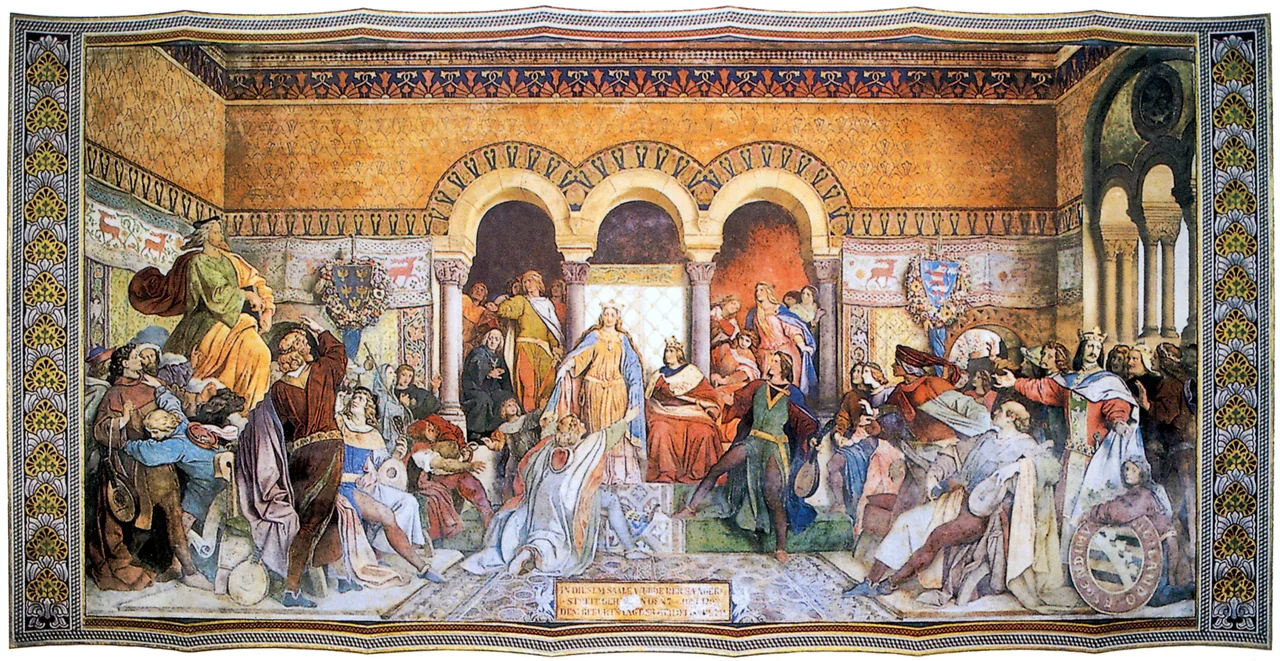
Between 1172 and 1211 the Wartburg was one of the great princely courts of the German Reich, and Landgrave Hermann I spent freely on the finest German poets alive. Walther von der Vogelweide sang here. Wolfram von Eschenbach wrote part of Parzival at the castle in 1203. Out of that circle grew the Sängerkrieg, the legendary song contest supposedly held in 1206 or 1207, in which the court's minstrels competed with their lives at stake - a story with no reliable evidence and an enormous afterlife, since Richard Wagner built Tannhäuser on it. The hall those poets performed in still stands. The Palas, begun around 1160, is considered the best-preserved non-ecclesiastical Romanesque building north of the Alps.
The Girl Sent Up the Hill
Elisabeth of Hungary arrived at the Wartburg at the age of four, sent by her mother to be raised into a suitable consort for Landgrave Ludwig IV. She lived in the castle from 1211 to 1228 and married Ludwig in 1221, and what the chroniclers remembered was not her rank but her relentless charity toward the poor of Eisenach, which her court found embarrassing. Ludwig died on crusade in 1227. Elisabeth left the castle, followed her confessor Konrad to Marburg, and died there in 1231 at twenty-four. The Roman Catholic Church canonised her four years later, which is close to immediate. Churches, hospitals, and charities across Europe still carry her name, and the castle she was raised in is still the first place her story is told.
Junker Jörg
In May 1521 a party of horsemen ambushed a traveller in the Thuringian forest and carried him off. The abduction was staged, the traveller was Martin Luther - excommunicated by the pope and declared an outlaw by the emperor - and the man who arranged it was his own prince, Frederick the Wise, who wanted him alive and out of sight. Luther spent the next ten months in a small room at the Wartburg under the name Junker Jörg, growing out his hair and beard and dressing as a minor nobleman. He also worked. In roughly eleven weeks he translated the entire New Testament from Greek into German, finishing before he left in March 1522; it was printed that September and is still known as the September Testament. Its effect on the written German language is difficult to overstate. Visitors are shown an ink stain on the wall, left by the night Luther supposedly hurled his inkwell at the devil - a legend that surfaces well after his lifetime, and a stain that souvenir-hunters have chipped away and custodians have obligingly renewed. The castle's record on dissent was not uniformly generous. In 1925 the handwritten signature of Fritz Erbe, an Anabaptist peasant imprisoned in the castle roughly two decades after Luther sheltered there, was found scratched into the wall of his cell.
The Bonfire and the Backlash
On 18 October 1817, around five hundred students from the newly founded Burschenschaften climbed to the Wartburg to mark two anniversaries at once: three hundred years since the Reformation began, and four years since Napoleon's defeat at Leipzig. They wanted a united Germany and constitutional government, and they got neither. What they did was light a fire on a nearby hill and throw in books by authors they considered reactionary, starting with the Napoleonic Code. Two years later the German Confederation used the murder of the writer August von Kotzebue as grounds for the Carlsbad Decrees, banning the fraternities, censoring the press, and putting the universities under watch. The Wartburg spent the following century being restored into the image nineteenth-century Germany wanted of itself; much of the interior dates from that work rather than the Middle Ages. Ludwig II of Bavaria came away so taken with it that he built Neuschwanstein. UNESCO added the castle to the World Heritage List in 1999, and it remains the most-visited site in Thuringia after Weimar.
From the Air
The Wartburg sits at 50.966°N, 10.306°E, on a wooded ridge 410 m above sea level, roughly 2 km southwest of Eisenach in western Thuringia. It is an excellent visual landmark: a long, narrow, half-timbered complex running along the crest with a prominent south tower, silhouetted against forest on all sides and with no comparable structure nearby. The Hörsel valley runs east-west to the north of the ridge, carrying the historic Via Regia and now the A4 autobahn - the clearest linear reference in the area. The Thuringian Forest rises immediately south, with the Rennsteig ridge trail just beyond. Best viewed at 1,500-3,000 ft AGL and from the east or southwest, where the castle stands clear of the ridgeline; from directly overhead it flattens into the trees. Erfurt-Weimar (EDDE) lies about 45 km east, Kassel Calden (EDVK) about 80 km northwest, and Frankfurt (EDDF) roughly 160 km southwest. Morning valley fog in the Hörsel is common in autumn and can leave the castle standing above an undercast.
Nearby Stories
- 1st German Bratwurst Museum 5.1 km away
- Fulda Gap 13 km away
- Memorial and Education Centre Andreasstraße 13 km away
- Battle of Frankenhausen 27 km away
- 7000 Oaks 30 km away
- Zwingenberg Castle 146 km away
- The Defenestration of Prague: The Thrown Men Who Started a Thirty Years' War 256 km away
- The Dancing Plague of 1518: When Strasbourg Couldn't Stop Dancing 296 km away