.jpg)
7000 Oaks
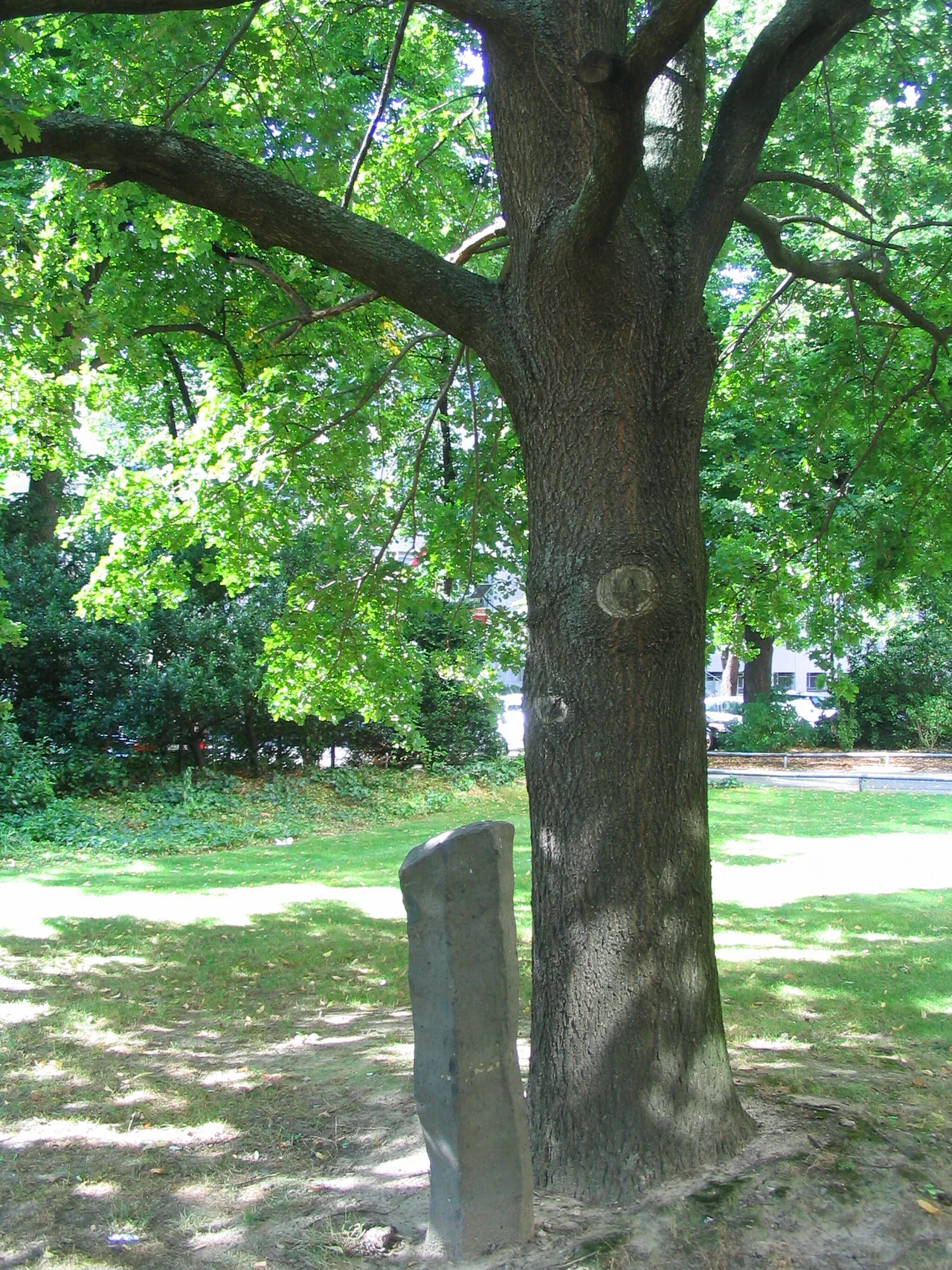
Seven thousand basalt columns were tipped onto Friedrichsplatz in 1982 and stacked into a great wedge aimed at the front steps of the Fridericianum. To most of Kassel it looked like a delivery of road stone that nobody had come to collect. It was in fact a clock. Joseph Beuys had arranged that a column could leave the square in only one way - carried off to stand beside a newly planted oak somewhere in the city, paid for by whoever wanted the stone gone. The pile could not grow. It could only shrink, and at the rate the money came in that would take years. Kassel was going to have to watch its own central square slowly empty, one stone at a time, which was the point.
The Rules of the Pile
The full title was 7000 Oaks - City Forestation Instead of City Administration, and the subtitle was not a joke. Beuys wanted a city that grew rather than one that was managed, and he had worked out a mechanism that forced the two into the same transaction. Every tree came with a stone; every stone came out of the heap. Volunteers did the planting. Raising the money was the hardest part of the whole undertaking, harder than the digging, harder than the politics. Beuys was explicit that the trees alone were not the work. "The planting of seven thousand oak trees is only a symbolic beginning," he said, and the basalt column was there to mark that beginning - the slow, living thing set permanently against the hard, unchanging one. He called this kind of thing social sculpture: art made of what a society decides to do. He was not aiming to please anybody. "I not only want to stimulate people, I want to provoke them."
Kassel Objects
It worked. The conservative state government, dominated by the Christian Democrats, lined up against the project, while Kassel's own mayor, a social democrat, stood by Beuys throughout. Plenty of residents simply thought the black markers were ugly, and in 1982 somebody made the point by heaping pink stones on the sites as a prank. A motorcyclist died in a collision with one of the markers, which turned an aesthetic argument into a bitter one. And because a tree needs ground, the oaks kept appearing where cars had been parking, earning the project a reputation as a destroyer of parking spaces - a charge that carries more weight in a rebuilt German city centre than any argument about art. Tolerance came gradually, roughly in step with the planting. Each new tree made the next one easier to accept.
Finished by Someone Else
Beuys did not see the pile go. Born in Krefeld in 1921, a Luftwaffe radio operator shot down over Crimea, later the most argued-about artist in West Germany, he died of heart failure in Dusseldorf on 23 January 1986 with the work several years unfinished and thousands of columns still stacked on the square. His son Wenzel planted the last tree in 1987, and documenta 8 counted the completed project among its works. There is something fitting about a piece designed to take longer than an exhibition being finished by the next generation, in public, as the terms required. The city of Kassel maintains the trees to this day.
What Forty Years Looks Like
Walk Kassel now and the work is no longer an event but a condition. Oaks stand along ordinary streets, in front of housing blocks and beside car parks, each with its basalt column at the base, and many of the trees have long since outgrown the stone they were planted with - which was, of course, the comparison Beuys wanted you to be able to make. The idea travelled. The Dia Art Foundation maintains thirty-seven of the tree-and-stone pairs in New York City and counts them among the sites in its care. In 2000 the Center for Art, Design and Visual Culture at the University of Maryland, Baltimore County, planted more than 350 trees in Baltimore parks with over 500 volunteers, schoolchildren included, on Beuys's principle that everyone is an artist. In 2007 the artists Ackroyd & Harvey came to Kassel and collected acorns from the original oaks; a hundred trees grown from them were shown at Tate Modern in 2021. The pile on Friedrichsplatz is gone. It is standing all over the city instead.
From the Air
The 7000 Oaks are scattered across the whole of Kassel in northern Hesse, with the origin point on Friedrichsplatz at 51.313N, 9.497E - the large open rectangle in front of the long neoclassical block of the Fridericianum, in the middle of the old city. There is no single object to spot from the air; what you are looking at is street trees, best appreciated low and slow at 1,500-2,500 ft with the sun behind you, when the oaks show as an unusually even, unusually young canopy threaded through a rebuilt postwar street grid. Use the Fulda river along the eastern edge of town and the Karlsaue, the baroque park running southeast to the water, to orient. The regional landmark is unmistakable: the Bergpark on the wooded hill west of the city, with the Hercules monument and its cascade aimed straight at the centre. Kassel-Calden (EDVK) is just northwest; Paderborn Lippstadt (EDLP) lies northwest beyond the hills, Frankfurt (EDDF) south. Hilly terrain on all sides brings ridge cloud in poor weather, and the canopy reads best in late spring or autumn colour.
Nearby Stories
- Wartburg 7.9 km away
- Edersee Dam 8.5 km away
- Sababurg 10 km away
- 1st German Bratwurst Museum 15 km away
- Fulda Gap 15 km away
- Stadtallendorf 18 km away
- Unicorn Cave 21 km away
- Niederhagen concentration camp 35 km away