.jpg)
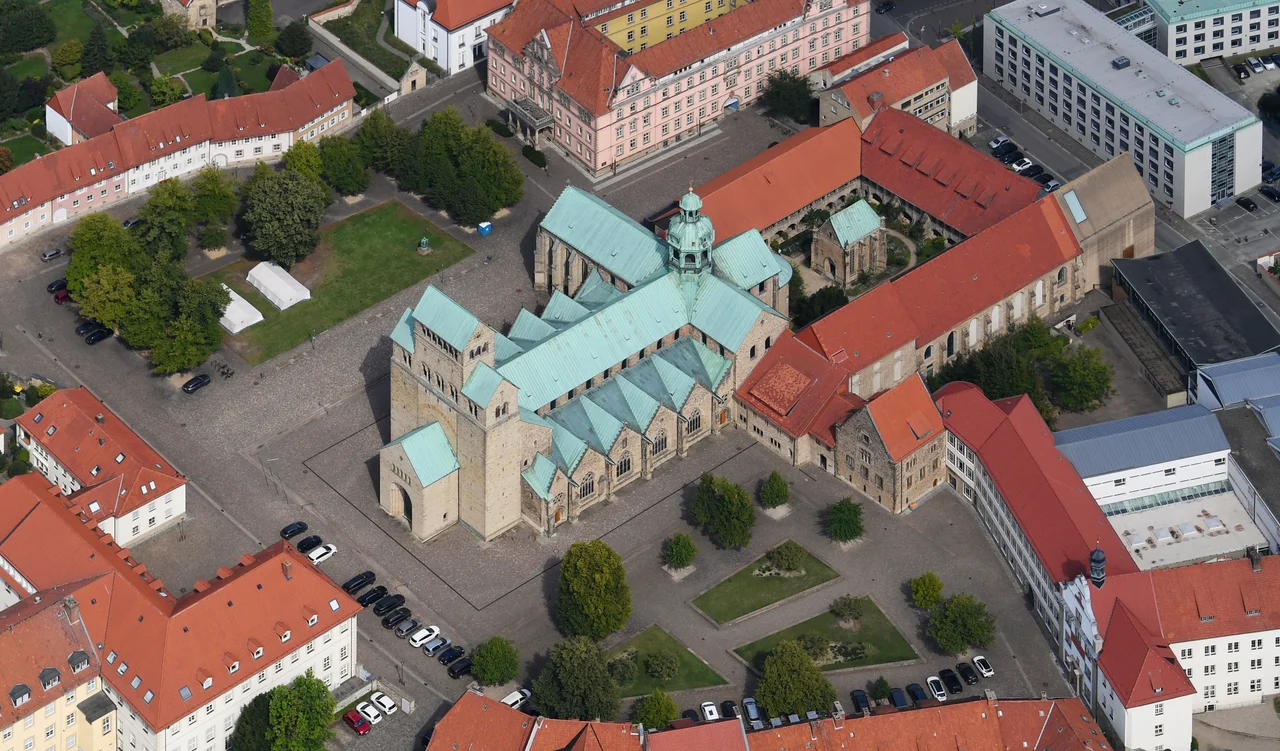
Hildesheim Cathedral
In the spring of 1945, twenty-five green shoots came up through the rubble at the east end of Hildesheim Cathedral. They belonged to a wild dog rose that had grown against the outer wall of the apse for as long as anyone could remember; the air raid of 22 March had killed everything above ground and left a charred stump buried under the debris. The first sparse flowers appeared in 1947. By 1948 there were 122. Hildesheim already had a name for the plant — der Tausendjährige Rosenstock, the thousand-year rose — and after that spring nobody in the city was inclined to argue with it.
A Reliquary That Would Not Come Loose
The story the city tells begins with a hunt. Emperor Louis the Pious, out in the forest, needed to hear Mass, and a reliquary of the Virgin he was carrying was hung on the branch of a wild rose for the service. Afterwards it could not be taken off the branch. He read that as an instruction, founded his new bishopric on the spot rather than at Elze as he had planned, and dedicated it to Mary, whose emblem is the rose.
The diocese dates from 815, which is where the legend puts the plant's age. Botanical documentation is more cautious and gives it roughly seven hundred years, still enough to make it a serious candidate for the oldest living rose in the world. It climbs about ten metres up the apse wall in the courtyard of the cloisters, and the cathedral was quite literally built around it.
Bernward's Bronze
A chapel of St Mary stood on the site of the present apse by 815. Bishop Altfrid replaced it in 872 with a cruciform three-aisled basilica and a two-storey westwork, and the church took the shape it still has between 1010 and 1020 — a symmetrical plan with an apse at each end, the signature of Ottonian building in Old Saxony. Fire did severe damage in 1046. The cloister went up between 1060 and 1070.
What draws art historians here are the bronzes commissioned by Bishop Bernward, who died in 1022. The cast doors carry scenes from Genesis down one leaf and from the Gospels down the other, set against each other panel by panel so that the fall and the redemption read side by side. Beside them stands a bronze column that winds the life of Christ up its shaft in a spiral. The cathedral also keeps two of the four great Romanesque wheel chandeliers, the Hezilo and the Azelin — hoops of gilded bronze hung above the crossing like circular walls of light — along with a bronze font of about 1225 showing the Baptism of Christ in the Jordan.
What the Diggers Found
The renovation of 2010 to 2014 turned into an excavation. Under the floor, archaeologists uncovered the ninth-century foundations of the original St Mary's chapel: a building six metres by six with an apse to the east, its sandstone footings extraordinarily thick for something so small, and the remains of the first altar still sitting in the apse.
West and south of it lay an older cemetery, and twenty graves came out of it. In August 2012 the team lifted the skeleton of a young woman who had died around the year 800, buried with a small knife and the glass beads of a necklace — the oldest complete burial ever found at Hildesheim Cathedral, and older than the diocese that has stood over her ever since.
The Twenty-Second of March
RAF and RCAF bombers hit Hildesheim on 22 March 1945. The cathedral's main building was almost entirely destroyed; the westwork and the outer walls were what remained standing. The organ went the same day — an instrument of 54 stops built in 1909 into a case from 1617.
Reconstruction ran from 1950 to 1960, and the cathedral was reconsecrated on 27 March 1960. The westwork was rebuilt on the model of the one at Minden Cathedral, which had also been badly bombed; the gatehouse in front of it was reduced by about half; the baroque crossing tower went back up as it had been. From outside, the building looks much as it did before the raid. In 1985 UNESCO listed it as a World Heritage Site together with St Michael's Church across the city.
Closed for Four Years
On 10 January 2010 the cathedral shut its doors for the largest church construction project in Germany. The basilica of St Godehard took over as the bishop's church, the same role it had played in the postwar years, and some of the treasures went travelling — the Metropolitan Museum of Art in New York showed a selection while the work went on.
New bells were cast on 16 November 2013, named for witnesses of the faith particularly venerated in the diocese. Bell number eight carries the name of Bishop Altfrid, who raised the money that built the cathedral in the first place; number nine is named for Hedwig, patron of refugees, because so many refugees arrived in Hildesheim after the war and shaped what it became. The Cantabona is the second-largest bell in Lower Saxony, after the Bell of Christ and Peace in the Marktkirche in Hanover.
The cathedral reopened on 15 August 2014, at the opening of the diocese's twelve-hundredth year. Outside, against the apse wall, the rose was in leaf.
From the Air
Hildesheim Cathedral stands at 52.1489°N, 9.9472°E on the Domhügel, the low hill at the southern edge of the city centre, with the Innerste and its Mühlengraben channel to the west. From 2,000-3,500 ft the cathedral's baroque crossing tower and blocky westwork read as a pale mass on the hilltop, with St Michael's Church on its own rise just to the north and the compact rebuilt city centre between them; the Harz foothills rise to the south. Hildesheim lies directly beneath the arrival and departure corridors for Hannover (EDDV), 28 km north — expect controlled airspace and busy traffic. Braunschweig-Wolfsburg (EDVE) is about 45 km east and Kassel-Calden (EDVK) about 85 km south. The city has a general-aviation airfield of its own on the northeastern edge. Winter fog is common in the Innerste valley and often lingers past midday.
Nearby Stories
- Holzminden prisoner-of-war camp 3.3 km away
- Battle at the Harzhorn 6.4 km away
- Brocken 7.8 km away
- Asse II mine 8.5 km away
- Hamelin 9.2 km away
- International Wind- and Watermill Museum 12 km away
- Herrenhausen Gardens 22 km away
- Dümmer 79 km away