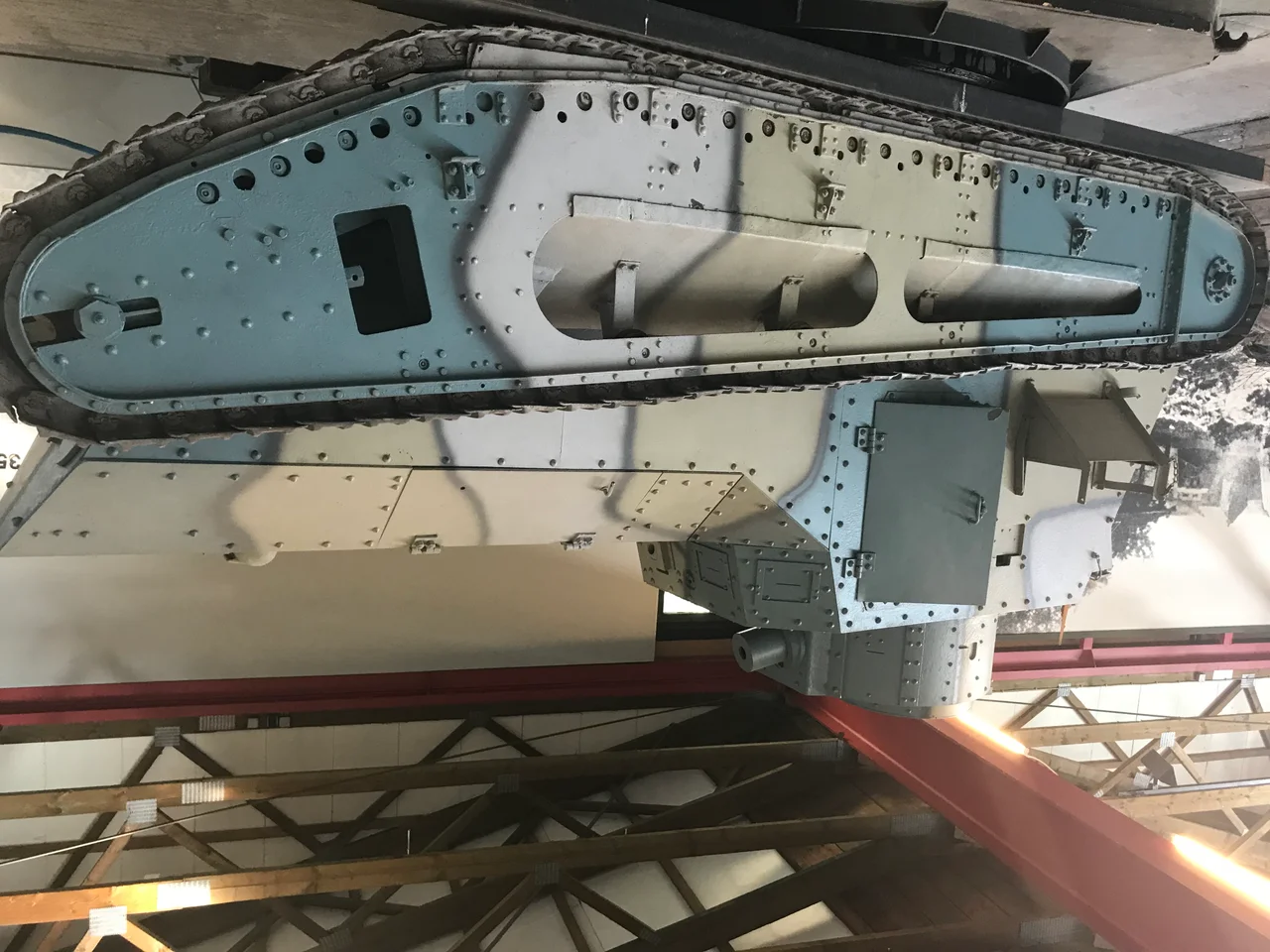

German Tank Museum
One of the museum's best-known objects is a fake, and the label says so. For years the Deutsches Panzermuseum in Munster displayed a tunic as Erwin Rommel's. It was not his - the provenance fell apart under examination, and the museum's own staff now describe it as highly improbable that Rommel ever owned it. Most institutions would quietly retire such a thing to a store room. This one left it in the case and rewrote the label into an essay on how the forgery was caught and why a museum has to keep interrogating its own holdings. That decision explains the place better than the hundred-odd armoured vehicles parked in its halls.
A Teaching Collection That Got Out
The collection began as an instructional aid. The Panzertruppenschule, the Bundeswehr's school for training the officers and NCOs of Germany's armoured units, kept vehicles on hand to teach with, and in 1983 an agreement between the federal defence minister and the town of Munster turned that working collection into a museum open to the public. It is still jointly run - the municipality on one side, the army's teaching collection at the Munster training centre on the other. The site covers around 9,000 square metres with 7,500 of it under roof across five halls; a separate building for special exhibitions, a shop and a cafeteria opened in 2003. More than 125,000 people visited in 2023, and a renovation budgeted at 19.3 million euros, approved in 2018, was scheduled to put the work out to tender in 2025.
Rare, Rarer, Only One
The core of the collection is around forty Bundeswehr and former East German National People's Army vehicles alongside some forty German tanks and other Wehrmacht vehicles from the Second World War, with Soviet, British and American machines from the same war standing nearby for comparison, and modern types including the Israeli Merkava. Then there are the singularities. A replica A7V, Germany's first tank, is the only example of its type in continental Europe; the only other one anywhere is at Bovington. The Daimler DZVR 21, an armoured police car from the Weimar Republic, is the last survivor of its kind. There is one of just two remaining Sturmtigers, a prototype Jagdpanzer IV, and an MBT-70, the abandoned joint American-German design of the 1960s. A Swedish Stridsvagn m/21-29 stands close by, which is really a modified German LK II wearing someone else's flag. Most of the vehicles run or are being worked towards running, and the restoration staff research each one back to its original configuration and paint scheme.
Iron, Textile, Gold, Wood
The smaller objects are organised by material rather than by date, into four paths collectively called the Elemente des Krieges - the Elements of War. Iron is small arms and ammunition from the seventeenth century onward, and reads as a history of technology. Textile is uniforms from the late nineteenth century on, which is social history: who wore this, and what was expected of them once they had. Gold is medals and decorations, and that is cultural history - what a society chose to reward, and how it dressed the choice up. Wood is war toys from the twentieth and twenty-first centuries, the history of ordinary life, and the most uncomfortable of the four. A toy tank on a nursery floor is a fact about a society rather than a fact about a tank.
Technology, Culture, Society
The museum states its frame in three words - Technik, Kultur, Gesellschaft - and means them as a refusal. A hall full of armour can very easily become a shrine, and this one works hard not to be one. Vehicles are treated as entry points into social, economic, political and cultural history rather than as achievements; operational and political history keep their place, but no longer have the room to themselves. That is a demanding position to hold in a garrison town, next to an active training area, in a country whose armoured forces did what they did between 1939 and 1945. The machines in these halls were built to kill people, and most of them were used for it. The museum's argument is that you understand that better by looking at them closely, with a historian's questions attached, than by looking away.
The Hatch Is Open
Outside the halls sits a Leopard 1 with a flight of steps up to the hull and a ladder down through the turret hatch, and visitors are invited in. It is the exhibit that does the most work. A tank looks enormous from the car park and is claustrophobic from the inside - four crew folded into a space with no windows, navigating by periscope and radio, sealed in with the noise. Munster lies in the middle of the Lüneburg Heath, thirty-five kilometres southwest of Lüneburg, and most people arrive expecting an afternoon of hardware. The inside of the Leopard tends to be the part they talk about on the way home.
From the Air
The museum stands at 52.987 degrees N, 10.111 degrees E, in Munster, Lower Saxony, at the heart of the Lüneburg Heath. From the air the giveaway is the Munster training area immediately around the town - large tracts of cleared, scarred and unfarmed ground standing out against the neat field patterns and dark pine blocks of the surrounding heath, with the River Örtze winding south of the town. The A7 autobahn runs north to south about 20 km to the west. Nearest airports: EDHG (Lüneburg, grass, 980 m) about 35 km northeast, EDDV (Hannover) about 65 km south, EDDH (Hamburg) about 70 km north. Recommended viewing altitude 2,500 to 4,000 feet. Important: this is an active military training area with associated restricted and danger airspace - check current NOTAMs and the German AIP before planning anything near it.
Nearby Stories
- Celle 13 km away
- Neuengamme concentration camp 23 km away
- International Wind- and Watermill Museum 27 km away
- Stalag X-B 30 km away
- Stones Fan Museum 41 km away
- Bad Nenndorf Interrogation Centre 45 km away
- Worpswede 45 km away
- Ludwigslust Palace 63 km away