
Stalag X-B
Nobody agrees on how many people died at Sandbostel. The estimates run from eight thousand to fifty thousand, and the width of that gap is itself the central fact about this place: the men who ran the camp kept careful records of the prisoners whose governments could ask after them, and did not bother with the rest. At least 313,000 people from more than fifty-five nations passed through the wire between 1939 and 1945 - French, Belgian, Polish, Serbian, British, Italian, American, Soviet. What happened to any given prisoner depended almost entirely on which of those words applied to him. Some went home thin. Some were starved to death a few hundred metres from men opening Red Cross parcels.
Barracks at the Edge of the Bog
The ground had been used for holding people before the war started. In 1932, during the Depression, the Lutheran state church of Hanover opened a camp here for unemployed single men and set them to roadwork and land improvement; in 1933 the Reichsarbeitsdienst took it over, and it was later used to intern people the new state had decided it did not want. Then in August 1939 the military construction office in Bremen chose the site for a Mannschafts-Stammlager serving Wehrkreis X, and in September the barracks went up on the strip between the village of Sandbostel and the labour camp on the edge of the Teufelsmoor - flat, wet, treeless country nine kilometres south of Bremervörde. Around 150 huts eventually stood there. The population swung between a few thousand and thirty thousand men.
Two Camps Inside One Fence
British and American prisoners at Sandbostel were, on the whole, treated according to the Geneva Convention. Red Cross parcels reached them, neutral observers were allowed in to look, and most stayed adequately fed until the end. Italian soldiers arrived after the 1943 armistice as military internees - among them an artillery officer named Giovannino Guareschi, who sat in this camp at Christmas 1944 and wrote La favola di Natale, and who published his camp diary in 1946 under the title Diario clandestino. A Canadian naval doctor, Charles Miller Fisher, was interned here after his ship went down; he became one of the great neurologists of the century. Their survival is worth stating plainly, because it establishes what the camp was capable of when it chose.
The Men Denied the Word Prisoner
Soviet prisoners were given none of it. They were refused prisoner-of-war status outright, which meant no parcels, no inspections, no letters, no protection - and the guards operated a shoot-to-kill policy that applied to them and to nobody else. They were housed without adequate shelter through a north German winter and fed rations calculated below survival, and were driven out to work anyway. In the winter of 1941 and 1942, after the first transports arrived from the east, they began dying in numbers that the camp administration made no serious attempt to record. Epidemics moved through them because starving men in the open in January cannot fight typhus. None of this was a failure of supply. Every element of it - the classification, the rations, the absence of shelter, the orders the guards were given - was chosen, and the men it was chosen for were soldiers who had surrendered.
Four Thousand Six Hundred and Ninety Names
At the war cemetery at Sandbostel, 4,690 Soviet prisoners are known by name. That is not the number who died; it is the number whose names outlasted them. Considerably more lie in the mass graves of Gräberfeld 1, and in 1954 a second field was laid out to take roughly 2,400 concentration camp dead who could not be identified. The Soviet authorities raised a memorial at the cemetery in 1945 reading Here lie 46,000 Russian soldiers and officers, tortured to death in Nazi imprisonment. The figure was too high, and in 1956 the Bremervörde district authorities and the Lower Saxony interior ministry had the memorial dynamited on those grounds. Most non-Soviet dead had been repatriated by then - the Italians reinterred at Hamburg-Öjendorf, others carried home by their governments. About 170 individual graves remain, Polish, Yugoslav, or unknown.
The Last Three Weeks, and What Stands Now
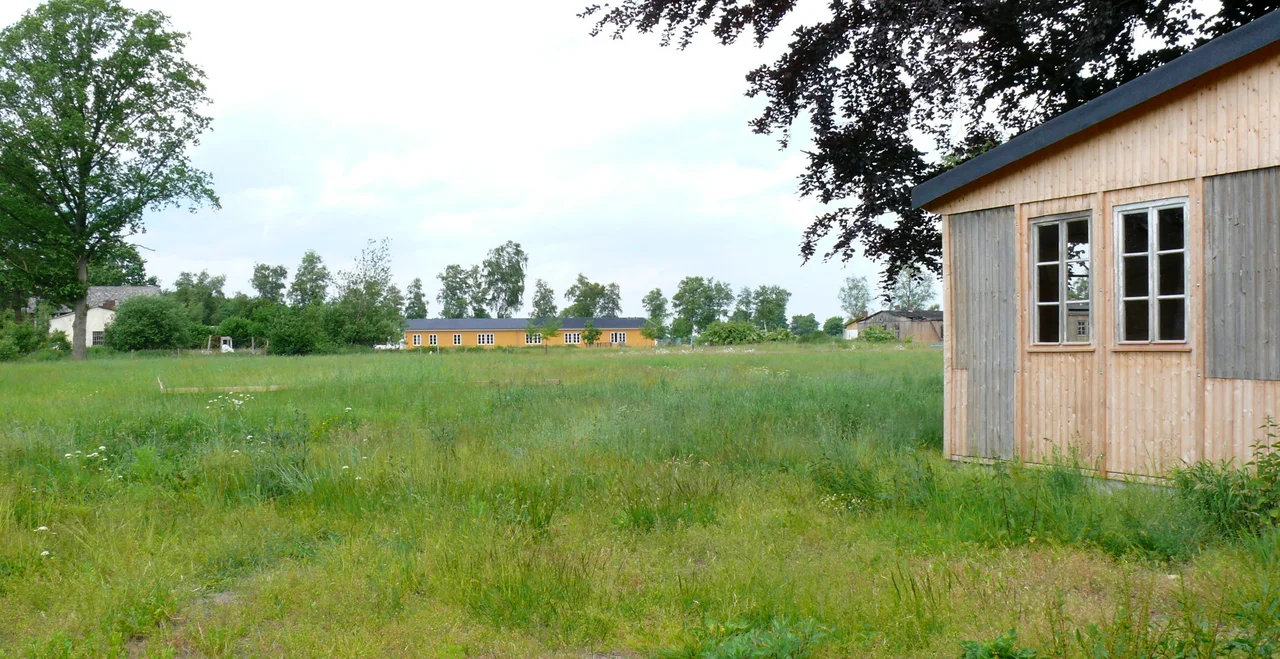
In April 1945 at least 8,000 prisoners from Neuengamme concentration camp were pushed into a section of Sandbostel and left there without food or medical care; at least 3,000 of them died between the twelfth and the twenty-ninth. On 20 April most of the SS guarding that compound marched out with several hundred prisoners, after which the POWs began sharing their own rations with the dying men next door. The camp commandant had already agreed to hand control to the prisoners under the French colonel Marcel Albert, and on 21 April two of them walked out and carried an appeal for help to the Guards Armoured Division at Zeven. Fighting held the relief up until 29 April, when British XXX Corps reached the gate and found around 15,000 surviving POWs and some 8,000 Neuengamme survivors. Soldiers who saw it called the place Little Belsen. Hundreds kept dying every day afterwards regardless. The site was later a British internment camp, then a prison, then a Bundeswehr store, and in 1974 a business park with a riding stable, a militaria shop and a brothel. A foundation was established in 2004 and the Gedenkstätte Sandbostel opened in 2007, with its permanent exhibition following in April 2013. More than twenty of the original huts survive, most of them standing in the part of the camp where the Soviet prisoners were held.
From the Air
The former Stalag X-B lies at approximately 53.3996N, 9.1098E, on flat farmland between the village of Sandbostel and the Oste valley in the Rotenburg district of Lower Saxony - 9 km south of Bremervörde and about 43 km northeast of Bremen. From the air the memorial site reads as a rectangular cluster of long, low, dark-roofed huts set apart from the surrounding fields, with the war cemetery a short distance away. Recommended viewing altitude is 1,500 to 3,000 feet AGL; the terrain is unrelieved and gives no natural landmark, so track the Oste or the Bremervörde-Zeven road in. Bremen Airport (EDDW) is roughly 45 km southwest, Hamburg (EDDH) about 70 km east, and Nordholz (ETMN) some 50 km northwest. Ground fog forms readily over this low, wet country on still mornings from autumn through spring.
Nearby Stories
- Stadland 9.3 km away
- Hatten 9.5 km away
- Schnoor 11 km away
- Hohe Weg Lighthouse 17 km away
- Hurricane Festival 21 km away
- Ahlden House 37 km away
- Großer Knechtsand 47 km away
- Lilleø 194 km away