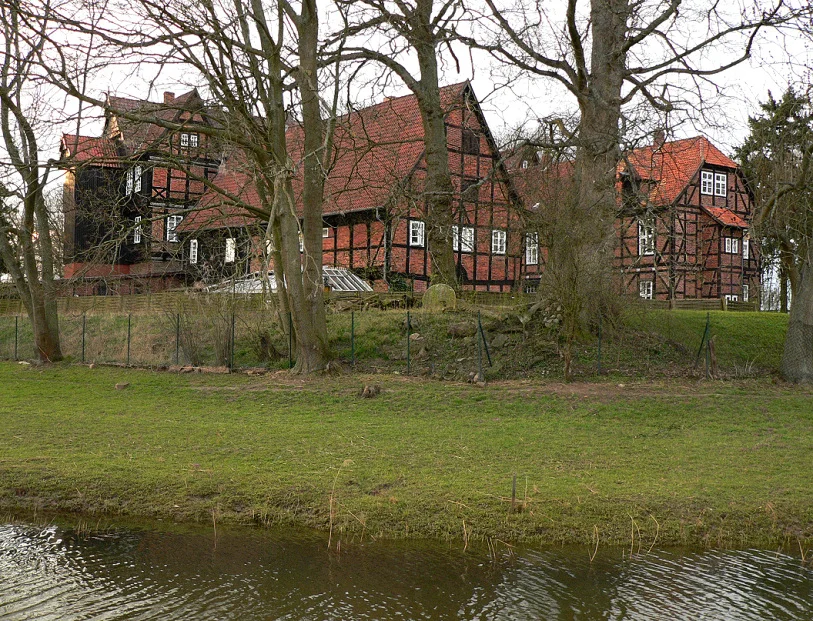

Ahlden House
The terms were specific. She could walk in the courtyard. Later, under escort, she could take the garden, and later still she could be driven out - but no more than two kilometres from the house, and always with an officer. She could not remarry. She could not see her children. Her name was struck from the official documents of the court she had married into. Sophia Dorothea of Celle arrived at Ahlden House in the winter of 1694, twenty-eight years old and freshly divorced, and she was still there when she died in November 1726 at the age of sixty. In those years her husband became King George I of Great Britain and her son became King George II. Neither of them ever saw her again.
A Water Castle That Lost Its Water
The house went up in 1549 as a moated seat on the Aller, on the flat edge of the Lüneburg Heath, opposite the older castle of Bunkenburg - a thirteenth-century fortification whose ruins still sit in the low ground across the water. Then the river left. In a flood in 1618 the Aller shifted its channel eastward, and because an embankment downstream diverted the Leine into the abandoned bed, it was the Leine that ended up flowing past Ahlden instead; since 1648 that channel has been the half-dry oxbow the locals call the Old Leine. The defences went the same way. In 1690 the rampart was levelled to make room for a French pleasure garden, and in the nineteenth century the moats were filled in altogether. A water castle now stands on dry ground next to a river that is not the one it was built beside.
Three Wings and a Falling Beam
Most of the house is timber-framed; only the ground floor of the west wing is brick. The three two-storey wings form a horseshoe around a courtyard once almost entirely enclosed, and they held stables and coach houses as well as living rooms. The south wing is the oldest surviving part, finished in 1579 under Duke William the Younger of Brunswick-Lüneburg according to an inscription cut into one of its beams, and its courtyard face carries a lavishly decorated Renaissance front. The west wing came in 1613, built for Duke Christian the Elder by his seneschal Johann Behr; you can still find the recesses in the entrance passage where the drawbridge sat. That construction went badly. A roof joist worked loose during the work and came down on the crew, seriously injuring fourteen men. The north wing was rebuilt in 1705 by the architect Johann Caspar Borchmann because it was falling apart, and the gatehouse that once guarded the approach - clearly drawn on Merian's engraving of about 1654 - was pulled down around 1800.
The Prisoner of Ahlden
Sophia Dorothea was born at Celle Castle in September 1666 and married George Louis in November 1682, into a court that treated her as an unfortunate necessity. By the early 1690s she was involved with a Swedish count, Philip Christoph von Königsmarck. On the night of 11 July 1694, after a meeting with her at the Leineschloss in Hanover, Königsmarck walked out and was never seen again. The marriage was dissolved on 28 December that year, with Sophia Dorothea named as the guilty party, and she was brought to Ahlden. Her allowance was substantial - eight thousand thalers a year, later rising to twenty-eight thousand - and her mother was permitted to visit as often as she liked. Everything else was withheld. She lived out three decades in the horseshoe of timber wings, in a house comfortable enough to be called a residence and closed enough to be called what it was. When she died George I forbade mourning in London and in Hanover, and her body was carried to the Stadtkirche in Celle the following May and buried secretly, at night.
The Working Building
For most of its life the place was an office rather than a prison. The princely Amt of Ahlden was created in 1431, and the house belonged to it: an Amtmann collected the district's taxes and farmed the state estate attached to the building, and justice had been dispensed in Ahlden since 1310. The Thirty Years' War reached it as well - imperial troops under Tilly took the house after a day's siege and then successfully held it against eight hundred Danish besiegers. From 1726, the year Sophia Dorothea died in it, Ahlden became the residence of the state seneschals. Major alterations from 1784 adapted it for administration and fitted it with a prison of a more ordinary kind. The Amt was finally dissolved in 1884 after roughly 450 years and its functions moved to the district of Fallingbostel; the district court sat in the building until 1972.
The Courtyard Stays Open
By the 1970s the house needed serious work, and state funds covered a restoration completed in 1975 at a cost of 90,000 marks. What happened next was an unusual bargain: an antiques auction house bought the building for its headquarters, on the condition that the courtyard remain open to the public through the day. That is still the deal. Ahlden is a private residence and a working art auction business, and the only way to see inside is to turn up while the lots are on view before a sale. Nearly five centuries of ducal politics, provincial bureaucracy and one very famous confinement, and the front door now opens for people who came to look at furniture.
From the Air
Ahlden House stands at approximately 52.7592N, 9.5579E, on the southern edge of the Lüneburg Heath in the Heidekreis district of Lower Saxony, in the village of Ahlden beside the old Aller channel now known as the Old Leine. From the air, look for the horseshoe of three long steep-roofed wings around an open courtyard, set among trees on the north bank of the river a few kilometres upstream of the Aller-Leine confluence; the braided river meadows around it are the clearest navigational feature in otherwise flat farmland. Recommended viewing altitude is 1,500 to 2,500 feet AGL. Hannover-Langenhagen (EDDV) lies roughly 50 km southeast, Bremen (EDDW) about 70 km northwest, and the military field at Celle-Wietzenbruch (ETHC) some 35 km east. River valley fog is common here on calm mornings from autumn into spring.
Nearby Stories
- Eschede train disaster 9.9 km away
- Hurricane Festival 13 km away
- Herrenhausen Gardens 19 km away
- Worpswede 21 km away
- Lüneburg 24 km away
- International Wind- and Watermill Museum 25 km away
- Minden 32 km away
- Schnoor 36 km away