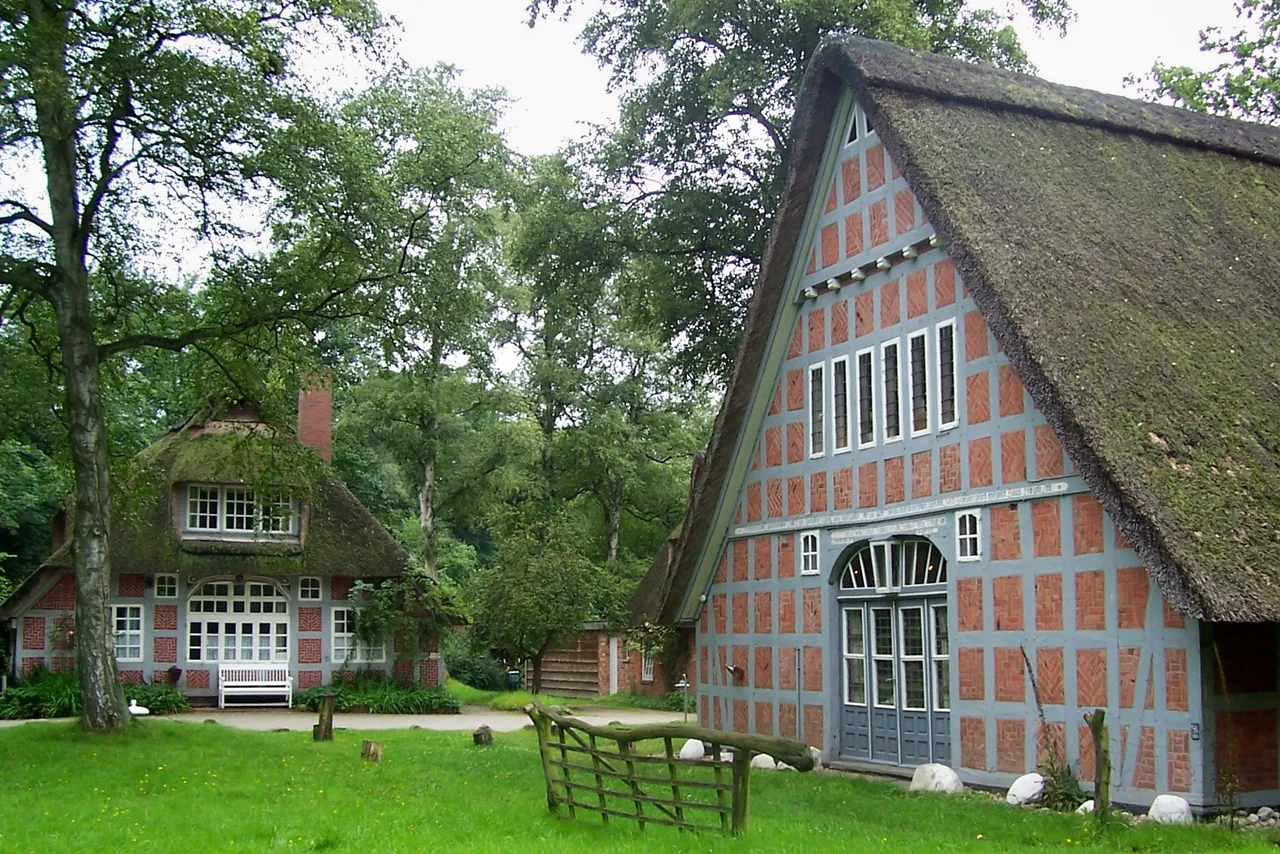

Worpswede
In 1900 two art students climbed the church tower on the Weyerberg and rang the bells for fun. The village below heard a fire alarm. The two were duly fined, and neither Clara Westhoff nor Paula Becker had the money to pay, so the parish accepted payment in kind. Look up inside the Church of Zion today and the settlement is still there: cherub heads modelled by Westhoff at the pendentives, floral ornaments by the woman who would sign herself Paula Modersohn-Becker running along the columns to the ceiling. Westhoff would marry Rainer Maria Rilke the following year. Becker had seven years left to live and was about to change what German painting could do. Worpswede is a village of roughly that density - a few hundred houses on the edge of a drained bog, where an unreasonable share of German art history happened to occur.
A Shopkeeper's Daughter Starts It
The colony begins with an act of ordinary kindness. In 1884 Mimi Stolte, daughter of a Worpswede shopkeeper, was staying with her aunt in Düsseldorf when she met Fritz Mackensen, a young art student with no money. She invited him home for the holidays. He came, looked at the Teufelsmoor - the Devil's Moor, a vast flat peatland under an enormous sky - and in 1889 he moved there for good. Others followed: Hans am Ende, Otto Modersohn, then Fritz Overbeck, Carl Vinnen and Paula Becker, who married Modersohn. Writers came through as well, among them Gerhart Hauptmann and Thomas Mann. Rilke arrived, stayed, and in 1903 published a monograph simply titled Worpswede that fixed the place in the German imagination. Mackensen never forgot where it started; a memorial tablet he made still stands in front of the Stolte family's shop.
What They Came For
The landscape they painted was manufactured. Worpswede was first recorded in 1218, but the moor around it stayed impassable until 1750, when the moor commissioner Jürgen Christian Findorff began draining the Teufelsmoor and settling colonists on it. What that produced is a horizon almost without interruption - black peat, birch stands, canals carrying flat-bottomed barges of cut turf to Bremen - broken only by the Weyerberg, the low hill the village sits against. On top of it stands the Church of Zion, built between 1757 and 1759 to plans by Johann Paul Heumann, court architect to George II of Great Britain and Hanover, who as supreme governor of the Hanoverian Lutheran church helped pay for it. Its tower went up in 1798, and it turns up again and again in the colony's paintings for the simple reason that it is the only vertical thing for miles.
Paula
Paula Modersohn-Becker painted in Worpswede and in Paris, in short intense bursts, working toward something no one around her was doing - flattened, weighted, unsentimental figures and still lifes that read now as the doorway into German modernism. She died on 20 November 1907, aged thirty-one, of an embolism, eighteen days after giving birth, during the extended bed rest her doctors had prescribed. Rilke, who had known her for years, spent two nights in Paris the following autumn writing Requiem for a Friend, a poem about a woman whose work and life were made to compete for the same hours. She is buried in the churchyard that spreads around the Church of Zion, among roughly eighty graves of painters, writers, musicians and craftspeople. Twenty years after her death, Bremen opened a museum devoted entirely to her paintings - the first anywhere in the world dedicated to a woman painter.
Barkenhoff
In 1895 Heinrich Vogeler bought a cottage, planted birches around it, and named it Barkenhoff for the trees. It became the social centre of the colony, and when a railway was pushed through the moor Vogeler was handed the job of designing its stations. The Worpswede station opened in 1910 and is the only one on its line still in its original shape; it serves food now. Then the First World War killed Hans am Ende and broke something in Vogeler. He came back a pacifist, joined the Communist Party, divorced Martha, abandoned the romantic manner that had made his name and turned to painting workers. In 1931 he emigrated to the Soviet Union; in 1941 the Soviet authorities deported him to Kazakhstan, where he died in 1942. Barkenhoff spent years as a children's home and reopened as a Heinrich Vogeler museum in 2004. Martha built her own place nearby, the Haus im Schluh, still run by their descendants as museum, guesthouse and weaving mill.
The Second Generation, and the Cheese Bell
Bernhard Hoetger arrived and built compulsively - the Niedersachsenstein, the Grosse Kunstschau, the café called Kaffee Verrückt, his own house Hinterm Berg - before going on to shape Bremen's Böttcherstraße, so the two places carry the same fingerprints. The strangest building came from a man who failed at art entirely. Edwin Koenemann came in 1908 hoping to be an artist, ended up making a living as a tour guide, and in the early 1920s was handed an issue of Bruno Taut's magazine Frühlicht with plans for a domed house nobody had built. He built it, on the Weyerberg, in 1926, following Taut's façade closely and inventing his own interior around a central chimney with the stairs winding up like a snail shell. The village named it the Käseglocke - the cheese bell - and it has been a museum since 2001. About 130 artists and craftspeople still live in Worpswede today.
From the Air
Worpswede lies at approximately 53.2222N, 8.9278E, some 20 km north-east of Bremen on the edge of the Teufelsmoor in Lower Saxony. From the air the giveaway is the terrain: a flat, dark, geometrically drained peatland cut by straight canals and ditches, with the Weyerberg rising as a modest wooded bump on the village's southern side and the Church of Zion's spire on top of it. Recommended viewing altitude is 1,500 to 3,000 feet AGL, low enough to read the drainage grid that Findorff's colonists cut into the bog. Bremen Airport (EDDW) is roughly 30 km south-west; Hannover-Langenhagen (EDDV) about 110 km south. The moor generates ground fog readily on still autumn mornings, which is precisely the light the painters came for and precisely the visibility you do not want.
Nearby Stories
- Wildeshausen 1.9 km away
- Hurricane Festival 2.6 km away
- Wittemoor Timber Trackway 6 km away
- Butjadingen 14 km away
- Ahlden House 17 km away
- Visbek 44 km away
- Jade Bight 51 km away
- Lilleø 209 km away