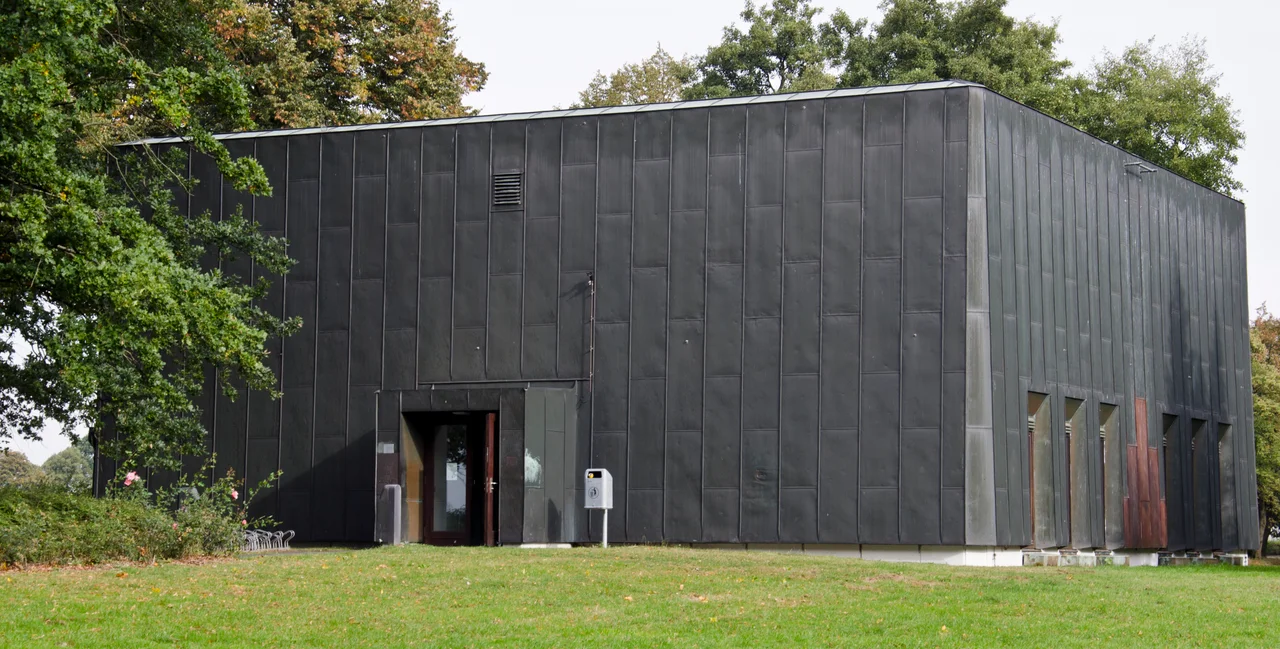

Neuengamme concentration camp
In 1937 Hitler designated five cities to be rebuilt as showpieces of the regime, and Hamburg was one. Its Elbe waterfront was to be remade in dark clinker brick, and bricks on that scale need clay, kilns and labour. In September 1938 the SS-owned Deutsche Erd- und Steinwerke bought a disused brickworks and half a million square metres of marshland at Neuengamme, southeast of the city; that December a hundred prisoners arrived from Sachsenhausen to build the camp that would make them. At least 42,900 people died in the system that grew out of it.
Annihilation Through Labour
The phrase is the SS's own — Vernichtung durch Arbeit — and it described policy, not consequence. Prisoners worked ten to twelve hours a day on rations so thin that most new arrivals were dead within three months, and dysentery killed more people here than any other disease. Men slept on the barrack floor until three-tier bunks went in during 1941; from 1944 two or three shared each bunk.
Three work details were known among the prisoners as the death commandos: cutting the canal through to a branch of the Elbe, working the clay pit, hauling the excavated soil. The ground was heavy wet peat and the tools were inadequate. From 1942 the business shifted from bricks to weapons, and firms including Messap, Jastram and the Walther works built plants inside the wire, using workers they did not have to pay.
What People Held On To
Prisoners kept hold of each other anyway — small groups they defended, drawing, woodcarving, arguments about books, poems and songs recited from memory. John William, a French resistance fighter sent here in 1944 after helping to sabotage a factory at Montluçon, discovered his singing voice trying to lift the men around him, and became a well-known singer after the war.
Others did not get out. Fritz Pfeffer, the dentist who had hidden in the Amsterdam annexe with Anne Frank's family, died here in December 1944. Johann Trollmann, stripped of the German light-heavyweight title in 1933 because a Sinti boxer was not to hold it, was beaten to death at Neuengamme's Wittenberge subcamp in April 1944.
Twenty Children
Kurt Heissmeyer, an SS physician from Berlin, held a theory that had already been discredited: that injecting live tuberculosis bacilli would immunise the patient. He tested it on people the regime classified as racially worthless. In the autumn of 1944, twenty Jewish children were brought from Auschwitz to Neuengamme for his use — the youngest five, the oldest twelve. Their lymph nodes were cut from under their arms and sent to a laboratory.
They had names. Mania Altmann, five, and Eleonora Witońska, five, both from Radom, with Eleonora's brother Roman, six. Marek James, six, from Radom. Sergio De Simone, seven, from Naples. Riwka Herszberg, seven, from Zduńska Wola. Alexander Hornemann, eight, from Eindhoven, and his brother Eduard, twelve. Jacqueline Morgenstern and Georges-André Kohn, both twelve, from Paris. Walter Jungleib, twelve, from Slovakia.
On 20 April 1945, with British forces closing on Hamburg, the children were driven to a disused school at Bullenhuser Damm, given morphine and hanged in the basement. Four adult prisoners who had looked after them were killed with them: the French doctor René Quenouille, the French chemist Gabriel Florence, and the Dutch orderlies Anton Hölzel and Dirk Deutekom.
Heissmeyer went home to eastern Germany and practised as a lung specialist until 1959. Tried in 1966, he told the court he had not considered camp inmates to be of full human value; he died in prison the following year. Arnold Strippel, who oversaw the killings at the school, was never convicted of them and died in 1994. The basement is a memorial now, with a rose garden outside planted for the children.
The Ships in the Bay
On 19 April 1945 the order came to clear the main camp. Over the following week more than nine thousand prisoners were taken out and loaded onto four ships in the Bay of Lübeck: the liners Cap Arcona and Deutschland and the steamers Thielbek and Athen. They were held in the holds for days without food or water. The order came from Hamburg's Gauleiter, Karl Kaufmann; at the postwar trial the city's SS and police chief said they were to be killed on Himmler's orders.
On 3 May, RAF Hawker Typhoons attacked. Word that the ships were packed with prisoners did not reach the squadrons in time. Cap Arcona burned and rolled over, Thielbek went down fast, and people who reached the water were strafed from the air or shot by SS men on shore. Around seven thousand died; roughly 450 prisoners lived. Bodies washed up along the Baltic beaches for weeks, and the last was found in 1971.
What the Ground Became
In March 1946 fourteen camp officials went on trial before a British military court in Hamburg, the first of thirty-three trials of Neuengamme staff. Prisoners from six countries gave evidence about the 197 Soviet prisoners of war gassed in the arrest bunker on 25 September 1942, the 251 gassed four weeks later, and the experiments. Eleven of the fourteen were hanged that October, among them the commandant, Max Pauly.
The ground itself was harder to settle. Hamburg built a prison on it in 1950, where the barracks had stood, and prisons ran there until February 2006. The first memorial was placed at the far northern edge, on the old SS plant nursery — soil fertilised with ash from the crematorium — safely away from the working jail. A full museum opened only in 2005.
Only a tenth of the camp's records survive; the SS made prisoners clear the site before the end. The House of Remembrance lists 23,394 people by name, and the verified total is at least 42,900. A plaque set into the memorial ground in 2025 names the seventy countries they came from.
From the Air
The Neuengamme memorial lies at 53.4274°N, 10.2263°E in Hamburg's Bergedorf district, in the flat Vierlande marshes about 20 km southeast of the city centre and 3 km south of the Elbe. From 1,500-3,000 ft the site reads as a long rectangular clearing set among drained fields and glasshouse nurseries, with the surviving brickworks and its chimney at the southern end and the straight camp canal running toward a branch of the Elbe. The whole area sits beneath Hamburg's terminal airspace with busy arrival and departure flows — coordinate before loitering. Hamburg (EDDH) is about 25 km northwest, Hamburg-Finkenwerder (EDHI) about 30 km west, and Lübeck (EDHL) about 55 km northeast. Marsh fog is frequent on autumn and winter mornings and can sit below 200 ft over the Vierlande well into the day.
Nearby Stories
- Ebstorf Abbey 6.7 km away
- Stones Fan Museum 22 km away
- Hurricane Festival 30 km away
- Sieben Steinhäuser 32 km away
- Ludwigslust Palace 39 km away
- Großer Knechtsand 101 km away
- Scharhörnbake 134 km away
- Lilleø 149 km away