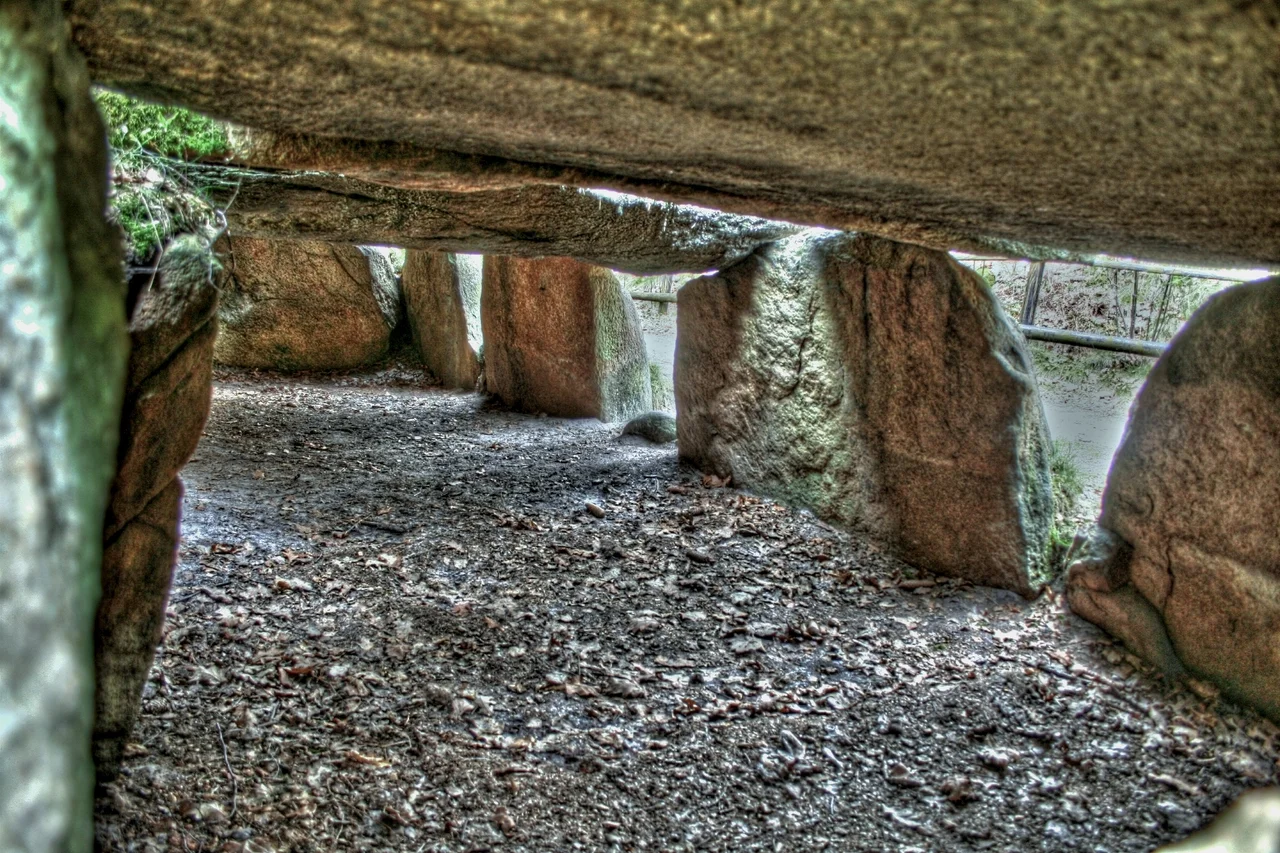

Sieben Steinhäuser
The road in is swept for unexploded ammunition. It starts at a barrier near Ostenholz, runs several kilometres through ground that is closed to the public on every working day of the year, and it is open only at weekends and on public holidays, between eight in the morning and six in the evening, and only when no exercise is under way. At the end of it, in a shallow dip beside a stream on the Lüneburg Heath, five stone chambers built by farmers roughly five thousand years ago sit inside earth banks that the German army threw up to keep artillery rounds from landing on them. The Sieben Steinhäuser are among the finest megalithic tombs in northern Germany. They are also, by some distance, the hardest to visit.
Five Houses Called Seven
Start with the name, because it is wrong and has been for a long time. Sieben Steinhäuser means seven stone houses; there are five graves and there is no evidence there were ever more. An illustration made in 1744 already shows five, and the first written record of the site, from 1720, gives no larger figure. The likeliest explanation is grammatical rather than archaeological. Seven does duty in German for an unspecified quantity - Siebensachen, seven things, is what you call all your belongings when you pack them - and the people who named these chambers were probably saying something closer to a whole lot of stone houses than seven of them. The tombs were counted by somebody who did not count.
What the First Farmers Left
They were built in the third millennium BC by communities of the funnel beaker culture, the first settled farmers of this landscape, and they are graves before they are anything else. Each chamber is rectangular and aligned northeast to southwest, roofed with capstones that rest not on continuous walls but on three or four points of contact, which is what gives them their improbable, propped look. Grave A runs 6.5 by 2 metres inside, with four supporting stones down each side and three capstones over the top, the middle one narrower than the others and broken; the entrance sat in the middle of the southeastern flank, though only its pair of pillars survives. Grave D is the one people photograph, and it is unlike its neighbours - closer in form to tomb types found in France, where the other four resemble the graves of the Elbe-Weser Triangle to the north. Its capstone measures 4.6 by 4.2 metres and is half a metre thick, over a squat chamber roughly 4 by 3 metres. None of this was meant to be seen. Every one of the graves was originally buried under an earth mound, and what stands exposed today is the skeleton of a monument that wind and weather stripped.
Then the Artillery Arrived
A local official had the site placed under protection as early as the first half of the nineteenth century, and formal cultural monument status followed in 1923. Four of the graves were excavated and restored between 1924 and 1937. What happened in between is the strange part: the German army laid out an enormous training area right across this stretch of heath, and rather than clearing the tombs it built around them. In the summer of 1936 the army administration threw an earth wall a metre and a half high around the site, and in 1958 - by which time the range had passed into NATO hands and the guns had got a great deal heavier - the graves were enclosed in ramparts several metres high, specifically to absorb the impact of shells. The result is a Neolithic cemetery in a bunker, defended by the same force that puts it at risk.
Five Thousand Years, and One Bad December
Stone that has stood since before the pyramids can still come down without warning. In December 2013 Grave C collapsed, and the site was structurally repaired and restored over July and August of 2015. It is a useful corrective to the way these places are usually described. A dolmen is not a permanent object; it is an arrangement of very heavy pieces that has held its balance for a long time and will not hold it forever, and the propped capstones that make the Sieben Steinhäuser photogenic are exactly the feature that makes them fragile. Add ground vibration from an active gunnery range and the arithmetic gets worse. The tombs survive because people keep deciding, decade after decade, that they should.
The Heath Around Them
The setting is quietly beautiful in the way this country is: open heath and pine at 56 to 67 metres above the sea, with a stream called the Hohe Bach running north to south past the graves on its way to the Meiße and eventually the Aller. Bad Fallingbostel lies to the northwest, Bergen to the east, and the whole area is thick with prehistoric burial ground - the Bonstorf Barrows, the Dohnsen-Siddernhausen dolmen, the Oldendorfer Totenstatt, all within reach on the same heath. That density is the point worth carrying away. This was not an isolated monument on empty land. It was one cemetery among many in a populated Neolithic landscape, and the reason it survives so completely is that for the last ninety years almost nobody has been allowed to walk on it.
From the Air
The Sieben Steinhäuser lie at approximately 52.8006N, 9.7975E, near the centre of the Bergen-Hohne Training Area on the Lüneburg Heath in Lower Saxony, at 56 to 67 metres above sea level. This is active restricted military airspace and range activity is frequent - check NOTAMs and treat the whole training area as avoid-by-default. From outside the boundary the range reads as a large tract of heath, pine block and bare impact ground with no settlement in it, unmistakably different from the farmed land around it; Bad Fallingbostel sits off its northwestern corner and Bergen off its eastern edge, with the A7 autobahn and the Walsrode interchange to the southwest. Hannover-Langenhagen (EDDV) is roughly 60 km south, Bremen (EDDW) about 85 km northwest, and the air base at Faßberg (ETHS) some 30 km northeast. Heath haze and low cloud are common in autumn.
Nearby Stories
- Eschede train disaster 9.9 km away
- Hurricane Festival 13 km away
- Herrenhausen Gardens 19 km away
- Worpswede 21 km away
- Lüneburg 24 km away
- International Wind- and Watermill Museum 25 km away
- Minden 32 km away
- Schnoor 36 km away