
Expo 2000
Kraftwerk was paid US$190,000 for five seconds of music. The jingle - a vocoded voice saying the name of the fair - became the signature sound of Expo 2000, and when Chancellor Gerhard Schröder was asked about the fee he said he "wouldn't have spent so much money." As a line item it was trivial against a world exposition that ended roughly US$600 million in the red. As a story it stuck, because it confirmed what a lot of Germans already suspected about the whole enterprise: expensive, clever, and impossible to explain. The fair ran in Hanover from 1 June to 31 October 2000, the only world exposition Germany has staged since the war. Twenty-five million people came. Forty million had been expected.
Won by One Vote
The Bureau International des Expositions awarded the fair to Hanover on 14 June 1990, beating Toronto by twenty-one votes to twenty. A single delegate decided it. Two years later the city council published a survey of local opinion and found that 51.5 per cent of area residents supported hosting - another margin so thin it barely qualified as a mandate. Studio Arnaboldi/Cavadini of Locarno won the master-plan competition in 1992, working in a joint venture with Albert Speer und Partner, and a dedicated company was set up in 1994 to build and run the thing. Construction began on 22 April 1996. The site went up on the Hanover fairground, already the largest exhibition ground in the world, with a further 600,000 square metres opened up alongside its existing million.
Nobody Could Say What It Was
Earlier expos had shown off what the present could do. Expo 2000 proposed instead to present solutions for the future, which is a considerably harder thing to put on a poster. The advertising was described at the time as cerebral, and it did not help. The Berlin marketing firm Scholz & Friends said flatly that "the organizers have failed to convey to the public a clear image of what Expo 2000 is going to be: an entertainment park, a blown-up museum, or a nature reserve." Sponsors hesitated for the same reason - Ralf Strobach of Hanover's Citizens' Initiative for Environment Protection observed that companies had spent a long time unsure whether they were funding an eco-show or a technology showcase - and sponsorship was not cheap: US$4.8 million to become an official product supplier, US$14.5 million to become a world partner. Neither was a ticket. Pre-ordered admission cost 69 marks, at a time when Germany's fifty-three main theme parks averaged around thirty.
The Buildings Made the Case
The architecture, meanwhile, argued for the fair far better than the campaign did. Shigeru Ban built the Japanese pavilion as a gridshell of recycled paper tubes; German building control refused to certify a structure held together at the joints with tape, so a secondary wooden frame was added, and the honeycomb went up in three weeks. Peter Zumthor's Swiss pavilion was stacked larch and Scots pine held by steel rods and springs. MVRDV's Dutch pavilion, at thirty-six metres the tallest structure on the site, piled six Dutch ecosystems on top of one another under the slogan "Holland creates Space," with a lake and windmills on the roof generating the building's power. Portugal's, by Álvaro Siza Vieira and Eduardo Souto de Moura, wore fifty-five tonnes of expanded cork. The ZERI pavilion, an enormous bamboo hall, was raised by forty-one Colombian woodworkers from more than 4,500 guadua canes and had to be built twice - once in Manizales, once in Hanover - before the final permit came through the day before opening. It drew an estimated 6.4 million visitors, and it had no doors and no queues.
The Empty Plot
A hundred and fifty-five nations took part. The United States, having agreed to attend, reversed the decision late, and the ground reserved for the American pavilion sat undeveloped for the whole five months - a rectangle of nothing in the middle of a fair about the future. Final attendance was 25,210,000 against a projection of forty million, and the shortfall did what shortfalls do to a budget built on gate receipts. Once the numbers were visibly failing, a new campaign was hurried out at the German domestic market with the British actor Peter Ustinov and the television star Verona Feldbusch, this time selling fun rather than ideas, under the slogan Das gibt's nur einmal, es kommt nie wieder - this only happens once, it's never coming back. The slogan was accurate. It was also about four months late.
Scattered Across Two Continents
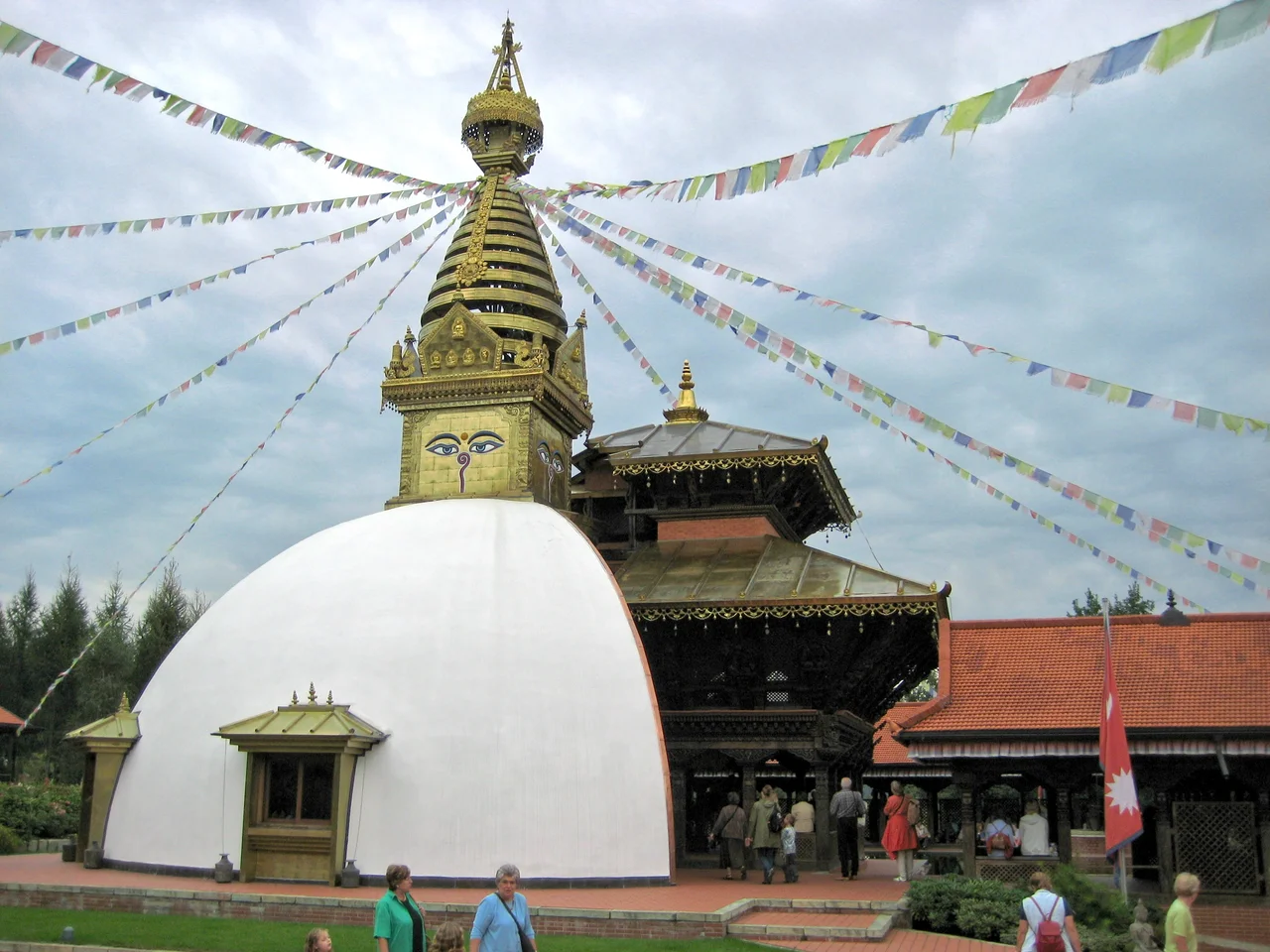
Most of the national pavilions were demolished, or dismantled and shipped home, and the fair's afterlife scattered widely. The Christ Pavilion was rebuilt at Volkenroda monastery in 2001. Mexico's went to the art college in Braunschweig, the Nepal Himalaya Pavilion to Wiesent near Regensburg with a botanical garden around it, and a glass sculpture called United Earth, shown in the Polish pavilion, now stands at the centre of the European Parliament's agora in Strasbourg. Bertelsmann's Planet m, which had an elevator that carried 200 people at a time, became a building of the University of Applied Sciences Hannover. The Dutch pavilion stayed put, was looted, and stood derelict with its windows smashed for years until MVRDV announced restoration plans in December 2017. The exhibition grounds went back to hosting the trade fairs they had hosted since 1949, and the area around Expo Plaza became Hanover's district for information technology, design, media and the arts. The fair failed. The site did not.
From the Air
The Expo 2000 site occupies the Hanover fairground at 52.3217N, 9.8122E, on the southeastern edge of the city near Laatzen in Lower Saxony, about 8 km from the centre. From the air it is one of the largest built footprints in northern Germany: over 1.6 million square metres of pale hall roofs laid out in a regular grid, with the Expo Plaza quarter and its surviving pavilions on the southeastern side and the low Kronsberg ridge rising just east of it. The Hermesturm tower marks the fairground centre. The A7 autobahn runs along the eastern edge and the Messe/Laatzen rail station serves the site directly, so the linear infrastructure makes the complex easy to identify from several kilometres out. Hannover-Langenhagen (EDDV) lies roughly 20 km north-northwest; expect its controlled airspace over the whole area. A viewing altitude of 2,000 to 3,000 feet AGL frames the entire fairground. During major fairs the site generates heavy road and rail traffic and occasional temporary restrictions.
Nearby Stories
- Fagus Factory 11 km away
- Lengede 13 km away
- Intercity Experimental 14 km away
- Eschede train disaster 20 km away
- Goslar 21 km away
- Ahlden House 24 km away
- Externsteine 24 km away
- Schöma 52 km away