
Lengede
On 3 November 1963 an exploratory drill broke through into a cavity fifty-six metres beneath a field outside Lengede, and the men at the surface heard tapping come back up the hole. It had been ten days since the mine flooded. The rescue operation had been on the point of ending — the management had already started making arrangements for funerals — and this section of the workings was so old that no accurate plans of it existed. The drill had been sunk on the insistence of miners who knew their colleagues and knew where they would have run.
Eight in the Evening
Washing iron ore takes water, and at the Mathilde mine the water was held in artificial settling ponds sitting directly above the underground workings. On the evening of 24 October 1963, at around eight o'clock, pond number twelve gave way. Roughly 475,000 cubic metres of water and mud went into the mine.
One hundred and twenty-nine men were underground. Seventy-nine of them got out immediately, walking and running for the shafts as the water came through. That left fifty men somewhere below, in a mine that was filling, in the dark, with no way of telling anyone where they were.
Seven, Then Three
A group of seven was located and reached with a drill. When the water level dropped the next day, they were floated out.
Four more had made it to the raised end of a gallery. It lay below the water line, but the air trapped at the high end held the flood back like a diving bell, and the pocket became the only thing keeping them alive. Rescuers drilled down some seventy-nine metres and pumped compressed air ahead of themselves to protect it. Three of the four came up on 1 November. The fourth had died while they worked. The survivors were lifted one at a time in the Dahlbusch Bomb, a torpedo-shaped steel capsule barely forty centimetres across, in which a man stands upright with his arms pinned at his sides — then spent hours in a pressure chamber before they could be released. By now reporters had arrived from all over the world: 366 newspapermen and 83 radio and television staff, camped at a pithead in a village most of them had never heard of a week earlier.
The Old Man
Twenty-one men had run the other way, into a worked-out section that miners call the Alter Mann — the Old Man — abandoned, unmapped and already partly caved in.
It was the worst place to be and the only place to go. Falling rock killed several of them outright. The ventilation was poor and got worse. After a while the lamps went dark, and the survivors sat in a collapsing void with no light, no air movement and no reason to believe anyone knew they existed. Above ground, the operation was winding down. It was miners at the surface, thinking through what their colleagues would have done in the seconds after the water came, who argued that the Old Man had to be drilled. Nobody could tell them exactly where to put the bit.
Four More Days
When the tapping came back up the borehole on 3 November, the rescuers lowered food, then water, then a microphone. Ludwig Erhard, three weeks into his term as chancellor, arrived on 6 November and spoke down the hole to the men at the bottom of it.
Then the real drilling began, and it had to be done carefully. Normal practice used water to flush the cuttings, but water was judged too heavy for ground this fragile below forty metres, so compressed air was used instead. At six in the morning on 7 November the shaft reached them. Two miners rode the capsule down to help their colleagues into it, one at a time, and one at a time the eleven survivors came up. They had been underground for fourteen days.
What It Cost
West Germany called it the Wunder von Lengede, the Miracle of Lengede, and for a country in the middle of its economic miracle the name did double duty. The eleven were on every front page in Europe.
Twenty-nine men died. When the mine was finally cleared, it became clear that some of them had also survived the flood and had lived roughly a fortnight underground, in sections nobody reached in time. One man was never found at all. Legal proceedings ground on for some five years over who, if anyone, was responsible for a settling pond that emptied itself into a working mine, and in the end nobody was prosecuted.
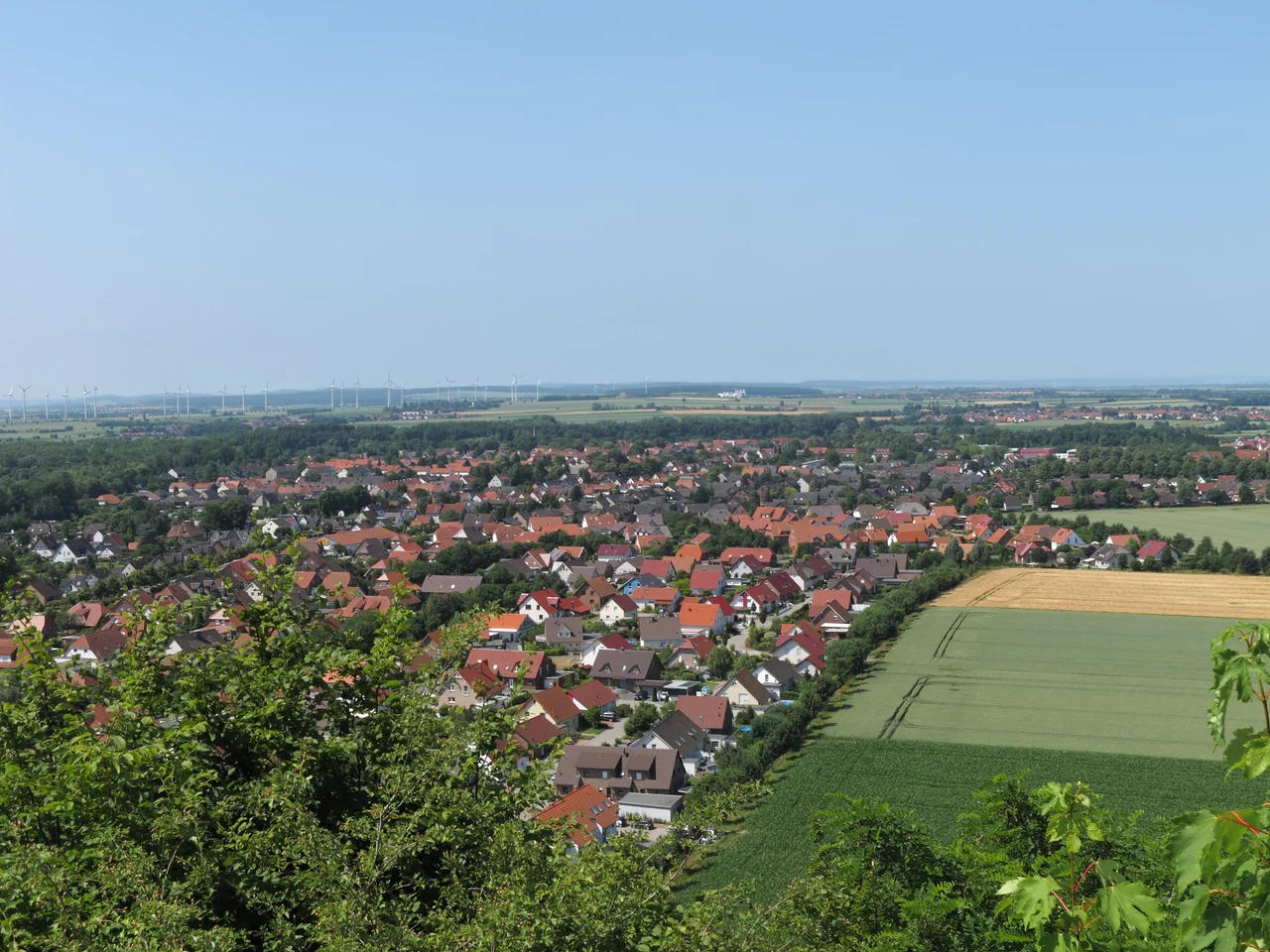
Lengede today is an unremarkable municipality of five villages — Barbecke, Broistedt, Klein Lafferde, Woltwiesche and Lengede itself — eighteen kilometres southwest of Braunschweig, with no headframe left standing. The ground under the fields still holds the shape of what happened there.
From the Air
Lengede lies at 52.2049°N, 10.3078°E, on flat farmland in the Peine district about 18 km southwest of Braunschweig and 40 km southeast of Hanover. There is no dramatic terrain here — from 1,500-3,000 ft you are looking at a patchwork of sugar-beet and grain fields with five village clusters scattered across it, the Fuhse stream threading north, and the industrial mass of the Salzgitter steelworks unmistakable about 10 km south. The disused mine ground and its former settling ponds lie immediately around the village. Braunschweig-Wolfsburg (EDVE) is roughly 20 km northeast and is the field whose airspace applies; Hildesheim (EDVM) is about 25 km west and Hannover (EDDV) about 50 km northwest. The Harz rises to the south and generates afternoon cumulus in summer; autumn and winter bring persistent low stratus and radiation fog over this whole basin.
Nearby Stories
- Upper Harz Water Regale 4.5 km away
- Schöningen spears 6.4 km away
- Herrenhausen Gardens 9.9 km away
- GEO600 14 km away
- Bode Gorge 15 km away
- International Wind- and Watermill Museum 17 km away
- Holzminden prisoner-of-war camp 26 km away
- Gardelegen Massacre 39 km away