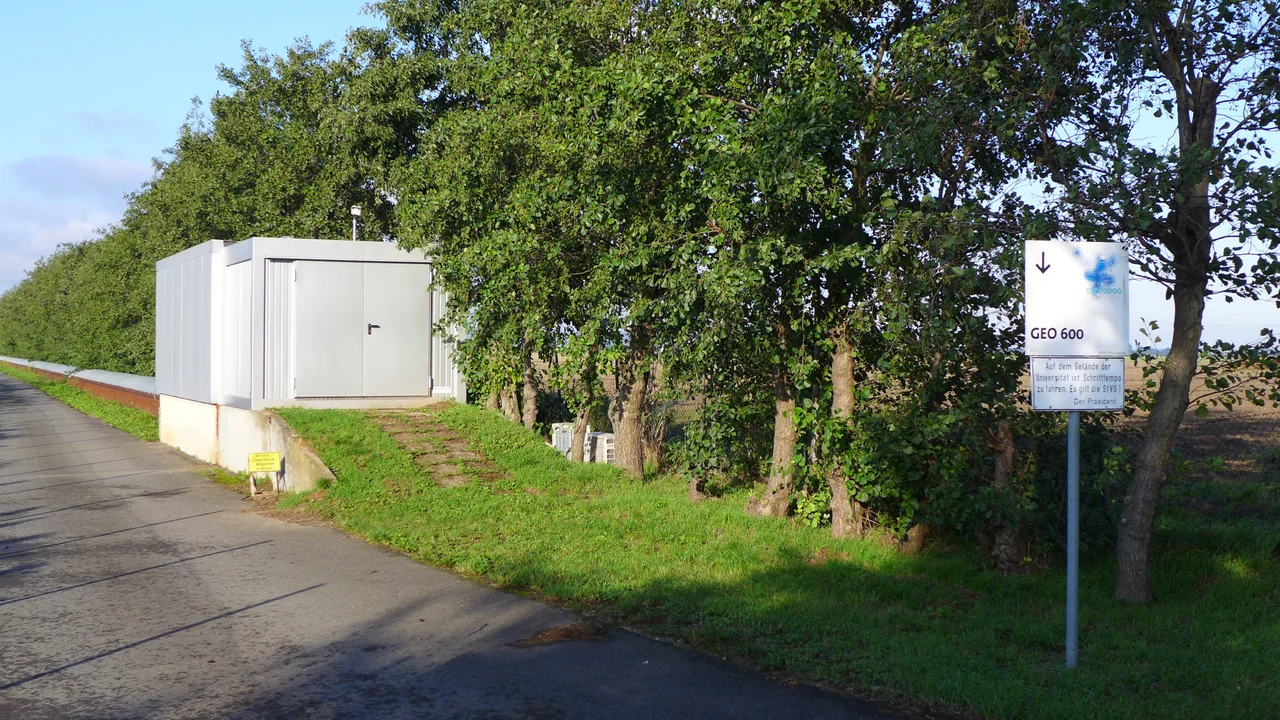

GEO600
There is nothing to look at. Two shallow trenches run across farmland near Sarstedt, twenty kilometres south of Hannover, each six hundred metres long, meeting at a right angle, each covered by a corrugated steel tube that could pass for a drainage culvert if it were not so implausibly straight. Inside the tubes is a vacuum emptier than the space between planets. Inside the vacuum a laser beam bounces between hanging cylinders of glass, and the machine's whole purpose is to notice if the distance between them changes by a fraction of the width of a proton - which is what happens when a gravitational wave from a pair of colliding black holes passes through Lower Saxony. GEO600 has never caught one. It is still one of the most consequential instruments in the field, because nearly every trick the detectors that did catch them depend on was proved out here first.
Two Trenches in a Field
The layout is a Michelson interferometer, scaled up and made monstrously precise. A laser is split in two, sent down two perpendicular arms, bounced back and recombined; change one arm's length relative to the other and the beams interfere differently. GEO600's arms are 600 metres long and the beam runs each one twice, for an effective optical path of 1,200 metres. The optics sit in ultra-high vacuum at less than a hundred-millionth of a millibar. The main mirrors are fused silica cylinders eighteen centimetres across and ten thick; the beam splitter, twenty-six across and eight thick, is the only piece of glass the full-power beam must pass through rather than bounce off, so it was cut from a special grade of silica. Unlike LIGO and Virgo, GEO600 has no resonant cavities in its arms at all - a deliberate divergence, and part of why it became a laboratory rather than a rival.
Glass Hung From Glass
At this sensitivity everything is noise. A mirror hanging on a wire hears the wire; a mirror with a magnet glued to it hears the glue. So GEO600's main mirrors hang from fibres of the same fused silica the mirrors themselves are made of - monolithic suspensions, chosen because silica loses less mechanical energy than steel, and mechanical loss is noise wearing a different hat. The secondary mirrors, less critical, keep their steel wires and glued-on magnets pushed around by coils. The main mirrors are moved instead by electrostatic drives: combs of electrodes behind the glass that raise an uneven electric field the mirror can feel but never touches. A ring of heaters at the far east mirror warms it so that thermal expansion tunes its radius of curvature. And the entire suspension cage rides on piezoelectric crystals that shove it in the opposite direction to whatever the ground is doing, cancelling the planet out.
The Small One That Wrote the Playbook
Construction began in September 1995, a German-British project run by the Max Planck Institute for Gravitational Physics and Leibniz University Hannover with Glasgow, Birmingham and Cardiff. It has taken data alongside LIGO since 2002 and reached design sensitivity in 2006, with a peak of about two parts in ten thousand billion billion per root hertz at 600 Hz - limited by laser power at the high end and by seismic ground motion at the low. What matters more is what it demonstrated. Signal recycling, in which an extra mirror at the output forms a resonant cavity with the far mirrors and amplifies a potential signal. Homodyne readout. An output mode cleaner filtering light that cannot be carrying a signal. And, most striking, squeezed vacuum injected into the dark port of the beam splitter - manipulating quantum uncertainty itself to buy a factor of about 1.5 in sensitivity above 700 Hz. These are now standard equipment in every large detector on Earth.
The Hologram That Wasn't
By 2007 the collaboration was reporting, openly and in public talks, that it had unexplained noise in the middle of its frequency band. Craig Hogan, a physicist at Fermilab, proposed something more exciting than a loose cable: that the noise was real - the quantum graininess of spacetime itself, predicted if the universe encodes its information holographically. In 2009 New Scientist ran it as a cover story about living inside a hologram. The chronology is less cinematic than the coverage. Hogan's own Physical Review D paper of May 2008 cites a 2007 GEO600 talk that had already described the mid-band 'mystery' noise, and a GEO600 paper submitted in October 2007 said much the same. Karsten Danzmann, the project's principal investigator, offered the deflating and correct answer: the daily business of improving these experiments always throws up excess noise. Usually you find the cause and it goes away. This one did.
Still On, Until December
On 14 September 2015, when the two Advanced LIGO detectors registered the first gravitational wave ever observed, GEO600 was in engineering mode and would not have been sensitive enough regardless. It joined the observing run four days later. Its contribution has been stubbornness: from September 2011, with LIGO and Virgo both down for upgrades, it was the only large laser interferometer on the planet still watching, and it stayed on again through the shutdowns of 2020. Its output includes not just the main photodiode but microphones, seismometers, accelerometers and magnetometers, and volunteers have long sifted that data on home computers through Einstein@Home. After thirty-one years, the instrument is scheduled to shut down for good on 31 December 2026. Its techniques leave the field in far better shape than they found it.
From the Air
GEO600 sits at 52.2469N, 9.8083E on open farmland near Sarstedt in the Hildesheim district of Lower Saxony, roughly 20 km south of Hannover. It is a genuinely difficult target to spot: the two 600 m arms are covered by low corrugated tubes barely wider than a farm track, and the only real giveaway is the perfect right angle they make against the irregular field boundaries around them, with a small cluster of buildings at the corner. Low, raking light and a viewing altitude of 1,000 to 2,000 feet AGL give the best chance; from higher up it vanishes into the field pattern entirely. The terrain is flat lowland farmland with the Leine valley running north toward Hannover, and the built-up areas of Sarstedt and Hildesheim make the easiest reference points. Hannover-Langenhagen (EDDV) is about 25 km north and its Class C airspace reaches down over this area, so coordinate before any low work. Braunschweig-Wolfsburg (EDVE) lies roughly 50 km east. Winter fog in the Leine lowlands is frequent and persistent.
Nearby Stories
- Fagus Factory 11 km away
- Lengede 13 km away
- Intercity Experimental 14 km away
- Eschede train disaster 20 km away
- Goslar 21 km away
- Ahlden House 24 km away
- Externsteine 24 km away
- Schöma 52 km away