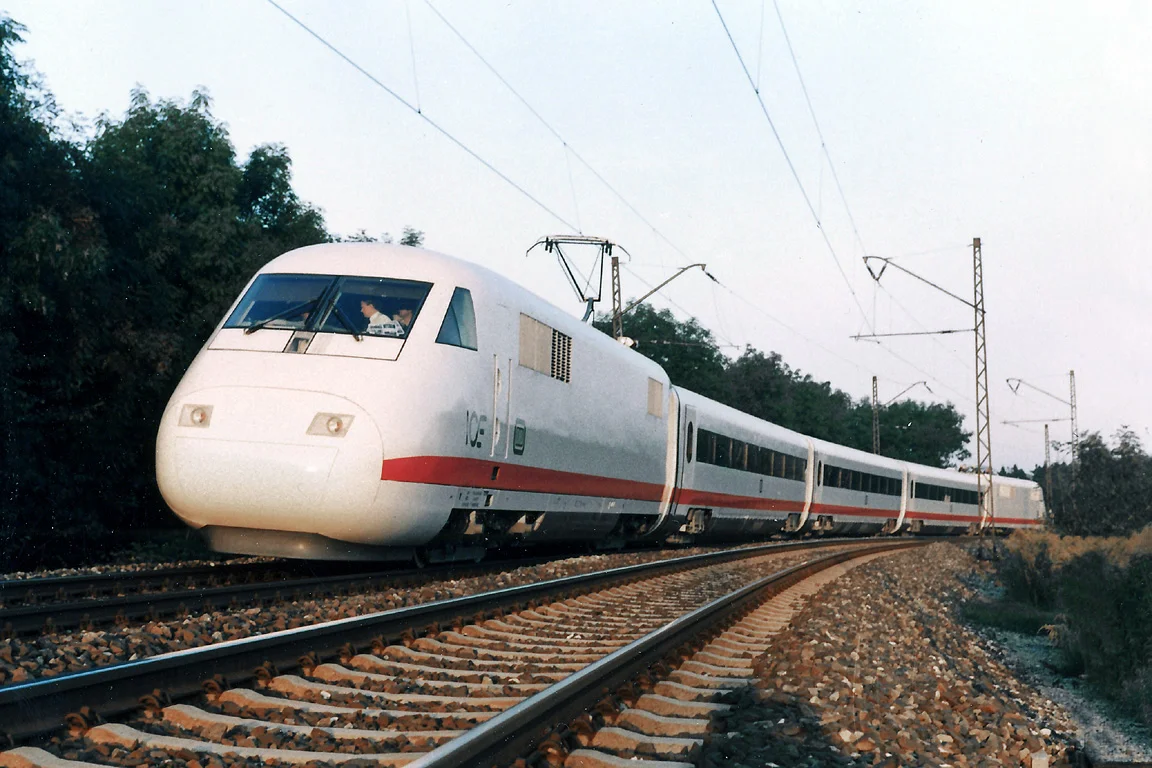

Intercity Experimental
On 1 May 1988, on a stretch of new railway near Gemünden am Main that had not yet opened to the public, a four-car German test train reached 406.9 kilometres per hour. It was the fastest anything had ever gone on steel wheels, and it settled a question that had been open in German transport policy for twenty years. The train was called the Intercity Experimental, later renamed ICE V, and it was not designed to carry anybody anywhere. It was designed to prove a point — and every Intercity Express running in Germany today descends from it.
A Question Asked in 1968
The federal research ministry commissioned a study in 1968 on whether high-speed rail made technical and economic sense in Germany. The results came back in 1971 saying the railways needed to go faster, and in 1972 the ministry took the lead on developing the technology to do it. A working group under the heading Rail/Wheel was set up at the Bundesbahn Central Offices in Minden. It had a rival from the beginning. Ministry money was also flowing into magnetic levitation, into the Transrapid programme and the great test loop built out on the Emsland moors, and for years the two approaches were funded side by side without anyone being willing to say which would win. Meanwhile the conventional side accumulated paper. Messerschmitt-Bölkow-Blohm proposed a 300 km/h train for 200 to 600 passengers in 1978. It was never built.
Named on the Day the Money Arrived
The concept that survived was a train with two power cars and a rake of coaches between them, backed by the ministry through a notice in the federal register on 10 February 1981. Then it stalled, because the ministry could not fully secure industry's participation, and the Bundesbahn — which had already voted to start — had to wait. Financing was finally secured on 6 September 1981, and on the same day the project shed its engineering designation, R/S-VD, and became the IC Experimental. The 1982 plan called for six coaches and space for six hundred passengers. What was actually built was leaner: two Class 410 power cars and up to three Class 810 intermediate coaches, one of them packed with measuring equipment while the others demonstrated what a modern high-speed interior might feel like. Each power car weighed 78 tonnes and delivered up to 3,640 kilowatts. Under the aerodynamic shell and the corporate livery, they were closely related to the Class 120 locomotives the Bundesbahn already had.
Everyone Built a Piece of It
The programme was spread across German industry in a way that looks less like procurement than like a national project. Development began in September 1983 under Bundesbahn leadership in Munich, with manufacturing starting before the year was out. Krupp, Henschel and Krauss-Maffei built the mechanical parts of the power cars; Siemens, AEG and Brown, Boveri & Cie supplied the electrics; Friedrich Krupp in Essen finished power car 410 001 and Thyssen-Henschel in Kassel finished 410 002. The electrical assembly was ready by October 1984, and in January 1985 the bodyshells went onto their chassis. The coaches came from Messerschmitt-Bölkow-Blohm's contract of 1984, were built by Duewag at Krefeld-Uerdingen, finished by Linke-Hofmann-Busch at Salzgitter and taken to Donauwörth for their electrical fit-out. Half a dozen companies that had spent the century building tanks, aircraft and locomotives were now building one train.
317, Then 407
The train was delivered in 1985 and went public on 26 November that year with a run at 317 km/h, timed to the celebrations for 150 years of German railways. Not everything went smoothly. On 3 September 1986 at the Burgsinn depot on the Hannover-Würzburg line, a set of points was thrown underneath the train and power car 410 001 derailed at 15 km/h. Operations resumed ten days later as a three-car formation, and for ten months one of the coaches ran with a driver's cab hastily fitted into it so the test programme would not slip further. Then came 1 May 1988 and 406.9 km/h. The record lasted nineteen months before a French TGV Atlantique took it in December 1989, but it remains the German rail speed record to this day, and it did what it was built to do: it demonstrated that wheel on rail could go fast enough that levitation was not required.
Where It Ended Up
Deliveries of the ICE 1 power cars, now Class 401 and directly derived from the ICE V's, began in 1987 — before the record run that made the prototype famous. After that the experimental train was mostly used for materials evaluation, the unglamorous work of finding out what fatigues and what does not. It was retired in 1998 and replaced by the ICE S. Power car 410 002 has been in the Deutsches Museum's transport collection in Munich since April 2006. Power car 410 001, together with one of its coaches, sits at the research and technology centre in Minden, visible from outside the perimeter fence. Two of the middle coaches had been scrapped by 2010. There is a neatness to the Minden ending: the working group that started all of this in 1972 was convened in that same town.
From the Air
The coordinates 52.2911°N, 8.9397°E place this at the railway research and technology centre in Minden, on the Weser in eastern North Rhine-Westphalia, where power car 410 001 is preserved. From the air, Minden's standout feature is the Wasserstraßenkreuz — the Mittelland Canal crossing directly over the Weser on an aqueduct, one of the clearest man-made landmarks in northern Germany and visible from a considerable distance. The cathedral and the compact old town sit on the west bank. About 8 km south, the Weser breaks through the hills at the Porta Westfalica gap, with the Kaiser Wilhelm monument on the eastern shoulder. Sightseeing altitudes of 1,500-3,000 ft AGL are ideal for picking out the canal crossing and the rail yards. Nearby airports include EDDG (Münster/Osnabrück) to the west, EDDV (Hannover) to the east and EDDW (Bremen) to the north. The Weser valley fogs readily on calm autumn mornings.
Nearby Stories
- Schöma 6.8 km away
- Meller Möbelfabrik 12 km away
- RAF Gütersloh 15 km away
- Hermannsdenkmal 16 km away
- Electorate of Hanover 17 km away
- Fagus Factory 23 km away
- Ahlden House 23 km away
- Diepholz 41 km away