.jpg)
Hermannsdenkmal
Ernst von Bandel was seventy-five years old at the unveiling. He had laid the foundation stone in October 1838, when he was thirty-eight, and had then watched the money dry up, the public lose interest, and his own fortune go into the work to keep it moving. He stopped in 1846 and did not resume in earnest for a quarter of a century. What rescued the project was not art but politics: after the German Empire was proclaimed in 1871, a monument to Germanic unity suddenly had a constituency, and the Reichstag voted the funds. Bandel stood on the Grotenburg on 16 August 1875 to watch his statue unveiled before Emperor William I, the Crown Prince and a crowd of twenty to thirty thousand. He was showered with honours. He died thirteen months later.
Twenty-Six Metres of Copper
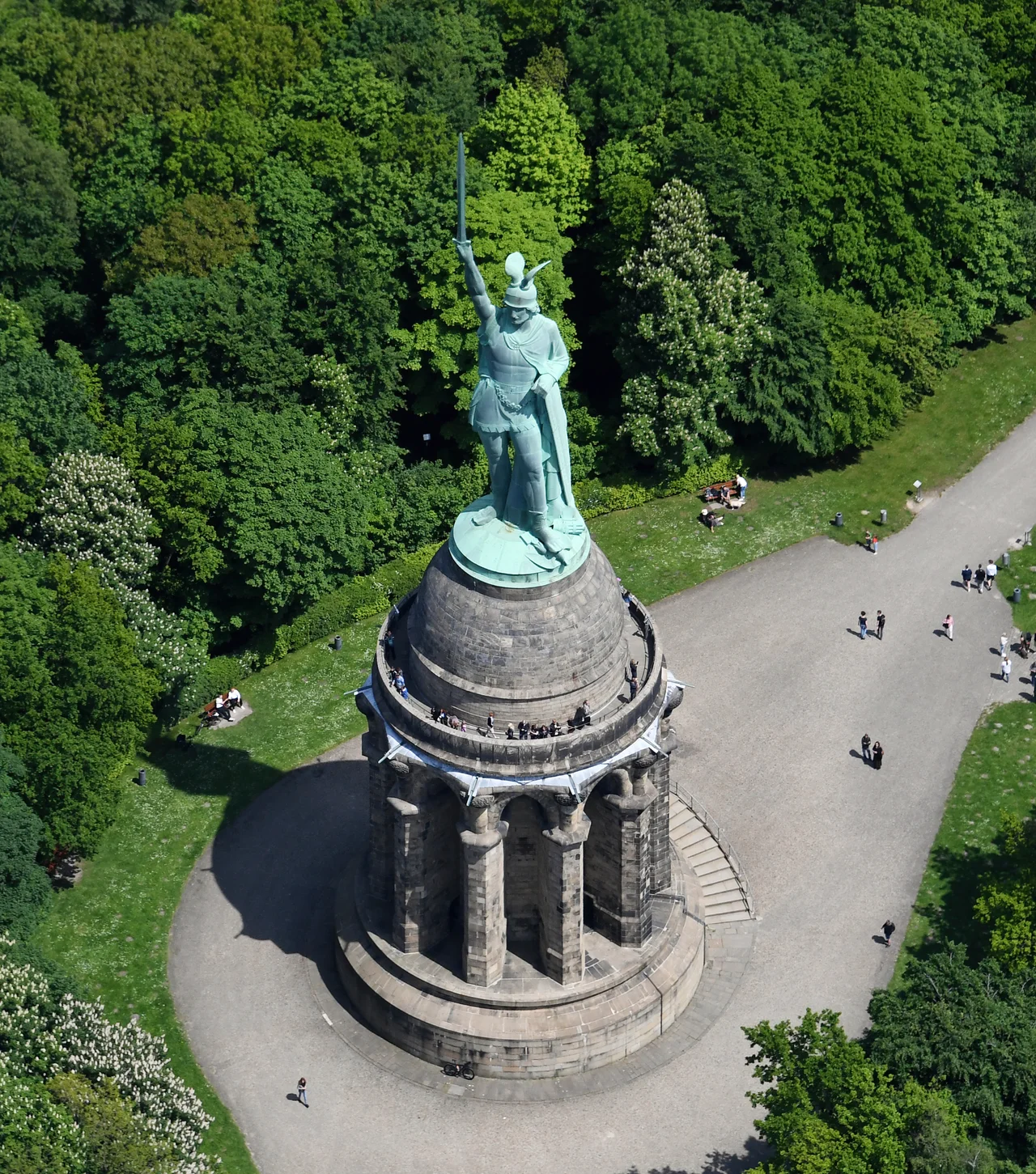
What he built is enormous and, close up, oddly thin. The figure is 26.57 metres tall, the whole monument 53.46 metres including its sandstone pedestal, and the statue itself is a shell: roughly two hundred copper plates riveted together over an iron frame, weighing something like 11.8 tonnes. The raised sword alone is seven metres long and about 550 kilograms.
Every detail argues a case. The figure faces west - partly because Varus's legions were thought to have come from that direction, and partly because the sworn enemy in 1875 was France. The clothing is what the nineteenth century believed ancient Germans wore, and the body is what Bandel considered a typically Germanic one. The left foot rests on a Roman eagle, the legionary standard; beside it lies a fasces, the emblem of Roman judicial authority. The sword blade carries gold lettering: German unity my strength, my strength Germany's might.
What Happened in 9 AD
The event underneath all this is real and was genuinely catastrophic. In 9 AD Arminius, a chieftain of the Cherusci who had served Rome as an auxiliary cavalry commander, turned on the provincial governor Publius Quinctilius Varus and led an alliance of Germanic tribes into an ambush that destroyed three Roman legions. The vast majority of those men - soldiers, servants, camp followers, families - never came out of the woods. Rome called it the Varian disaster, and Augustus never got over it.
Historians have argued for two centuries about what it changed. The defensible version is that it contributed to the Roman Empire's decision not to hold the country east of the Rhine. That is a considerable thing, and it is much less than the monument claims.
The Wrong Hill
Bandel built where he did because that was where the battle was believed to have happened. It almost certainly did not. Archaeological work has since pointed strongly to Kalkriese, near Osnabrück - about a hundred kilometres north-west of the Grotenburg.
The name is a similar story. Roman writers referred to the saltus Teutoburgiensis, and the wooded ridge running through Lippe was assigned that name in the nineteenth century, when this stretch of country was being fitted out as a national landscape. The forest was named after the battle, not the other way round. None of which has dislodged the statue, and the region's identity is now firmly built on it.
Hermann Was Not His Name
Arminius is a Latin name recorded by Roman authors. What the Cherusci called him is not known. The equation with Hermann dates from the 1520s and may have started with Martin Luther, and by the nineteenth century the substitution was complete.
The rest of the story was assembled with equal care. German nationalism in the 1800s needed a founding figure who had made one people out of many, and Arminius was fitted to the role on the grounds that he had united the tribes. Roman accounts of the tribes fighting one another were simply ignored, as was the fact that Arminius was killed some years later by rivals among his own people. This is worth naming plainly, because the monument is otherwise very persuasive: the unity it celebrates was a nineteenth-century political programme projected back eighteen hundred years onto a man whose alliance did not outlast him.
Herman the German
The politics did not stop in 1875. Hitler visited in 1926, and after 1930 the Nazi Party used the site for assemblies, the Hitler Youth prominent among them; by 1936 the monument was drawing 191,000 visitors a year. The statue has been available to anyone with a use for it, which is the recurring hazard of monuments built to abstractions.
It is also, by now, thoroughly and affectionately domesticated. English speakers call it Herman the German. German emigrants raised a smaller version above New Ulm, Minnesota, in the 1890s. Over 530,000 people a year come up the wooded hill to look at it, and lightning-detection networks record something on the order of 234 strikes a year on or around the figure - a seven-metre copper-sheathed sword held up at 386 metres being, in the end, a lightning rod with opinions.
From the Air
The Hermannsdenkmal stands at 51.912°N, 8.839°E on the Grotenburg, a 386 m hill in the Teutoburg Forest about 5 km south-west of Detmold in the Lippe district. It is one of the easiest landmarks to identify in northern Germany: a single pale green-weathered copper figure, 53 m from base to sword tip, standing alone on a bare hilltop clearing inside otherwise continuous dark forest, with the remains of a circular rampart ringing it. From 2,000-4,000 ft it is visible for a considerable distance in clear air, and it makes a reliable reference for finding the Externsteine a short distance to the south-east. Paderborn-Lippstadt (EDLP) lies roughly 30 km south, Bielefeld (EDLI) about 25 km north-west, Münster/Osnabrück (EDDG) about 75 km west and Hannover (EDDV) about 85 km north-east. The ridge collects low cloud and generates turbulence in strong north-westerly flow; the statue shows best in low afternoon light, which separates the copper from the trees.
Nearby Stories
- Meller Möbelfabrik 6.6 km away
- RAF Gütersloh 9.3 km away
- Intercity Experimental 9.5 km away
- Sababurg 16 km away
- GEO600 22 km away
- Fagus Factory 22 km away
- Niederhagen concentration camp 22 km away
- Warsteiner 29 km away