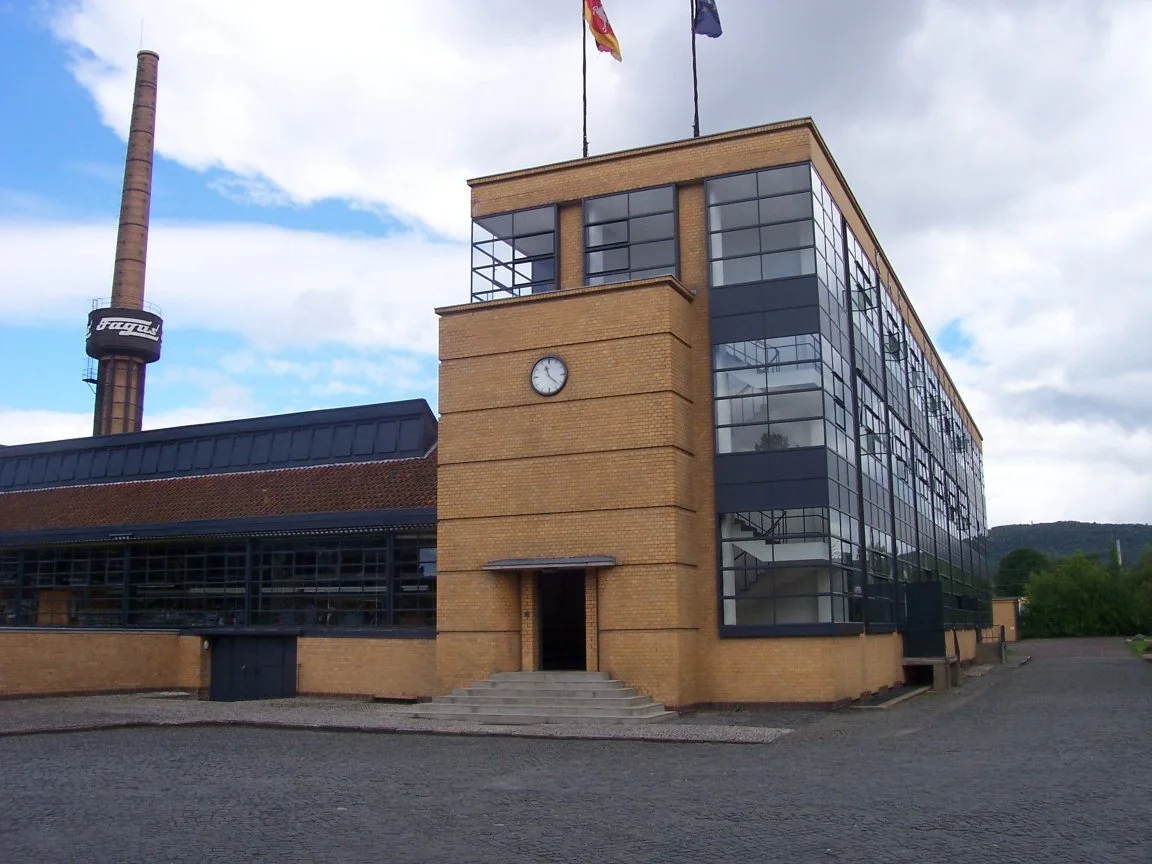

Fagus Factory
Carl Benscheidt chose his building site to be seen. In October 1910 he resigned from the shoe-last firm in Alfeld he had run since 1896, after falling out with the founder's son, and immediately bought the plot directly across the railway line from his old employer's works. The two factories would face each other over the tracks. Benscheidt decided that the elevation on the railway side — the one read at speed, through a train window, by everyone passing up the Leine valley — was going to be a permanent advertisement. Then he went looking for an architect who could make it one.
A Facade Aimed at a Railway
Benscheidt had come to the trade sideways. He started out working for Arnold Rikkli, a practitioner of naturopathic medicine, and it was there that he first met orthopedic shoe lasts — the wooden forms a shoe is built around. Hired in 1887 as works manager at Carl Behrens's last factory in Alfeld, he took over the whole company when Behrens died in 1896 and built it into one of the largest of its kind in Germany.
His new firm had American capital and American expertise behind it, and a competent architect: Eduard Werner, a factory specialist he knew from an earlier renovation of the Behrens plant. Werner's layout was sound. His exteriors were not what Benscheidt wanted. In January 1911 Benscheidt wrote to Walter Gropius, then twenty-seven and largely untested, offering him a strange, narrow commission — redesign the facades of another man's building. Gropius took it, brought in his partner Adolf Meyer, and stayed for fourteen years.
The Corner That Isn't There
Gropius and Meyer had spent the previous year in the office of Peter Behrens, working on his AEG turbine factory in Berlin, finished in 1909. Fagus is their reply to it, and the reply is close to an exact inversion.
Both buildings free their corners of visible support and run glass the full height of the wall between piers. But Behrens capped his corners with heavy masonry slanting inward and set the glass back behind the piers, so the frame reads as load-bearing and the whole thing reads as monumental. At Fagus the corners are simply left open, the piers are recessed, and the glass comes forward to the front plane. The wall stops pretending to hold anything up.
Gropius put it plainly: "The role of the walls becomes restricted to that of mere screens stretched between the upright columns of the framework to keep out rain, cold and noise." He called the effect etherealization, and he cheated to get it — heavier horizontals than verticals in the glazing, longer windows at the corners, taller ones on the top floor, and a black brick base just 40 centimetres high standing four centimetres proud of the yellow brick above.
It Is Made of Bricks
For most of a century, writers described the main building as a steel or concrete frame carrying a curtain wall, on the reasonable grounds that it looks like one. It isn't. During the restoration that began in 1982, the engineer in charge, Jürgen Götz, found plain brickwork rising from the basement with reinforced wood floors above — planks laid on loose sleepers, unable to act as continuous shears and so unable to brace the building at all.
The glazing was equally improvisational. Those tall vertical strips of window that appear to run three storeys are three separate sections, each only floor-to-floor in height, screwed to the building on four sides, with three-millimetre steel plates sealing the wedge between frame and pier. The most famous glass wall in early modern architecture is a superb impression of a glass wall.
Fourteen Years, Interrupted
Construction started in May 1911 and Benscheidt wanted product moving by that winter; he very nearly got it. By winter 1912 the orders had outrun the plant, and the expansion of 1913 roughly doubled the built area, extending the complex to the street on the south side and giving it a second proper face. It was barely finished when the war came. Between 1914 and 1918 only small work was possible — a power house, and the chimney stack that became one of the site's signatures.
Afterwards came the porter's lodge, the enclosure wall, and the unhurried business of the interiors, which Gropius and Meyer designed with teachers and students from the Bauhaus, down to the furniture. A further expansion was drawn between 1923 and 1925 and never built. In 1927 Benscheidt wrote to Gropius that everything would have to stop, for lack of money.
Still Cutting Lasts
UNESCO listed the Fagus Factory in 2011, a century after the first shovel went in, and the listing is unusual because the site never became a monument in the ordinary sense. Benscheidt's buildings are still a working factory, turning out lasts for the shoe industry along with fire-protection products and precision wood-milling machinery, behind Gropius's glass. The company name comes from fagus, Latin for beech — the wood the lasts were originally cut from.
The architectural historian Annemarie Jaeggi has argued that the whole composition was built for a moving eye, its shifts of height and rhythm calculated from the perspective of the railroad tracks. Benscheidt got his advertisement. It has run rather longer than he can have expected.
From the Air
The Fagus Factory stands at 51.9837°N, 9.8126°E, beside the Hannover–Göttingen railway on the edge of Alfeld, in the narrow Leine valley about 55 km south of Hannover. From 1,500–3,000 ft the complex reads clearly: a low run of yellow-brick blocks with one tall chimney, set hard against the tracks, the Leine curving past, and the wooded Sieben Berge and Ith ridges closing the valley to the north-east and west. Low sun catches the glazed corners. Nearest airfields: Hildesheim (EDVM) about 25 km north-east, Hannover (EDDV) about 55 km north, Kassel-Calden (EDVK) about 70 km south-south-west, Paderborn-Lippstadt (EDLP) about 90 km south-west. Terrain is gentle, but the Leine valley holds morning fog well into the day through autumn and winter.
Nearby Stories
- GEO600 11 km away
- Unicorn Cave 15 km away
- Imperial Palace of Goslar 16 km away
- Intercity Experimental 17 km away
- Externsteine 17 km away
- Sababurg 18 km away
- Physikalisch-Technische Bundesanstalt 21 km away
- Eresburg 32 km away