
Physikalisch-Technische Bundesanstalt
When a radio-controlled clock in a German kitchen jumps to the top of the hour, it is obeying a number that began as a count of caesium atoms in a low building on the western edge of Braunschweig. The Physikalisch-Technische Bundesanstalt is where the Federal Republic keeps its second — and its metre, its kilogram, its ampere and its volt. Every scale in every supermarket, every fuel pump, every hospital dosimeter in the country is, through a chain of calibrations, checked against something in this compound.
The Second Lives Here
German law is unusually direct about this. The Units and Time Act names the PTB as the country's sole authority for realising and disseminating the legal units, and specifically entrusts it with the legal time. There is no committee, no vote. There are four primary caesium clocks, two of them fountains, in which laser-cooled atoms are launched gently upward through a microwave cavity and timed as they fall back through it.
What comes out is not a reading of some external clock. It is the definition itself, made physical — the second as the world agreed to build it, assembled from scratch in a temperature-stabilised room in Lower Saxony and compared continuously with the handful of institutes elsewhere doing the same thing. If the number drifts, nothing external corrects it. The institutes correct each other.
Seventy-Seven and a Half Kilohertz
The time gets out of Braunschweig by longwave. DCF77 transmits from Mainflingen, about 27 km southeast of Frankfurt am Main, on 77.5 kHz, its carrier steered by the Braunschweig clocks; Media Broadcast runs the mast on the PTB's behalf. The nominal service radius is 2,000 km, which is enough to cover most of Europe and a good deal of what lies beyond it.
The station has been broadcasting a standard frequency since 1 January 1959, and full date and time information since June 1973. That second date is the one that matters domestically: it is why cheap German alarm clocks stopped needing to be set. Every spring and autumn, tens of millions of devices change hour without a human touching them, all of them listening to the same faint hiss from a field in Hesse. For anyone who prefers a wire to the air, the PTB also runs public NTP servers on the internet and a dial-up time service on the telephone network.
The Business of Being Sure
Time is the famous part. The institute is much larger than that: nine technical-scientific divisions, around sixty departments, more than two hundred working groups, split between Braunschweig and two Berlin sites. In Berlin-Adlershof it operates its own electron storage ring, the Metrology Light Source, producing calibration light from the terahertz range up into the extreme ultraviolet.
Some of the mandate is genuinely strange. Because German law requires it, the PTB grants type approval for gaming machines that pay out winnings. It also once approved voting computers, a duty that quietly evaporated when the Federal Constitutional Court ruled on 3 March 2009 that such machines were inadmissible in German elections. Blank-firing and signal weapons need a PTB proof mark to be sold legally, which is why they are colloquially called "PTB weapons." And a division devoted to technical cooperation exports the least glamorous and most useful thing the institute has: the habit of measuring things the same way twice.
Helmholtz Takes the Job
The lineage runs back to 1887 and the founding of the Physikalisch-Technische Reichsanstalt, an institution built on the argument that a newly industrial Germany could not compete without agreed standards. Werner von Siemens supplied private land in Berlin-Charlottenburg. Hermann von Helmholtz, then the most celebrated physicist in the country, became its first president and served until 1894.
What followed reads like a roll of German physics: Friedrich Kohlrausch, Emil Warburg, Walther Nernst, Friedrich Paschen in the president's chair; Hans Geiger, Max von Laue and Walther Bothe on the staff at various points; Ida Tacke, who with her collaborators identified the element rhenium, working in its laboratories. The institute measured blackbody radiation with a precision that helped force quantum theory into existence — precision instrumentation quietly rearranging the foundations of physics.
From Charlottenburg to Watenbüttel
The record is not clean. Johannes Stark, awarded the Nobel Prize in 1919 and by the 1930s the loudest advocate of a racially defined "German physics," ran the Reichsanstalt from 1933 to 1939; Abraham Esau led it from then until the end of the war. The PTR was dissolved with the Reich it had been named for, and much of what its laboratories had done went with it.
What exists today was re-founded in the west, at Braunschweig-Lehndorf-Watenbüttel, with Wilhelm Kösters taking office as president in 1948. Berlin-Charlottenburg was retained, and a second Berlin site added later. The institute now employs roughly 2,100 people plus around 130 apprentices, on a budget in the region of €290 million, and it is ranked with the American NIST and the British NPL as one of the three senior metrology laboratories in the world. Cornelia Denz has been its president since 2022. None of this is visible from the road, which is the point. The work of the place is to be so reliable that nobody has to think about it.
From the Air
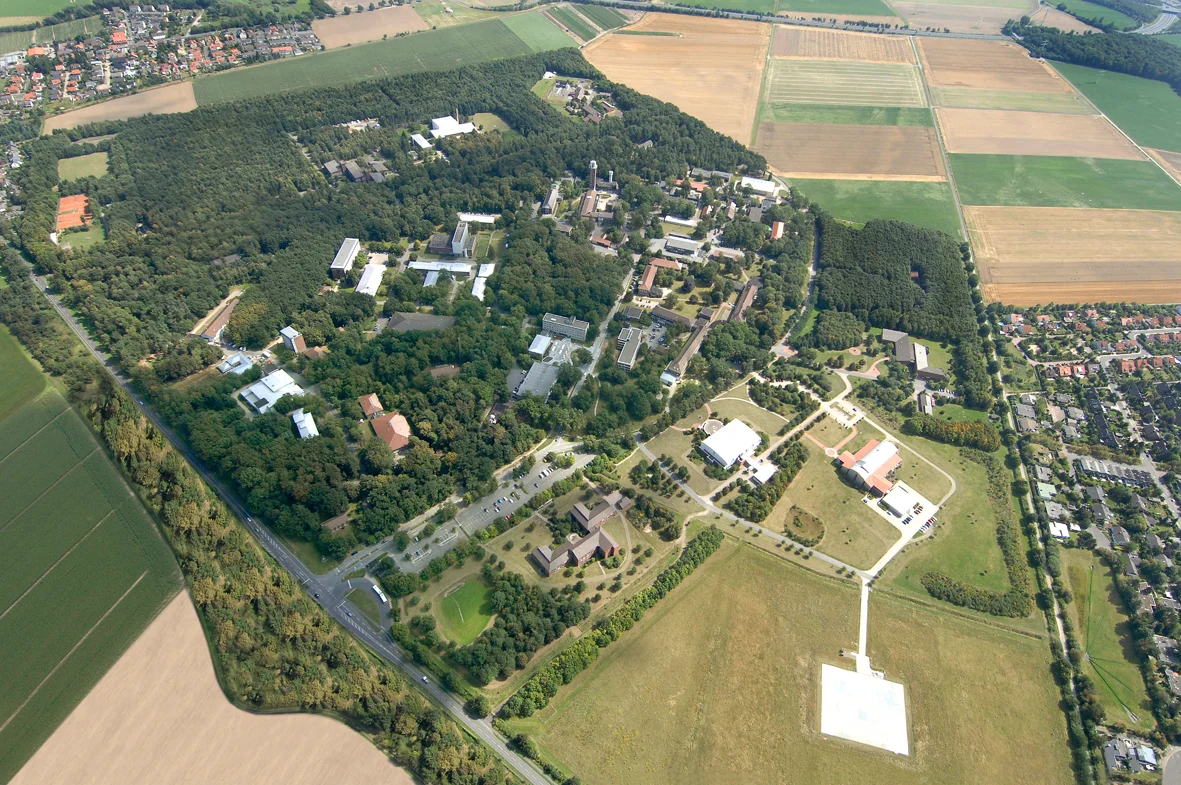
The PTB's Braunschweig campus lies at 52.2953°N, 10.4636°E, in Lehndorf-Watenbüttel on the northwestern edge of the city. From 2,500–4,000 ft it reads as a walled green rectangle of low, widely spaced laboratory blocks and lawn, notably emptier than the industrial and residential grid around it — the spacing is deliberate, since vibration and electromagnetic noise are enemies of the work. Braunschweig-Wolfsburg (EDVE) is about 7 km east-northeast at 52.319°N, 10.556°E and owns the airspace over the city; the A391/A392 autobahn junctions immediately south of the site make a clean visual reference. Hannover (EDDV) sits roughly 55 km west. The Harz ridge 40 km south gives a horizon fix in haze. Expect glider and GA traffic around EDVE on fine weekends, and note that this is a federal facility — keep altitude and stay outside the field's zone unless cleared.
Nearby Stories
- Expo 2000 3.7 km away
- Fagus Factory 5.7 km away
- Ströbeck 13 km away
- Goslar 15 km away
- Helmstedt–Marienborn border crossing 15 km away
- Celle 21 km away
- Sieben Steinhäuser 27 km away
- Stones Fan Museum 49 km away