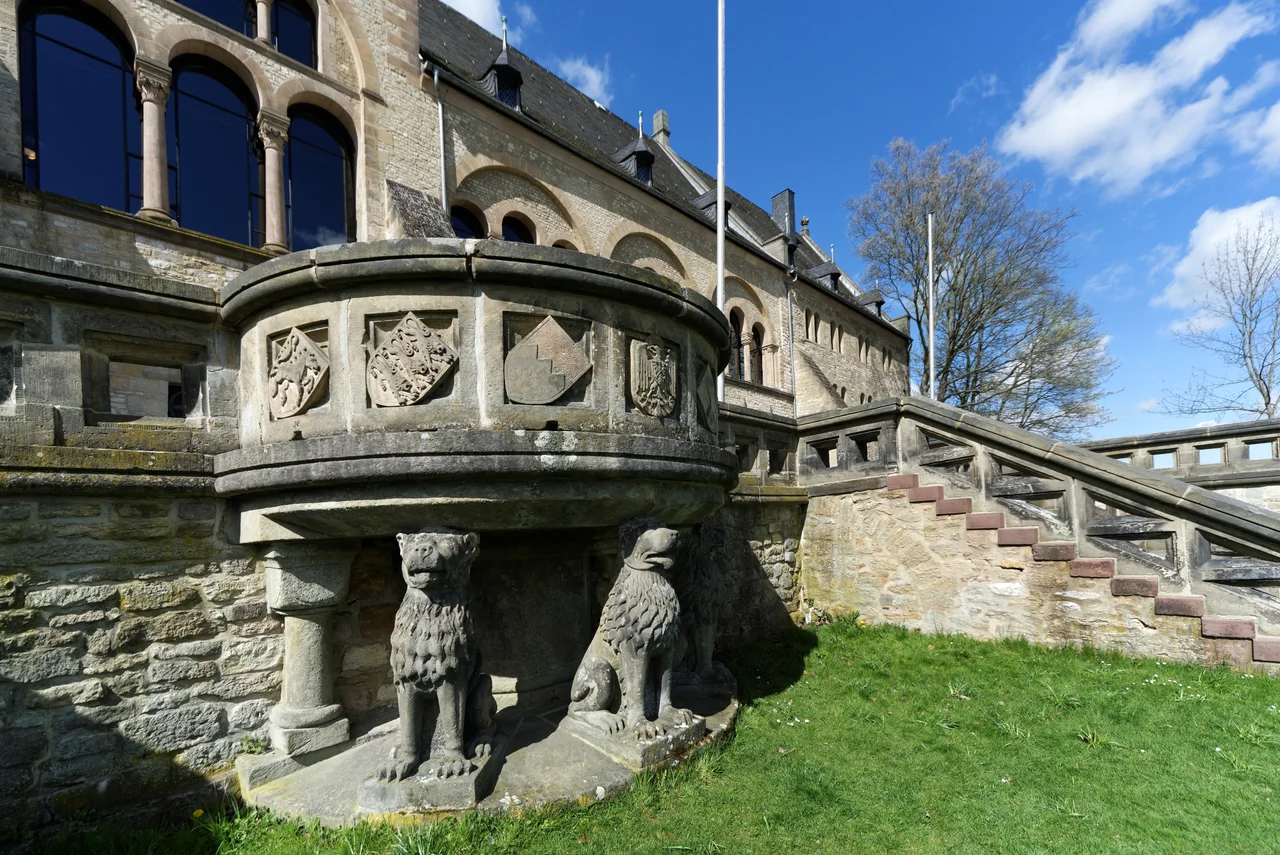

Imperial Palace of Goslar
Two thrones survive from the medieval Holy Roman emperors. One is Charlemagne's, in Aachen. The other stood in Goslar until the 1840s, when a Prussian prince bought it and installed it in a mock monastery at Glienicke Palace near Potsdam. It passed to the Hohenzollerns, and on 21 March 1871 Emperor William I sat in it to open the first Reichstag of the new German Empire. Its bronze arms and backrest, worked with curling tendrils, were cast in the second half of the eleventh century, most likely for Henry IV. The chair had been unemployed for seven hundred years. Then somebody found a use for it.
The Most Famous Residence in the Empire
That was the chronicler Lambert of Hersfeld's verdict, written while the place was still new. It began as an Ottonian hunting lodge and became serious in 1005, when Henry II built the first imperial mansion here. Ore from the Rammelsberg soon made the site more valuable than the older palace at Werla. Conrad II laid the foundation stone of the Church of Our Lady in the 1030s; his son Henry III finished the job, summoning the builder Benno II in 1048 and completing the Kaiserhaus we see today and the Collegiate Church of St Simon and St Jude by the mid-1050s.
The Kaiserhaus is 54 metres long and 18 wide, the largest secular building of its time anywhere. Inside are two stacked halls, each 47 by 15 metres — the upper for the emperor and his immediate circle, the lower for courtiers of lesser rank. None of the windows were glazed, which is a way of saying that court in a Harz winter was an endurance test.
What Happened in the Hall
Henry IV was born here on 11 November 1050 and grew up watching the empire misbehave in his own house. At Pentecost 1063 the Goslar Precedence Dispute — an argument between Bishop Hezilo of Hildesheim and Abbot Widerad of Fulda over who should sit where — turned into half a day of killing inside the cathedral. The boy king saw it.
His reign kept coming back to this hill. In the summer of 1073 he fled the palace for the castle of Harzburg to escape Saxon rebels, and at Christmas 1075 a letter from Pope Gregory VII reached him here threatening excommunication, opening the Investiture Controversy. In July 1219 Frederick II held an Imperial Diet here and took delivery of the Imperial Regalia.
Granary, Prison, Car Park
William of Holland was the last German king to reside at the palace, in 1253. A fire razed much of the district in 1289, the town took possession the following year, and the long descent began. The great hall served as a courtroom, then as storage; by the mid-sixteenth century both halls of the Kaiserhaus were in use as a granary. The Chapel of St Ulrich became a prison in 1575, which is the only reason it survives intact.
The churches went one by one. The Church of Our Lady lost its towers in 1672 and the rest in 1722, its stones carted off. The cathedral's walls were reported crumbling as early as 1331, and on 19 July 1819 the ruin was sold for 1,504 talers to be pulled down. Only the north porch was spared. The footprint of that basilica — the largest Romanesque church east of the Rhine when it was consecrated in 1051 — is now marked out in the surface of the palace car park.
A Ruin Turned Into an Argument
In 1865 more walls came down and demolition went on the town council's agenda. A state commission recommended restoration instead. Work began on 14 August 1868, stalled during the Franco-Prussian War, resumed in 1873 and finished in 1879; Emperor William I visited in August 1875 and gave the project a national blessing. It was not a cautious repair — the rebuilders enlarged and monumentalised what they found.
The interior made the politics explicit. Hermann Wislicenus won the decoration competition in 1877 and spent some two decades on 68 frescoes running imperial authority in one unbroken line from Charlemagne to Prussia. The central panel is an apotheosis of empire: William I on horseback, Bismarck and the German princes beneath him, medieval emperors floating overhead. On one wall Barbarossa rises from the Kyffhäuser wearing William I's face. On another, Sleeping Beauty stands in for a Holy Roman Empire dissolved in 1806 and woken in 1871. An eleventh-century hall had become a nineteenth-century argument for the state that had just been founded.
A Heart in a Gold Capsule
The oldest and quietest thing on the site is the double chapel of St Ulrich: a Greek cross below with three eastern apses, an octagon above with one, reserved for the imperial family — a combination found nowhere else in Germany.
At the crossing below stands a sarcophagus with a mid-thirteenth-century effigy on its lid: Henry III at full length, head on a pillow, a dog at his feet, sceptre in his right hand and the model of a church in his left. Inside, in an octagonal gold capsule, is his heart, buried in Goslar at his own request and kept in this chapel since 1884. The palace district has been a UNESCO World Heritage Site since 1992, with the old town and the Rammelsberg; Henry Moore's Goslar Warrior has lain in the gardens since 1975. The building has been a court, a warehouse, a granary, a jail and a national manifesto. Under the vault, the heart is still where he asked for it.
From the Air
The Kaiserpfalz stands at 51.9028°N, 10.4258°E, at the southern edge of Goslar's old town where the flat ground runs into the Harz escarpment. From 1,500–3,500 ft it is easy to pick out: the one large, isolated pale rectangle on an open green lawn immediately below the wooded slope, with the dense red-roofed old town packed against its northern side and no other building of comparable footprint nearby — the Kaiserhaus is 54 m long under a steep, high-gabled roof. The Rammelsberg processing plant and its pale slag heaps step down the hillside about a kilometre to the south, giving a reliable second reference. The Brocken (1,141 m) stands about 16 km south-east. Nearest airfields: Braunschweig-Wolfsburg (EDVE) about 50 km north, Ballenstedt (EDCB) about 58 km east-south-east, Magdeburg-Cochstedt (EDBC) about 68 km east, Hannover (EDDV) about 80 km north-west, Kassel-Calden (EDVK) about 90 km south-west. Expect rotor and mountain wave in southerly flow across the Harz front, and orographic cloud capping the escarpment directly behind the palace while the plain to the north stays clear.
Nearby Stories
- Ströbeck 4.6 km away
- GEO600 5 km away
- Fagus Factory 5 km away
- Unicorn Cave 5.5 km away
- Physikalisch-Technische Bundesanstalt 12 km away
- Helmstedt–Marienborn border crossing 13 km away
- Sababurg 26 km away
- Kyffhäuser Monument 33 km away