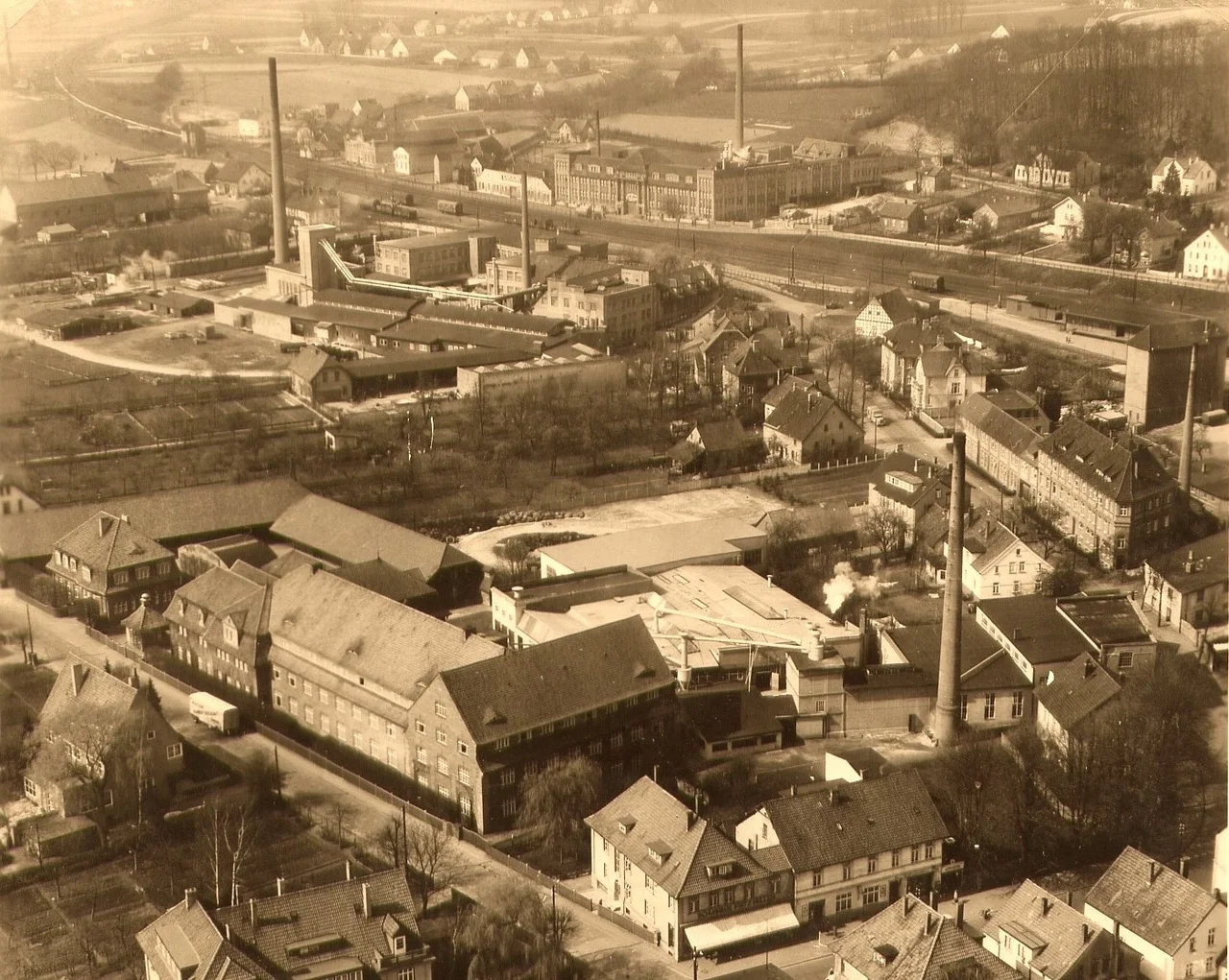

Meller Möbelfabrik
Somewhere in the imperial palaces of Ethiopia, before the revolution that ended the monarchy, Emperor Haile Selassie had a study made of wood from a sawmill in Melle, Germany. The desk, the cabinets, the chairs - all of it stamped with the superimposed initials MMM. The Meller Möbelfabrik, founded in 1870 in a small Lower Saxon town nobody had heard of, had a way of ending up in unexpected places. For a hundred and five years its furniture traveled out of Melle to ministries, banks, schoolrooms, and one African palace, until the buildings outlived the company and became, in a sense, its memorial.
Krumnack's Sawmill, 1870
It started as J.H. Krumnack, Möbelfabrik, Dampfsägewerk und Holzhandlung - a furniture factory, steam sawmill, and timber yard rolled into one ambitious German compound name. Krumnack chose a plot near the Melle railway station for an obvious reason: he wanted to ship nationwide. By 1904, the operation had grown enough to demand a new three-storey factory in classical industrial architecture, the same Neo-Renaissance brick building that still stands today on Oldendorfer Straße. But ambition outran capital. In 1908 sales declined, in 1909 Krumnack filed for insolvency, and on 27 September of that year the Bremerhaven timber importer Pundt & Kohn - the firm's largest creditor - took over the works and renamed it Meller Möbelfabrik GmbH.
Gerhard Kohn, Manager for 53 Years
Franz Kohn of Pundt & Kohn had two sons. Hans stayed in Bremerhaven to run the timber trade. Gerhard moved to Melle to run the new factory, and for the next fifty-three years he did exactly that, with the kind of unbroken stewardship that nineteenth-century capitalism could still produce. Under him the works expanded relentlessly. A forty-meter clinker chimney went up between 1916 and 1918, the tallest in town. In 1925 a new sawmill opened across Teichbruchstraße, linked to the main works by a narrow-gauge rail system whose wagons were pushed and pulled by horses. In 1927 Kohn built himself a villa called Haus Sonneck on the Meller Berg - heated by tile stoves and open fireplaces, with an electromagnetic call system that signaled to the kitchen which room wanted service.
Changing the Name
In August 1937, the family did something that hundreds of German families with Jewish-sounding surnames were doing under National Socialist pressure - they changed their name. Kohn became Kohnert by ministerial decree on 14 August 1937. The brothers were Christian and the request came from Hans, but the trigger was unmistakable: the Aryanisation campaign that was systematically pushing Jews and anyone who looked Jewish out of German economic life. The Kohn family had simply borne a surname that sounded too much like Cohen. When World War II came, the factory was converted to war production - ammunition boxes, and even aircraft repair and assembly, of which little record survives. Female workers replaced the drafted men. Later, forced laborers were brought in and quartered on the upper floors, while the cellars under the shipping department were converted into air-raid shelters.
The Economic Miracle Years
The factory came through the war undamaged. Postwar Germany needed furniture desperately, and MMM had a distribution network ready to deliver it. At the Cologne Furniture Fair, sales orders piled up faster than the workshop could fulfill them - production was routinely booked out six months in advance. The British occupation seized Haus Sonneck and renovated it with central coke heating; it was returned only in 1955, after the Occupation Statutes were lifted. By the mid-1950s, MMM had a bestseller line called Socrates Wohnmöbel - shelving units pitched at educated buyers, branded with the name of the philosopher to flatter the customer's bookish self-image. The name worked so well that the entire furniture range eventually traveled under it. In 1953 Gerhard Kohnert received the Order of Merit of the Federal Republic of Germany for his services to local industry.
End of the Line
Gerhard Kohnert died on 5 July 1962, after fifty-three years as general manager. His brother Hans took over, but the company's three-storey factory buildings - the very thing that made the works look impressive in 1904 - were now an industrial liability. Material flowed up and down stairs that should have moved horizontally on a single level. The capital needed to modernize had been transferred to the weakened parent company in Bremerhaven through a profit transfer agreement. In 1967, Hans sold MMM to its main creditors. New management squeezed a few more years out of the operation, but by 1974 liquidity had collapsed, and in 1975 the company filed for bankruptcy. Production stopped. The workforce of two hundred dispersed. What remains is the architecture: the listed 1904 factory, the 1924 office building (now a Kingdom Hall of Jehovah's Witnesses), the symmetric clinker brick housing estate on Bismarckstraße, and the altered shell of Haus Sonneck on the Meller Berg. A century of furniture-making, frozen in brick.
From the Air
Located at 52.21°N, 8.34°E in the city of Melle, Lower Saxony, in the long valley between the Wiehen Hills and the Teutoburg Forest. The factory complex lies just southwest of the Melle railway station, easily identified by the listed brick buildings along Oldendorfer Straße and Bismarckstraße. Nearest major airport: Münster Osnabrück (ICAO: EDDG) about 60 km southwest. Hannover (EDDV) is roughly 95 km east. The A30 motorway runs immediately to the north of the city. Best appreciated at low altitude on clear days, when the dense urban core of Melle stands out against the surrounding farmland.
Nearby Stories
- Ibbenbüren 2.3 km away
- Münster-Handorf Airfield 4 km away
- Diepholz 9.2 km away
- Minden 9.7 km away
- RAF Gütersloh 12 km away
- Hermannsdenkmal 14 km away
- Emsland Railway 31 km away
- Ahlden House 56 km away