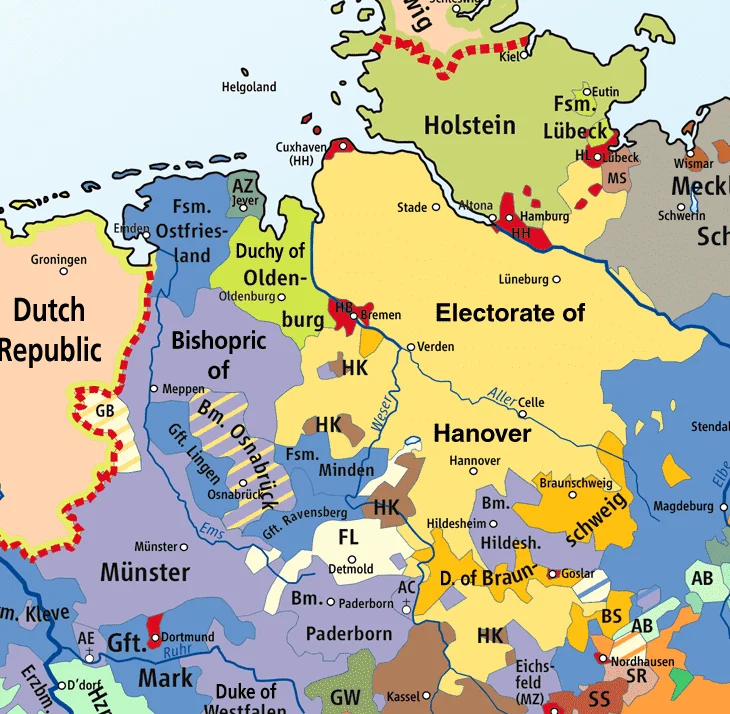

Electorate of Hanover
In 1701 the English Parliament went shopping for a Protestant heir and settled on a widow in Lower Saxony. Sophia of Hanover was a granddaughter of James VI and I, and by the arithmetic of the Act of Settlement she was the nearest Protestant relative of the future Queen Anne - which made a middling north German state, promoted to electoral rank barely nine years earlier, the designated source of Britain's next dynasty. Sophia died on 8 June 1714. Anne died on 1 August. Sophia's son, Elector George Louis, missed being the son of a queen by eight weeks and became King George I instead. What followed was two countries, one head, and almost nothing else in common. Hanover kept its own government, army and diplomats, and Britain spent much of the eighteenth century being dragged into continental wars over a territory most of its Parliament could not have placed on a map.
A Ninth Elector, Paid For in Soldiers
The electorate was a reward. In 1692 Emperor Leopold I raised Duke Ernest Augustus of the Calenberg branch of the House of Welf to prince-elector of the Holy Roman Empire, in return for help in the Nine Years' War and after persistent lobbying by his minister Otto Grote zu Schauen. Adding a ninth vote to the college that elected emperors was not popular with the eight who already had one, and the Imperial Diet withheld approval until 1708, by which time Ernest Augustus was dead and his son George Louis held the title. Officially it was Chur-Braunschweig-Lueneburg, after the whole ducal dynasty; everybody said Hanover, after the city the electors lived in, and the shorter name won. Two conditions came with the promotion, and both mattered later. The electorate was made legally indivisible - it could acquire land but never be split among heirs, the family's ruinous old habit - and its succession was fixed on male primogeniture.
One Head, Two Governments
George Louis became king of Great Britain and Ireland in 1714, and the two states were then ruled in personal union without ever merging. Hanover kept its own governmental bodies and Privy Council, and the constitutional fiction was maintained so scrupulously that whenever Hanoverian troops fought on the British side of a war, Hanover had to sign a treaty with Britain first. The electors, meanwhile, lived mostly in England. Day-to-day business ran through the German Chancery, a Hanoverian office installed inside St James's Palace, so a north German territory was administered in practice from a corridor of an English royal residence. Britain got a dynasty out of the deal. Hanover got an absentee sovereign and a permanent target painted on it by every enemy Britain made.
Growing by Inheritance and Cheque
The electorate expanded steadily and mostly without fighting. In 1705 George Louis inherited the Principality of Lueneburg with the Duchy of Saxe-Lauenburg on the death of his uncle George William. In 1715 he bought the duchies of Bremen and Verden from Frederick IV of Denmark - confirmed by the Treaty of Stockholm in 1719 - and a landlocked state suddenly had the North Sea. His son George II Augustus was enfeoffed with Saxe-Lauenburg in 1728 and gained Hadeln in 1731, the price being recognition of the Pragmatic Sanction that rewrote Habsburg inheritance law; Bremen-Verden followed in 1733, with George swearing to respect estate privileges four centuries old. Osnabrueck came in 1803. In 1700 the Protestant territories adopted the Gregorian calendar but refused to call it that, using the term Improved Calendar so as not to say the name of a pope. Sunday 18 February was followed by Monday 1 March.
The Wars It Could Not Avoid
In the summer of 1757 a French army invaded, beat George II's son the Duke of Cumberland at Hastenbeck, and drove the Anglo-Hanoverian force back into Bremen-Verden, where he capitulated on 18 September at Kloster-Zeven. George II refused to recognise the convention his son had signed, and the following year a British, Prussian, Hessian and Brunswick force threw the occupiers out. Worse followed. In 1801 twenty-four thousand Prussian soldiers walked in and Hanover surrendered without a shot. In 1803, nine days after Britain declared war on France, French troops crossed the border; the Convention of Artlenburg on 5 July disarmed the Hanoverian army, and the Privy Council fled across the Elbe. The Holy Roman Empire was dissolved on 6 August 1806, abolishing the office of prince-elector altogether, and by 1810 Hanover proper had been swallowed into Napoleon's Kingdom of Westphalia. None of this was accepted. Ministers kept working out of London, the Privy Council ran its own diplomatic service to Vienna and Berlin, and the disbanded soldiers reassembled in England as the King's German Legion - the only German army that fought continuously against France for the whole of the Napoleonic Wars.
Ended by a Queen
Allied troops overran the territory in November 1813 after Leipzig, the Westphalian client state collapsed, and the Congress of Vienna confirmed the old electorate in 1814 as the Kingdom of Hanover. The shared crown lasted another twenty-three years, then failed on a technicality. Hanover ran on semi-Salic law, which barred a woman from the throne while any male of the dynasty survived; Britain did not. When William IV died on 20 June 1837 his niece Victoria took the British crown, and his brother Ernest Augustus took the Hanoverian one. After a hundred and twenty-three years the two countries stopped sharing a monarch, and the reason was neither war nor revolution nor anybody's decision. It was a clause about daughters.
From the Air
The coordinates for the electorate are those of its capital, Hannover, at 52.3667N, 9.7167E in Lower Saxony, but the territory itself covered most of what is now that federal state - the Weser and Leine valleys, the Lueneburg Heath, and after 1715 the North Sea coast at the Elbe and Weser mouths, several hundred kilometres from end to end. Flying it means flying the North German Plain: flat, low, heavily farmed, with the Harz mountains rising to over 1,100 m on the south-eastern boundary as the only serious terrain. The Leine and the Weser are the two navigational threads, running roughly south to north; the Elbe marks the old eastern edge at Saxe-Lauenburg. Hannover-Langenhagen (EDDV) sits north of the city and its Class C airspace covers the historic capital, so coordinate early. Bremen (EDDW) serves the north-western quarter and Braunschweig-Wolfsburg (EDVE) the south-east. From 3,000 to 5,000 feet the geometry of the old state is still faintly legible in the pattern of ducal towns and Residenz gardens strung along the river valleys.
Nearby Stories
- Fagus Factory 11 km away
- Lengede 13 km away
- Intercity Experimental 14 km away
- Eschede train disaster 20 km away
- Goslar 21 km away
- Ahlden House 24 km away
- Externsteine 24 km away
- Schöma 52 km away