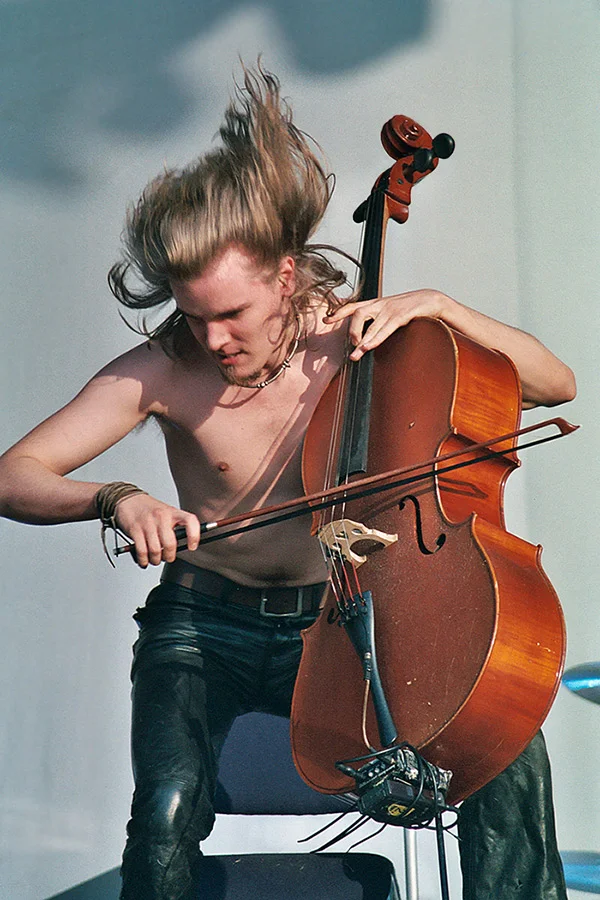

M'era Luna Festival
Second weekend of August, and the concrete of a disused military airfield on the northeastern edge of Hildesheim is at its most unforgiving — an open apron with no shade, holding heat like a griddle. Twenty-five thousand people arrive dressed almost entirely in black: velvet, latex, corsetry, floor-length coats, boots with more buckles than is strictly practical. Nobody changes into shorts. For the crowd at M'era Luna, sweating through the dress code is part of the deal, and the airfield's utter lack of atmosphere is precisely what makes it work. There is no scenery to compete with. The scene brings its own.
A Runway Instead of a Field
The first M'era Luna took place on 12 and 13 August 2000 at the Hildesheim airfield in Drispenstedt, on ground that had been a British Army airbase — one of hundreds of installations the British left behind in Lower Saxony as the garrisons of the Cold War wound down.
For most of its history the festival used two very different rooms. One was a conventional open-air stage, built up from scratch each summer. The other was an aircraft hangar: an enormous corrugated shed with a hard, slapping reverb that suited industrial and EBM sets far better than any purpose-built venue would have. In 2022 the hangar stage was retired in favour of a second outdoor stage. Something was lost with it, and the regulars will tell you so.
How Many Kinds of Dark
M'era Luna is billed as a gothic festival, which undersells the range considerably. The programme takes in gothic rock and dark wave, industrial and electronic body music, aggrotech, future pop and synthpop, symphonic and gothic metal, and a persistent medieval-folk strand that shows up with hurdy-gurdies and bagpipes.
What that means in practice is a bill where acts with nothing musically in common share a weekend and an audience. The Sisters of Mercy and Fields of the Nephilim, first-generation goth rock. Einstürzende Neubauten and Front 242 and Skinny Puppy from the industrial side. Nightwish, Within Temptation, Lacuna Coil and Apocalyptica from symphonic metal. Marilyn Manson, Rob Zombie, Korn and The Prodigy from further out. In Extremo, Subway to Sally, Saltatio Mortis and Faun playing medieval instruments through stacks. Placebo, Editors and White Lies from a scene that would probably resist the label altogether.
The Numbers Under the Eyeliner
Twenty-one thousand came in 2005, twenty-three thousand in 2009, twenty-four thousand in 2010, and the festival has settled at around twenty-five thousand — sold out most years — which makes it one of the largest dark-music events in Germany.
A good share of them fly. Hanover's airport is forty minutes away by train, and for a scene with strong followings in Britain, Scandinavia, the Netherlands and eastern Europe, that matters more than the road and rail connections that bring the German contingent. The camping ground fills with people who have travelled a long way to spend two days somewhere they do not have to explain themselves, then travelled home again.
A Moon With a Face
The name means nothing. The organisers wanted something that sounded round in the mouth and international on a poster, and invented it — M'era Luna is a fantasy word, not a phrase in any language.
The logo has a better pedigree. It is the moon from Georges Méliès' A Trip to the Moon, the 1902 film in which a capsule fired from a cannon lands in the eye of a moon with a human face — cinema's first great special effect, and an image that has been borrowed by everyone from silent-era poster artists to music video directors. An altered version of the logo was introduced in 2019. The original still describes the festival better than any genre label does: something antique, slightly grotesque, and unmistakably theatrical.
Two Summers Missing
The pandemic cancelled the 2020 and 2021 festivals outright. For a scene whose members are often the only person dressed that way in their town, two years without the weekend was a particular kind of loss — the festival is where a dispersed subculture becomes visible to itself, once a year, for forty-eight hours.
It came back at full strength. The airfield fills again on the second weekend of August, the concrete radiates, and the black coats stay on. Half a kilometre away sits a suburb of an ordinary Lower Saxon city that spends the rest of the year quietly getting on with things, and for two days a year finds a very large number of extremely polite people in corpse paint queuing at its bakeries.
From the Air
The festival grounds occupy the Hildesheim airfield at Drispenstedt, 52.1797°N, 9.9489°E, on the northeastern edge of the city. This is an active general-aviation field (EDVM) with a single runway, so the site itself is unmistakable from the air — a paved strip and apron surrounded, for one weekend each August, by a dense grid of tents and the twin stage structures. Best viewed from 1,500-2,500 ft. The Innerste river and the old town lie southwest; the cathedral and St Michael's Church mark the historic centre about 3 km away. Hannover (EDDV) is 28 km north and its approach corridors pass close overhead, so check airspace before descending. Braunschweig-Wolfsburg (EDVE) is about 45 km east. August weather here is usually stable with good visibility; afternoon thunderstorms building over the Harz foothills to the south are the main hazard.
Nearby Stories
- Holzminden prisoner-of-war camp 3.3 km away
- Battle at the Harzhorn 6.4 km away
- Brocken 7.8 km away
- Asse II mine 8.5 km away
- Hamelin 9.2 km away
- International Wind- and Watermill Museum 12 km away
- Herrenhausen Gardens 22 km away
- Dümmer 79 km away