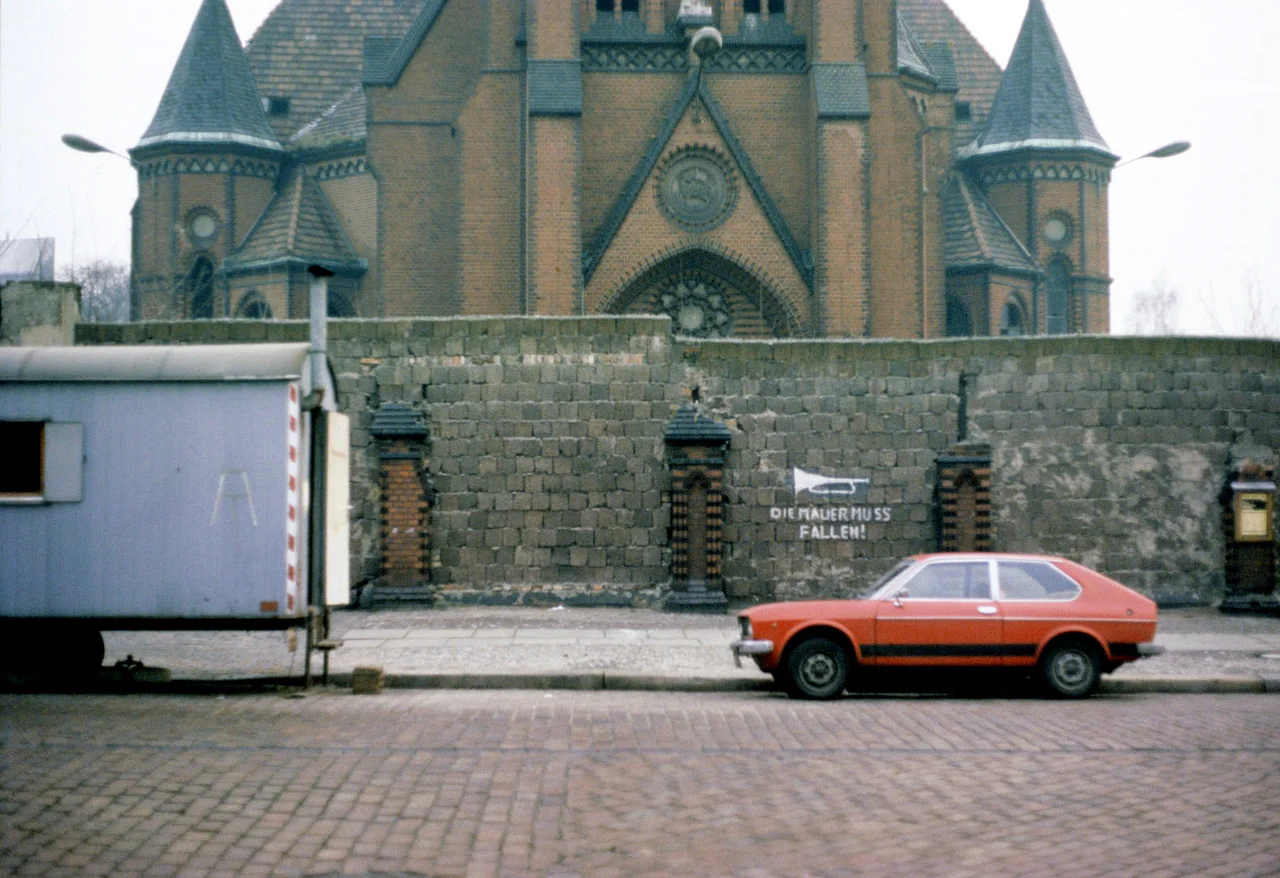

Bernauer Straße
On the morning of 22 August 1961, Ida Siekmann threw her bedding and a few belongings out of a third-floor window onto a Berlin pavement, and then she jumped after them. She was 58, a nurse, one day short of her fifty-ninth birthday. The building she lived in stood in the Soviet sector; the pavement below it lay in the French sector of West Berlin. The evening before, East German workers had started sealing the doors and windows of her block. She was badly injured on landing and died on the way to the Lazarus Hospital a few streets away — the first person killed by the Berlin Wall, nine days after construction began. The address was Bernauer Straße 48.
A Line Drawn in 1920
The street is old. It ran northeast out of the city as a commercial and military road toward the Margraviate of Brandenburg, and it took its present name on 29 May 1862, having previously been known only as Straße 50 and then Straße 80. What made it lethal was paperwork. When Greater Berlin was reorganised in 1920, house numbers 1 to 50, on the south side, were assigned to the district of Mitte, and numbers 51 to 121, on the north side, to Wedding. The roadway itself — the carriageway and both pavements — was given entirely to Wedding. Twenty-five years later Mitte became part of the Soviet sector and Wedding part of the French. The boundary between two worlds therefore ran not down the middle of the street but along the front doorsteps of one row of apartment blocks.
The Windows
That is why Bernauer Straße became famous. People stepped out of their own windows and landed in the West. Some were caught in nets held by West Berlin firefighters below; some, like Ida Siekmann, were not. On 15 August 1961, two days after the border was closed, a 19-year-old East German border guard named Conrad Schumann leapt over the coiled barbed wire at the corner of Ruppiner Straße and ran; a photographer caught him mid-air, and the picture went around the world. A sculpture called the Mauerspringer, the Wall Jumper, marks the spot now. The escapes ended the way such things end. Windows and doors were bricked up, the residents compulsorily cleared out by the autumn of 1961, and the buildings themselves demolished in 1963. A memorial tablet at the entrance to Swinemünder Straße names the ten people known to have died trying to get out along this street.
Under the Street
When the surface closed, the escapes went underground. The Bernauer Straße U-Bahn station sat inside East Berlin with one entrance opening onto the Western pavement, so the entrance was bricked into the Wall and the station became a ghost stop that trains rolled through without slowing. Tunnellers did better. In 1962 a tunnel surfaced at Schönholzer Straße 7 in the East, and 29 East Berliners of all ages crawled through it to the West without the border guards noticing; NBC News filmed the operation and broadcast it as The Tunnel. Two years later came the one everyone remembers. Over two nights in October 1964, 57 people escaped through a tunnel ending at Strelitzer Straße 55 before it was discovered, and shots were exchanged between guards and diggers. A young border guard, Egon Schultz, was killed. East German authorities built him into a martyr murdered by Western smugglers; when the files opened after 1989, they showed he had been hit by bullets from both sides.
Eight in the Morning, 11 November
The Wall was first breached on the evening of 9 November 1989. The following day, crews began cutting an opening where it crossed between Bernauer Straße and nearby Eberswalder Straße, working through the night while crowds pressed in on both sides to watch. The crossing opened at eight o'clock on the morning of 11 November, one of the very first of the new border crossings. The U-Bahn station came back to life on 12 April 1990, though at first only the northern entrance on the Western side was unsealed; the entrances leading into the East stayed shut until 1 July 1990, when customs and monetary union between the two Germanies abolished the checkpoints altogether. Dismantling this stretch produced one more first: British soldiers of 62 Transport and Movement Squadron working directly alongside the East German army, their lorries hauling concrete segments away toward Potsdam.
What They Left Standing
Bernauer Straße kept one of the longest surviving sections of the Wall, and in 1999 part of it became the Gedenkstätte Berliner Mauer — a memorial that reconstructs the border fortifications as they actually were, including the raked sand of the death strip that the tourist imagination usually leaves out. Elsewhere along the street, rows of steel poles trace the line the concrete used to follow, so that you can walk beside the Wall without anything blocking your view. Just inside the old Eastern side stood the Church of Reconciliation, marooned in the death strip and later demolished. Germany held its official fiftieth-anniversary commemoration here on 13 August 2011. The street itself has been rebuilt as a main road with a tram line, but much of the south side, where the emptied apartment blocks came down in 1963, has never been built on again — an absence you notice before you can explain it.
From the Air
Bernauer Straße runs at 52.5375°N, 13.3933°E, about 2.5 km north of the Reichstag, angling roughly southwest to northeast from Nordbahnhof to Mauerpark on the edge of Prenzlauer Berg. From the air the memorial strip is legible as a narrow, unusually green corridor cutting straight through otherwise dense nineteenth-century blocks — one of the clearest surviving traces of the Wall's course anywhere in Berlin, and a useful visual anchor for following the old border north and east. Berlin Brandenburg (EDDB) lies about 20 km south-southeast. Best appreciated from 1,500 to 3,000 feet; higher up the corridor blends into the general pattern of rail yards and parkland north of Mitte.
Nearby Stories
- E11 hiking trail 3.4 km away
- Bogensee 4.3 km away
- Maybach I and II 4.9 km away
- Treuenbrietzen 15 km away
- Battle of Fehrbellin 18 km away
- Falkenhagen Bunker 20 km away
- St. Mary's Church, Chojna 35 km away
- Eisenhüttenstadt 39 km away